
Homework Answers

![u(0)0 [x-0] 1 102 40 B=0 Similarly, 11(1)-1 [x=1]](http://img.homeworklib.com/questions/155b3eb0-72a4-11ea-8ad7-3d96a04a4447.png?x-oss-process=image/resize,w_560)

Add Answer to:
Please answer question 2
u(0,t)0 what would be the behavior of the rod temperature u(x.t) for...
Question 1: The separated solutions of the o fom u(x.t) -X(x)T(t), with the following solutions: ne-dimensional he...
 Question 1: The separated solutions of the o fom u(x.t) -X(x)T(t), with the following solutions: ne-dimensional heat equation dtt lu solutions of are - X(x)-Ax +B and T(t) E X(x) = A cos kx + B sin kx and T(t)=Ee-Det The boundary conditions for a metal rod insulated from both sides arex aum = 0 when x =0, and dx (e) Using the boundary conditions for u(x.t) wrie the boundary conditions for XCx), explain for full marks. (b) Find the...
Consider a 2 m long metal rod. The temperature u(z,t) at a point along the rod at any time t is found by solving the heat equation k where k is the material property. The left end of the rod ( 0) is...
 Consider a 2 m long metal rod. The temperature u(z,t) at a point along the rod at any time t is found by solving the heat equation k where k is the material property. The left end of the rod ( 0) is maintained at 20°C and the right end is suddenly dipped into snow (0°C). The initial temperature distribution in the rod is given by u(x,0)- (i) Use the substitution u(z,t) ta,t)+20-10z to reduce the above problem to a...
2. In lectures we solved the heat PDE in 1 +1 dimensions with constant-temperature boundary conditions u(0,t)u(L,t) -0. If these boundary conditions change from zero temperature, we need to do a litt...
 2. In lectures we solved the heat PDE in 1 +1 dimensions with constant-temperature boundary conditions u(0,t)u(L,t) -0. If these boundary conditions change from zero temperature, we need to do a little bit more work. Consider the following initial/boundary-value problem (IBVP) 2 (PDE) (BCs) (IC) u(0,t) = a, u(x,00, u(L, t)=b, st. and let's take L = 1, a = 1, b = 2 throughout for simplicity. Solve this problem using the following tricks b and A"(x)-0 (a) Find a...
Suppose heat is lost from the lateral surface of a thin rod of length L into...
 Suppose heat is lost from the lateral surface of a thin rod of length L into a surrounding medium at temperature zero. If the linear law of heat transfer applies, then the heat equation takes on the form du - hu- az ar 0<x<L, t > 0, ha constant. Find the temperature uix, t) if the initial temperature is fx) throughout and the ends 0 and XL are insulated. See the figure u(x, t) *)-(wax) ). 2 [(? I'moscoap 90.cr)()+(-*...
1. Consider the insulated heat equation up = cum, 0 <r<L, t > 0 u (0,t)...
 1. Consider the insulated heat equation up = cum, 0 <r<L, t > 0 u (0,t) = u (L, t) = 0, t > 0 u(x,0) = f(2). What is the steady-state solution? 2. Solve the two-dimensional wave equation (with c=1/) on the unit square (i.e., [0, 1] x [0,1) with homogeneous Dirichlet boundary conditions and initial conditions: (2, y,0) = sin(x) sin(y) (,y,0) = sin(x). 3. Solve the following PDE: Uzr + Uyy = 0, 0<<1,0 <y < 2...
(a) The temperature distribution u(x, t) of the one- dimensional silver rod is governed by the...
 (a) The temperature distribution u(x, t) of the one- dimensional silver rod is governed by the heat equation as follows. du a²u at ar? Given the boundary conditions u(0,t) = t?, u(0.6, t) = 5t, for Osts 0.02s and the initial condition u(x,0) = x(0.6 – x) for 0 SX s 0.6mm, analyze the temperature distribution of the rod with Ax = 0.2mm and At = 0.01s in 4 decimal places. (10 marks)
1 point) Solve the nonhomogeneous heat problem ut=uxx+4sin(2x), 0<x<π,ut=uxx+4sin(2x), 0<x<π, u(0,t)=0, u(π,t)=0u(0,t)=0, u(π,t)=0 u(x,0)=5sin(5x)u(x,0)=5sin(5x) u(x,t)=u(x,t)= Ste
 1 point) Solve the nonhomogeneous heat problem
ut=uxx+4sin(2x), 0<x<π,ut=uxx+4sin(2x), 0<x<π,
u(0,t)=0, u(π,t)=0u(0,t)=0, u(π,t)=0
u(x,0)=5sin(5x)u(x,0)=5sin(5x)
u(x,t)=u(x,t)=
Steady State Solution limt→∞u(x,t)=limt→∞u(x,t)=
Please show all work.
(1 point) Solve the nonhomogeneous heat problem Ut = Uxx + 4 sin(2x), 0< x < , u(0,1) = 0, tu(T, t) = 0 u(x,0) = 5 sin(52) u(a,t) Steady State Solution limt u(x, t) = Note: You can earn partial credit on this problem. Preview My Answers Submit Answers You have attempted this problem 0 times. You have unlimited attempts...
1 point) Solve the nonhomogeneous heat problem
ut=uxx+4sin(2x), 0<x<π,ut=uxx+4sin(2x), 0<x<π,
u(0,t)=0, u(π,t)=0u(0,t)=0, u(π,t)=0
u(x,0)=5sin(5x)u(x,0)=5sin(5x)
u(x,t)=u(x,t)=
Steady State Solution limt→∞u(x,t)=limt→∞u(x,t)=
Please show all work.
(1 point) Solve the nonhomogeneous heat problem Ut = Uxx + 4 sin(2x), 0< x < , u(0,1) = 0, tu(T, t) = 0 u(x,0) = 5 sin(52) u(a,t) Steady State Solution limt u(x, t) = Note: You can earn partial credit on this problem. Preview My Answers Submit Answers You have attempted this problem 0 times. You have unlimited attempts...
2. Heat equation Let ult, 2) satisfy the equation 4472(t, 2) +1, 0<r <1, t>0 with...
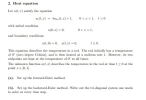 2. Heat equation Let ult, 2) satisfy the equation 4472(t, 2) +1, 0<r <1, t>0 with initial condition u(0,2) = 0, 0<x<1, and boundary conditions u(t,0) = 0, u(t,1)= 0, t> 0. This equation describes the temperature in a rod. The rod initially has a temperature of 0 (zero degree Celsius), and is then heated at a uniform rate 1. However, its two endpoints are kept at the temperature of 0 at all times. The unknown function u(t, x) describes...
solve for An as well! Find the temperature function u(x,t) (where is the position along the...
 solve for An as well!
Find the temperature function u(x,t) (where is the position along the rod in cm and t is the time) of a 6 cm rod with conducting constant 0.2 whose endpoint are insulated such that no heat is lost, and whose initial temperature distribution is given by: 4 if 1 x < 4 u (х, 0) — 0 otherwise To start, we have L =6 0.2 Because the rods are insulated, we will use the cosine...
solve for An as well!
Find the temperature function u(x,t) (where is the position along the rod in cm and t is the time) of a 6 cm rod with conducting constant 0.2 whose endpoint are insulated such that no heat is lost, and whose initial temperature distribution is given by: 4 if 1 x < 4 u (х, 0) — 0 otherwise To start, we have L =6 0.2 Because the rods are insulated, we will use the cosine...
d1=7 d2=8 Any help would be greatly appreciated. Question 3 Left end (r-0) of a copper rod of length 100mm is kept at a constant temperature of Temp-1 0 a 2 degrees and the right end and sides are in...
 d1=7
d2=8
Any help would be greatly appreciated.
Question 3 Left end (r-0) of a copper rod of length 100mm is kept at a constant temperature of Temp-1 0 a 2 degrees and the right end and sides are insulated, so that the temperature in the ul ul where D = 111 mm2/s for copper. rod, u(x,t), obeys the heat partial DE, Ot Ox (a) Write the boundary conditions for il(x,t) of the problem above. Note that for the left...
d1=7
d2=8
Any help would be greatly appreciated.
Question 3 Left end (r-0) of a copper rod of length 100mm is kept at a constant temperature of Temp-1 0 a 2 degrees and the right end and sides are insulated, so that the temperature in the ul ul where D = 111 mm2/s for copper. rod, u(x,t), obeys the heat partial DE, Ot Ox (a) Write the boundary conditions for il(x,t) of the problem above. Note that for the left...
 Question 1: The separated solutions of the o fom u(x.t) -X(x)T(t), with the following solutions: ne-dimensional heat equation dtt lu solutions of are - X(x)-Ax +B and T(t) E X(x) = A cos kx + B sin kx and T(t)=Ee-Det The boundary conditions for a metal rod insulated from both sides arex aum = 0 when x =0, and dx (e) Using the boundary conditions for u(x.t) wrie the boundary conditions for XCx), explain for full marks. (b) Find the...
 Consider a 2 m long metal rod. The temperature u(z,t) at a point along the rod at any time t is found by solving the heat equation k where k is the material property. The left end of the rod ( 0) is maintained at 20°C and the right end is suddenly dipped into snow (0°C). The initial temperature distribution in the rod is given by u(x,0)- (i) Use the substitution u(z,t) ta,t)+20-10z to reduce the above problem to a...
 2. In lectures we solved the heat PDE in 1 +1 dimensions with constant-temperature boundary conditions u(0,t)u(L,t) -0. If these boundary conditions change from zero temperature, we need to do a little bit more work. Consider the following initial/boundary-value problem (IBVP) 2 (PDE) (BCs) (IC) u(0,t) = a, u(x,00, u(L, t)=b, st. and let's take L = 1, a = 1, b = 2 throughout for simplicity. Solve this problem using the following tricks b and A"(x)-0 (a) Find a...
 Suppose heat is lost from the lateral surface of a thin rod of length L into a surrounding medium at temperature zero. If the linear law of heat transfer applies, then the heat equation takes on the form du - hu- az ar 0<x<L, t > 0, ha constant. Find the temperature uix, t) if the initial temperature is fx) throughout and the ends 0 and XL are insulated. See the figure u(x, t) *)-(wax) ). 2 [(? I'moscoap 90.cr)()+(-*...
 1. Consider the insulated heat equation up = cum, 0 <r<L, t > 0 u (0,t) = u (L, t) = 0, t > 0 u(x,0) = f(2). What is the steady-state solution? 2. Solve the two-dimensional wave equation (with c=1/) on the unit square (i.e., [0, 1] x [0,1) with homogeneous Dirichlet boundary conditions and initial conditions: (2, y,0) = sin(x) sin(y) (,y,0) = sin(x). 3. Solve the following PDE: Uzr + Uyy = 0, 0<<1,0 <y < 2...
 (a) The temperature distribution u(x, t) of the one- dimensional silver rod is governed by the heat equation as follows. du a²u at ar? Given the boundary conditions u(0,t) = t?, u(0.6, t) = 5t, for Osts 0.02s and the initial condition u(x,0) = x(0.6 – x) for 0 SX s 0.6mm, analyze the temperature distribution of the rod with Ax = 0.2mm and At = 0.01s in 4 decimal places. (10 marks)
 1 point) Solve the nonhomogeneous heat problem
ut=uxx+4sin(2x), 0<x<π,ut=uxx+4sin(2x), 0<x<π,
u(0,t)=0, u(π,t)=0u(0,t)=0, u(π,t)=0
u(x,0)=5sin(5x)u(x,0)=5sin(5x)
u(x,t)=u(x,t)=
Steady State Solution limt→∞u(x,t)=limt→∞u(x,t)=
Please show all work.
(1 point) Solve the nonhomogeneous heat problem Ut = Uxx + 4 sin(2x), 0< x < , u(0,1) = 0, tu(T, t) = 0 u(x,0) = 5 sin(52) u(a,t) Steady State Solution limt u(x, t) = Note: You can earn partial credit on this problem. Preview My Answers Submit Answers You have attempted this problem 0 times. You have unlimited attempts...
1 point) Solve the nonhomogeneous heat problem
ut=uxx+4sin(2x), 0<x<π,ut=uxx+4sin(2x), 0<x<π,
u(0,t)=0, u(π,t)=0u(0,t)=0, u(π,t)=0
u(x,0)=5sin(5x)u(x,0)=5sin(5x)
u(x,t)=u(x,t)=
Steady State Solution limt→∞u(x,t)=limt→∞u(x,t)=
Please show all work.
(1 point) Solve the nonhomogeneous heat problem Ut = Uxx + 4 sin(2x), 0< x < , u(0,1) = 0, tu(T, t) = 0 u(x,0) = 5 sin(52) u(a,t) Steady State Solution limt u(x, t) = Note: You can earn partial credit on this problem. Preview My Answers Submit Answers You have attempted this problem 0 times. You have unlimited attempts...
 2. Heat equation Let ult, 2) satisfy the equation 4472(t, 2) +1, 0<r <1, t>0 with initial condition u(0,2) = 0, 0<x<1, and boundary conditions u(t,0) = 0, u(t,1)= 0, t> 0. This equation describes the temperature in a rod. The rod initially has a temperature of 0 (zero degree Celsius), and is then heated at a uniform rate 1. However, its two endpoints are kept at the temperature of 0 at all times. The unknown function u(t, x) describes...
 solve for An as well!
Find the temperature function u(x,t) (where is the position along the rod in cm and t is the time) of a 6 cm rod with conducting constant 0.2 whose endpoint are insulated such that no heat is lost, and whose initial temperature distribution is given by: 4 if 1 x < 4 u (х, 0) — 0 otherwise To start, we have L =6 0.2 Because the rods are insulated, we will use the cosine...
solve for An as well!
Find the temperature function u(x,t) (where is the position along the rod in cm and t is the time) of a 6 cm rod with conducting constant 0.2 whose endpoint are insulated such that no heat is lost, and whose initial temperature distribution is given by: 4 if 1 x < 4 u (х, 0) — 0 otherwise To start, we have L =6 0.2 Because the rods are insulated, we will use the cosine...
 d1=7
d2=8
Any help would be greatly appreciated.
Question 3 Left end (r-0) of a copper rod of length 100mm is kept at a constant temperature of Temp-1 0 a 2 degrees and the right end and sides are insulated, so that the temperature in the ul ul where D = 111 mm2/s for copper. rod, u(x,t), obeys the heat partial DE, Ot Ox (a) Write the boundary conditions for il(x,t) of the problem above. Note that for the left...
d1=7
d2=8
Any help would be greatly appreciated.
Question 3 Left end (r-0) of a copper rod of length 100mm is kept at a constant temperature of Temp-1 0 a 2 degrees and the right end and sides are insulated, so that the temperature in the ul ul where D = 111 mm2/s for copper. rod, u(x,t), obeys the heat partial DE, Ot Ox (a) Write the boundary conditions for il(x,t) of the problem above. Note that for the left...
Most questions answered within 3 hours.
-
Where is the error in this code sequence?
String s1 = "Hello";
String s2 = "ello";...
asked 10 months ago -
Financial data for Joel de Paris, Inc., for last year
follow:
Joel de Paris, Inc.
Balance...
asked 10 months ago -
Consider this reaction:
Al2(SO4)3 (aq)+ BaCl3
(aq) Al2Cl6 (aq)- +
3BaSO4(s) . What is the...
asked 10 months ago -
Suppose that Savneet is considering increasing her
recent random sample from 20 car rentals to 40...
asked 10 months ago -
Trucks arrive at an unloading terminal at an average rate of 120
per hour.
Trucks arrive...
asked 10 months ago -
Why are methanol and ethanol completely soluble in water while
octanol is not very little soluble....
asked 10 months ago -
A facilities manager at a university reads in a research report
that the mean amount of...
asked 10 months ago -
When the CuSO4 is rehydrated by adding water to the anhydrous
compound, is this an endothermic...
asked 10 months ago -
A ray of sunlight is passing from diamond into crown glass; the
angle of incidence is...
asked 10 months ago -
A block of mass 0.249 kg is placed on top of a light, vertical
spring of...
asked 10 months ago -
how do the kidneys compensate in the presences of acidosis
a) trigger hyperventilate
b) reserve acid...
asked 10 months ago -
Question 501 pts
The rental rate of capital to the firm increases. Which of the
following...
asked 10 months ago