
Homework Answers
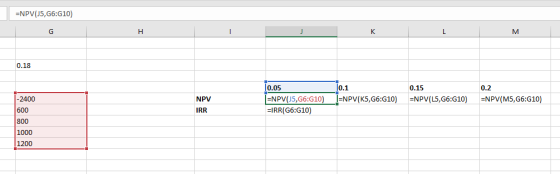
b. We solve IRR and NPV in below manner, formula has been shown in the next screenshot:
NPV can be solved by using 5%,10%,15%,20% substituting in the rate, and drag all the cash flows in the second line of the formula.
IRR can be solved by using all the cash flows.
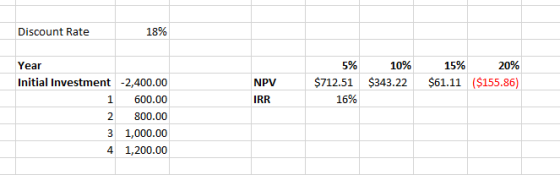
a. If discount rate is 18% , and the IRR is 16% , the investment is not much of a better an investment.
If you still need help with the above, please comment.
Add Answer to:
5. You are thinking of making an investment in a textile mill. The CFs of the...
Do calculations in excel and show work. You are thinking about buying an investment property in...
Do calculations in excel and show work. You are thinking about buying an investment property in San Jose for $150,000 today. You expect to earn $10,000 per year of net rental income (after costs, such as property tax, HOA and maintenance, etc.) on the property and you expect to sell it in 5 years for $200,000. If the annual discount rate is 8%, is this investment attractive to you? (a) What is the net present value of this investment? Is...
6) You are trying to decide from three investment opportunities with the following end-of-year CFs. Which...
 6) You are trying to decide from three investment opportunities with the following end-of-year CFs. Which investment would you choose assuming a 10% discount rate? Remember to show what each investment is worth to you today, to explain your choice. End of Year 400 400 400 400 500 400 400 400 400 600 6 600
SLIDII 2 Suppose that you are investigating two mutual exclusive investments (investment A and B) which...
 SLIDII 2 Suppose that you are investigating two mutual exclusive investments (investment A and B) which correspond to two listed firms A and B, respectively. The Net Cash Flows of these investments are the following: 13 100 (10,000) (10,000) 11,500 0 ogs B 13,500 The risk free interest rate is 2% and the market portfolio return is 8%. The beta coefficient (systematic risk) for firm A and B is equal to 0.5 (i.e. ba=bg=0.5) Which investment would you proceed with...
You are deciding between two mutually exclusive investment opportunities. Both require the same initial investment of...
 You are deciding between two mutually exclusive investment opportunities. Both require the same initial investment of $10.2 million. Investment A will generate $1.97 million per year (starting at the end of the first year) in perpetuity. Investment B will generate $1.47 million at the end of the first year, and its revenues will grow at 2.7% per year for every year after that. a. Which investment has the higher IRR? b. Which investment has the higher NPV when the cost...
Suppose that you investigate the case of two mutual exclusive investments, investment A and investment B,...
 Suppose that you investigate the case of two mutual exclusive investments, investment A and investment B, the annual Net Cash Flows of which are given below: to ti tz tz A (10,000) 4,000 4,000 10,000 B (50,000) 15,000 15,000 40,000 The risk free interest rate is equal to 2% while the market portfolio yields 7% on an annual basis. 4.1 Suppose that these investments refer to a firm the systematic risk factor of which (i.e. beta coefficient) is equal to...
Question 2 (evaluating investment projects) General Motors (or Toyota) is thinking of investing in new production...
 Question 2 (evaluating investment projects) General Motors (or Toyota) is thinking of investing in new production equipment, which will cost $500 million in year zero, and will generate cost savings of $300 million in year 1, $200 million in year 2, and $150 million in year 3. After 3 years, the salvage value is zero. The cost of capital (discount rate) is 25% for General Motors and 10% for Toyota. (Due to GM's recent bankruptcy, investors are scared to lend...
16) You are offered an investment that will pay the following cash flows at the end...
16) You are offered an investment that will pay the following cash flows at the end of each of the next five years at a cost of $800. What is the Net Present Value (NPV) if the required rate of return is 12% per year? Period Cash Flow 0 $0 1 $100 2 $200 3 $300 4 $400 5 $500 Remember that Excel’s NPV function doesn't really calculate the net present value. Instead, it simply calculates the present value of...
1. Time Value of Money You have been offered a unique investment opportunity. If you invest...
 1. Time Value of Money You have been offered a unique investment opportunity. If you invest $20,000 today, you will receive $1000 one year from now, $3000 two years from now, and $20,000 ten years from now. a. What is the NPV of the investment opportunity if the interest rate is 12% per year? Should you take the opportunity? b. What is the NPV of the investment opportunity if the interest rate is 2% per year? Should you take the...
You are CEO of Rivet Networks, maker of ultra-high performance network cards for gaming computers, and...
 You are CEO of Rivet Networks, maker of ultra-high performance network cards for gaming computers, and you are considering whether to launch a new product. The product, the killer X3000, will cost $892,000 to develop up front (year 0), and you expect revenues the first year of $809,000, growing to $1.41 million the second year, and then declining by 45% per year for the next 3 years before the product is fully obsolete. In years 1 through 5, you will...
Problem #4 – 15 pts Use sheet “Problem 4" You are considering a possible investment opportunity...
 Problem #4 – 15 pts Use sheet “Problem 4" You are considering a possible investment opportunity which will return $10,000 a year, each year, for the next 20 years. To help you evaluate this opportunity, use a two-way data table to calculate the Net Present Value based on various possible discount rates and up-front investment costs. Use the following values: Discount rates Investment costs 3% $70,000 4% $90,000 5% $100,000 6% $120,000 7% 150,000 E23 Name Box Interest rate Two-way...
 6) You are trying to decide from three investment opportunities with the following end-of-year CFs. Which investment would you choose assuming a 10% discount rate? Remember to show what each investment is worth to you today, to explain your choice. End of Year 400 400 400 400 500 400 400 400 400 600 6 600
 SLIDII 2 Suppose that you are investigating two mutual exclusive investments (investment A and B) which correspond to two listed firms A and B, respectively. The Net Cash Flows of these investments are the following: 13 100 (10,000) (10,000) 11,500 0 ogs B 13,500 The risk free interest rate is 2% and the market portfolio return is 8%. The beta coefficient (systematic risk) for firm A and B is equal to 0.5 (i.e. ba=bg=0.5) Which investment would you proceed with...
 You are deciding between two mutually exclusive investment opportunities. Both require the same initial investment of $10.2 million. Investment A will generate $1.97 million per year (starting at the end of the first year) in perpetuity. Investment B will generate $1.47 million at the end of the first year, and its revenues will grow at 2.7% per year for every year after that. a. Which investment has the higher IRR? b. Which investment has the higher NPV when the cost...
 Suppose that you investigate the case of two mutual exclusive investments, investment A and investment B, the annual Net Cash Flows of which are given below: to ti tz tz A (10,000) 4,000 4,000 10,000 B (50,000) 15,000 15,000 40,000 The risk free interest rate is equal to 2% while the market portfolio yields 7% on an annual basis. 4.1 Suppose that these investments refer to a firm the systematic risk factor of which (i.e. beta coefficient) is equal to...
 Question 2 (evaluating investment projects) General Motors (or Toyota) is thinking of investing in new production equipment, which will cost $500 million in year zero, and will generate cost savings of $300 million in year 1, $200 million in year 2, and $150 million in year 3. After 3 years, the salvage value is zero. The cost of capital (discount rate) is 25% for General Motors and 10% for Toyota. (Due to GM's recent bankruptcy, investors are scared to lend...
 1. Time Value of Money You have been offered a unique investment opportunity. If you invest $20,000 today, you will receive $1000 one year from now, $3000 two years from now, and $20,000 ten years from now. a. What is the NPV of the investment opportunity if the interest rate is 12% per year? Should you take the opportunity? b. What is the NPV of the investment opportunity if the interest rate is 2% per year? Should you take the...
 You are CEO of Rivet Networks, maker of ultra-high performance network cards for gaming computers, and you are considering whether to launch a new product. The product, the killer X3000, will cost $892,000 to develop up front (year 0), and you expect revenues the first year of $809,000, growing to $1.41 million the second year, and then declining by 45% per year for the next 3 years before the product is fully obsolete. In years 1 through 5, you will...
 Problem #4 – 15 pts Use sheet “Problem 4" You are considering a possible investment opportunity which will return $10,000 a year, each year, for the next 20 years. To help you evaluate this opportunity, use a two-way data table to calculate the Net Present Value based on various possible discount rates and up-front investment costs. Use the following values: Discount rates Investment costs 3% $70,000 4% $90,000 5% $100,000 6% $120,000 7% 150,000 E23 Name Box Interest rate Two-way...
Most questions answered within 3 hours.
-
Where is the error in this code sequence?
String s1 = "Hello";
String s2 = "ello";...
asked 11 months ago -
Financial data for Joel de Paris, Inc., for last year
follow:
Joel de Paris, Inc.
Balance...
asked 11 months ago -
Consider this reaction:
Al2(SO4)3 (aq)+ BaCl3
(aq) Al2Cl6 (aq)- +
3BaSO4(s) . What is the...
asked 11 months ago -
Suppose that Savneet is considering increasing her
recent random sample from 20 car rentals to 40...
asked 11 months ago -
Trucks arrive at an unloading terminal at an average rate of 120
per hour.
Trucks arrive...
asked 11 months ago -
Why are methanol and ethanol completely soluble in water while
octanol is not very little soluble....
asked 11 months ago -
A facilities manager at a university reads in a research report
that the mean amount of...
asked 11 months ago -
When the CuSO4 is rehydrated by adding water to the anhydrous
compound, is this an endothermic...
asked 11 months ago -
A ray of sunlight is passing from diamond into crown glass; the
angle of incidence is...
asked 11 months ago -
A block of mass 0.249 kg is placed on top of a light, vertical
spring of...
asked 11 months ago -
how do the kidneys compensate in the presences of acidosis
a) trigger hyperventilate
b) reserve acid...
asked 11 months ago -
Question 501 pts
The rental rate of capital to the firm increases. Which of the
following...
asked 11 months ago