Someone is travelling at a velocity of 2.8e8 m/s away from a stationary observer and throws...
Homework Answers
Given , Speed of the person (v1)= 2.8 x 10⁸ m/s and
Speed of the object (v2) thrown forward = 2.1 x 10⁸ m/s
If you think classically then, velocity of the object with respect to the stationary observer will be :
v = (2.8 +2.1 ) x 108 = 4.9 x 10⁸ m/s
Which is completely a wrong answer. Because it will violate the second postulate of Special Theory of Relativity . According to this postulate no object can move with a speed greater than the speed of light (C = 3 x 10⁸ m/s).
This type of velocity addition is done by using the most famous relativistic velocity addition formula . This formula is given by
 (this is derived from the special theory of relativity)
So, velocity of the object with respect to the stationary observer will be
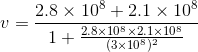
or, 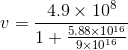
or, 
or, 
Hence, velocity of the object with respect to the stationary observer will be 2.96 x 10⁸ m/s .
For any doubt please comment and please give an up vote. Thank you.
Add Answer to:
Someone is travelling at a velocity of 2.8e8 m/s away from a
stationary observer and throws...
A train travelling at 43.4 m/s is approaching a stationary observer, and sounding a warning horn...
A train travelling at 43.4 m/s is approaching a stationary observer, and sounding a warning horn at 448 Hz. If the speed of sound is 340.7 m/s, calculate the frequency which the observer hears, in Hz to 3 sf.
Only need part c for the velocity in the y direction An observer is stationary in...
 Only need part c for the velocity in the y direction
An observer is stationary in the inertial system S. A car is moving in the x- direction with speed V with respect to the observer in S. The driver of the car is stationary with respect to the car, and thus the driver is in a different inertial frame S. The passenger of the car takes out a baseball, opens the sunroof of the car and throws out the...
Only need part c for the velocity in the y direction
An observer is stationary in the inertial system S. A car is moving in the x- direction with speed V with respect to the observer in S. The driver of the car is stationary with respect to the car, and thus the driver is in a different inertial frame S. The passenger of the car takes out a baseball, opens the sunroof of the car and throws out the...
Consider a muon traveling at 0.950 c relative to a stationary observer. If the observer observes...
Consider a muon traveling at 0.950 c relative to a stationary observer. If the observer observes the muon for 0.300 s, how much time has passed in the muon's frame of reference? Consider a muon travelling at 0.950 c relative to a stationary observer. If the observer observes the muon travel 1.50 m, how far did the muon travel in the muon's frame of reference?
A person throws an object into the air with an initial velocity of 3 ft. /s...
A person throws an object into the air with an initial velocity of 3 ft. /s from the ground (i.e. the initial height is zero). How fast is the object travelling when it hits the ground?
A rocket moves with a velocity of 0.890c to the right with respect to a stationary...
A rocket moves with a velocity of 0.890c to the right with respect to a stationary observer A. An observer B moving relative to observer A finds that the rocket is moving with a velocity of 0.926c to the left. What is the velocity of observer B relative to observer A? (Hint: Consider observer B's velocity in the frame of reference of the rocket. Give your answer to three significant figures. Let the positive direction be to the right. Indicate...
When the source of a wave and an observer move either towards or away from each...
 When the source of a wave and an observer move either towards or away from each other the observed frequency of the wave will be different from the frequency at which the wave is emitted. For example, if you are standing by the side of the road and a police car with a siren passes by, the frequency of the sound you hear will be higher when the car is moving towards you and lower when it is moving away...
LEARN MORE REMARKS If the train were going away from the observer, v, - -40.0 m/s...
 LEARN MORE REMARKS If the train were going away from the observer, v, - -40.0 m/s would have been chosen Instead. QUESTION Does the Doppler shift change due to temperature variations? If so, why? For typical daily variations in temperature in a moderate climate, would any change in the Doppler shift be best characterized as nonexistent, small, or large? Yes. A change in temperature changes the speed of sound and the Doppler shift, but only Insignificantly No. Temperature does not...
An airplane flies with a velocity of 45.0 m/s [ W 35o N] with respect to...
An airplane flies with a velocity of 45.0 m/s [ W 35o N] with respect to the air (this is known as air speed). If the velocity of the airplane according to a stationary observer on the ground is 30.0 m/s [W 60o N], what was the wind velocity?
A skater on a rink is travelling with a velocity 4.2M+0.72J m s i when she...
 A skater on a rink is travelling with a velocity 4.2M+0.72J m s i when she collides with a stationary skater of the same mass. After the collision, the first skater has a velocity 1.20i + 1.261 m s-1. Assume the rink is frictionless (a) What is the velocity of the second skater (initially stationary), after the collision? (b) What is the angle through which the fist skater's trajectory is turned (c) What is the coefficient of restitution between the...
Impulse F* At is an invariant for all observers moving co-linearly with a lab frame observer...
 Impulse F* At is an invariant for all observers moving co-linearly with a lab frame observer A moving observer at an angle relative to the lab frame would report a 2-dim collision with the x component of F" At being the invariant with x-axis as the lab frame axis 1 (from recitation-08) А 10 kg composite object traveling with velocity 29 rn/s, 0 degree) had an internal disturbance such that the composite object was split into Object-A with 3 kg...
 Only need part c for the velocity in the y direction
An observer is stationary in the inertial system S. A car is moving in the x- direction with speed V with respect to the observer in S. The driver of the car is stationary with respect to the car, and thus the driver is in a different inertial frame S. The passenger of the car takes out a baseball, opens the sunroof of the car and throws out the...
Only need part c for the velocity in the y direction
An observer is stationary in the inertial system S. A car is moving in the x- direction with speed V with respect to the observer in S. The driver of the car is stationary with respect to the car, and thus the driver is in a different inertial frame S. The passenger of the car takes out a baseball, opens the sunroof of the car and throws out the...
 When the source of a wave and an observer move either towards or away from each other the observed frequency of the wave will be different from the frequency at which the wave is emitted. For example, if you are standing by the side of the road and a police car with a siren passes by, the frequency of the sound you hear will be higher when the car is moving towards you and lower when it is moving away...
 LEARN MORE REMARKS If the train were going away from the observer, v, - -40.0 m/s would have been chosen Instead. QUESTION Does the Doppler shift change due to temperature variations? If so, why? For typical daily variations in temperature in a moderate climate, would any change in the Doppler shift be best characterized as nonexistent, small, or large? Yes. A change in temperature changes the speed of sound and the Doppler shift, but only Insignificantly No. Temperature does not...
 A skater on a rink is travelling with a velocity 4.2M+0.72J m s i when she collides with a stationary skater of the same mass. After the collision, the first skater has a velocity 1.20i + 1.261 m s-1. Assume the rink is frictionless (a) What is the velocity of the second skater (initially stationary), after the collision? (b) What is the angle through which the fist skater's trajectory is turned (c) What is the coefficient of restitution between the...
 Impulse F* At is an invariant for all observers moving co-linearly with a lab frame observer A moving observer at an angle relative to the lab frame would report a 2-dim collision with the x component of F" At being the invariant with x-axis as the lab frame axis 1 (from recitation-08) А 10 kg composite object traveling with velocity 29 rn/s, 0 degree) had an internal disturbance such that the composite object was split into Object-A with 3 kg...
Most questions answered within 3 hours.
-
Where is the error in this code sequence?
String s1 = "Hello";
String s2 = "ello";...
asked 11 months ago -
Financial data for Joel de Paris, Inc., for last year
follow:
Joel de Paris, Inc.
Balance...
asked 11 months ago -
Consider this reaction:
Al2(SO4)3 (aq)+ BaCl3
(aq) Al2Cl6 (aq)- +
3BaSO4(s) . What is the...
asked 11 months ago -
Suppose that Savneet is considering increasing her
recent random sample from 20 car rentals to 40...
asked 11 months ago -
Trucks arrive at an unloading terminal at an average rate of 120
per hour.
Trucks arrive...
asked 11 months ago -
Why are methanol and ethanol completely soluble in water while
octanol is not very little soluble....
asked 11 months ago -
A facilities manager at a university reads in a research report
that the mean amount of...
asked 11 months ago -
When the CuSO4 is rehydrated by adding water to the anhydrous
compound, is this an endothermic...
asked 11 months ago -
A ray of sunlight is passing from diamond into crown glass; the
angle of incidence is...
asked 11 months ago -
A block of mass 0.249 kg is placed on top of a light, vertical
spring of...
asked 11 months ago -
how do the kidneys compensate in the presences of acidosis
a) trigger hyperventilate
b) reserve acid...
asked 11 months ago -
Question 501 pts
The rental rate of capital to the firm increases. Which of the
following...
asked 11 months ago