Please help explain this problem to me
Homework Answers

Add Answer to:
Please help explain this problem to me
sto 3. The figure to the right shows a...
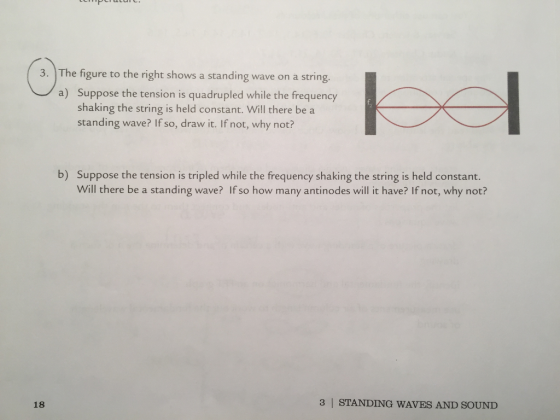
Can I please get an explanation 2.The figure to the right shows a standing wave on...
 Can I please get an explanation
2.The figure to the right shows a standing wave on a string. It has a frequency f Draw the standing wave if the frequency is changed to jf andf a. Original Wave Frequency, f Is there a standing wave if the frequency is changed to ? If so, how many antinodes does it have? b. Frequency, 3. Frequency, hf
Can I please get an explanation
2.The figure to the right shows a standing wave on a string. It has a frequency f Draw the standing wave if the frequency is changed to jf andf a. Original Wave Frequency, f Is there a standing wave if the frequency is changed to ? If so, how many antinodes does it have? b. Frequency, 3. Frequency, hf
Standing waves (Exercise 3 continued) So what can you say about the relation between the period...
 Standing waves (Exercise 3 continued) So what can you say about the relation between the period and frequency? The figure on the following page shows a standing wave on a string. It has frequency f Draw the standing wave if the frequency is changed to f . (Hint:What happens to wavelength if you change frequency?) Frequency f Frequencyf
1. The figure to the right shows a particle undergoing simple harmonic motion described by x(t)=...
 1. The figure to the right shows a particle undergoing simple harmonic motion described by x(t)= A cos(at +o). Notice that x(0) = A/2. What is the phase constant? 2. The figure to the right shows a snapshot of circular waves emitted by two in- phase sources. The point marked by the dot (directly in between two wave fronts emitted from source I at the time shown) is a point of: A. Maximum constructive interference. B. Maximum destructive interference. C. Partially constructive interference. D. Partially...
please show all work. need help with question c,d,e Name Problem 3 A standing wave is setup c 1 a string at the third harmonic (n-3), as seen in the figure. The length of the s ring is 0.350 m, th...
 please show all work. need help with question
c,d,e
Name Problem 3 A standing wave is setup c 1 a string at the third harmonic (n-3), as seen in the figure. The length of the s ring is 0.350 m, the tension in the string is 2.44 N and the mass per unit lengtl is 0.100 kg/m. (5 Points)/ a) What is the wavelength a ad frequency fof the standing wave? 5 points)b) If the amplitude of the v ave...
please show all work. need help with question
c,d,e
Name Problem 3 A standing wave is setup c 1 a string at the third harmonic (n-3), as seen in the figure. The length of the s ring is 0.350 m, the tension in the string is 2.44 N and the mass per unit lengtl is 0.100 kg/m. (5 Points)/ a) What is the wavelength a ad frequency fof the standing wave? 5 points)b) If the amplitude of the v ave...
(2) The figure shows a standing wave on a string. The wave has a frequency f....
 (2) The figure shows a standing wave on a string. The wave has a frequency f. Draw the new standing wave if the frequency is changed to (2/3)f Original wave, frequency f
I would appreciate if you could check my work for #2 and help me out with...
 I would appreciate if you could check my work for #2 and help
me out with #3. I tend to get confused with proportions, and I’m
not quite sure how to relate tension to frequency and wavelength
(unless that is the idea, and one doesn’t affect the other).
Thanks so much!
PHY 221 Prelab: Standing Waves Name 1. Make a sketch of a wave on a string. On the sketch, label the amplitude and wavelength of the wave. V :...
I would appreciate if you could check my work for #2 and help
me out with #3. I tend to get confused with proportions, and I’m
not quite sure how to relate tension to frequency and wavelength
(unless that is the idea, and one doesn’t affect the other).
Thanks so much!
PHY 221 Prelab: Standing Waves Name 1. Make a sketch of a wave on a string. On the sketch, label the amplitude and wavelength of the wave. V :...
please help! not sure how to answer these questions! show work 3-A mass m = 2.0...
 please help! not sure how to answer these questions! show
work
3-A mass m = 2.0 kg is attached to a spring having a force constant k = 290 N/m as in the figure. The mass is displaced from its equilibrium position and released. Its period of oscillation is approximately what? 00000000 ME 4- In the figure below, the oscillator produces standing waves as shown. The frequency of the wave is 60 Hz What is the wave speed of the...
please help! not sure how to answer these questions! show
work
3-A mass m = 2.0 kg is attached to a spring having a force constant k = 290 N/m as in the figure. The mass is displaced from its equilibrium position and released. Its period of oscillation is approximately what? 00000000 ME 4- In the figure below, the oscillator produces standing waves as shown. The frequency of the wave is 60 Hz What is the wave speed of the...
Please help with #3 ( a multi-part question) 2. When a 100 H tor is used...
 Please help with #3 ( a multi-part question)
2. When a 100 H tor is used to generate a sinusoidal wave on a certain string the z oscilla wavelength is 10 cm. When the tension in the string is doubled the generator produces a wave with a frequency and wavelength? The figure to the right shows a transverse harmonic wave moving to the right with a speed of 10 m/s and a wavelength of 25 cm 3. /u 13 m...
Please help with #3 ( a multi-part question)
2. When a 100 H tor is used to generate a sinusoidal wave on a certain string the z oscilla wavelength is 10 cm. When the tension in the string is doubled the generator produces a wave with a frequency and wavelength? The figure to the right shows a transverse harmonic wave moving to the right with a speed of 10 m/s and a wavelength of 25 cm 3. /u 13 m...
Problem 17.7 Previous Answers (Figure 1) shows a standing wave that is oscillating at frequency 100...
 Problem 17.7 Previous Answers (Figure 1) shows a standing wave that is oscillating at frequency 100 Hz. Correct Part B If the tension in the string is increased by a factor of 4, at what frequency will the to oscillate as a standing wave that looks like the one in the figure? Figure 1 of 1 Express your answer with the appropriate units 2000 Hz SubmitPr Previous AnswersRequest Answer X Incorrect; Try Agai Provide Feedback
The figure shows a standing wave on a string of length L = 1.20 m with...
 The figure shows a standing wave on a string of length
L = 1.20 m with fixed ends oscillating at frequency
f = 450 Hz. Answer the following questions.
1. What is the speed of wave propagation in the
string?
2. The linear mass density of the string is ? = 10.0 g/m. (Note
the units.) What is the tension FT in the
string?
3. The tension in the string is changed to
F'T = 324 N. What does the...
The figure shows a standing wave on a string of length
L = 1.20 m with fixed ends oscillating at frequency
f = 450 Hz. Answer the following questions.
1. What is the speed of wave propagation in the
string?
2. The linear mass density of the string is ? = 10.0 g/m. (Note
the units.) What is the tension FT in the
string?
3. The tension in the string is changed to
F'T = 324 N. What does the...
 Can I please get an explanation
2.The figure to the right shows a standing wave on a string. It has a frequency f Draw the standing wave if the frequency is changed to jf andf a. Original Wave Frequency, f Is there a standing wave if the frequency is changed to ? If so, how many antinodes does it have? b. Frequency, 3. Frequency, hf
Can I please get an explanation
2.The figure to the right shows a standing wave on a string. It has a frequency f Draw the standing wave if the frequency is changed to jf andf a. Original Wave Frequency, f Is there a standing wave if the frequency is changed to ? If so, how many antinodes does it have? b. Frequency, 3. Frequency, hf
 Standing waves (Exercise 3 continued) So what can you say about the relation between the period and frequency? The figure on the following page shows a standing wave on a string. It has frequency f Draw the standing wave if the frequency is changed to f . (Hint:What happens to wavelength if you change frequency?) Frequency f Frequencyf
 please show all work. need help with question
c,d,e
Name Problem 3 A standing wave is setup c 1 a string at the third harmonic (n-3), as seen in the figure. The length of the s ring is 0.350 m, the tension in the string is 2.44 N and the mass per unit lengtl is 0.100 kg/m. (5 Points)/ a) What is the wavelength a ad frequency fof the standing wave? 5 points)b) If the amplitude of the v ave...
please show all work. need help with question
c,d,e
Name Problem 3 A standing wave is setup c 1 a string at the third harmonic (n-3), as seen in the figure. The length of the s ring is 0.350 m, the tension in the string is 2.44 N and the mass per unit lengtl is 0.100 kg/m. (5 Points)/ a) What is the wavelength a ad frequency fof the standing wave? 5 points)b) If the amplitude of the v ave...
 (2) The figure shows a standing wave on a string. The wave has a frequency f. Draw the new standing wave if the frequency is changed to (2/3)f Original wave, frequency f
 I would appreciate if you could check my work for #2 and help
me out with #3. I tend to get confused with proportions, and I’m
not quite sure how to relate tension to frequency and wavelength
(unless that is the idea, and one doesn’t affect the other).
Thanks so much!
PHY 221 Prelab: Standing Waves Name 1. Make a sketch of a wave on a string. On the sketch, label the amplitude and wavelength of the wave. V :...
I would appreciate if you could check my work for #2 and help
me out with #3. I tend to get confused with proportions, and I’m
not quite sure how to relate tension to frequency and wavelength
(unless that is the idea, and one doesn’t affect the other).
Thanks so much!
PHY 221 Prelab: Standing Waves Name 1. Make a sketch of a wave on a string. On the sketch, label the amplitude and wavelength of the wave. V :...
 please help! not sure how to answer these questions! show
work
3-A mass m = 2.0 kg is attached to a spring having a force constant k = 290 N/m as in the figure. The mass is displaced from its equilibrium position and released. Its period of oscillation is approximately what? 00000000 ME 4- In the figure below, the oscillator produces standing waves as shown. The frequency of the wave is 60 Hz What is the wave speed of the...
please help! not sure how to answer these questions! show
work
3-A mass m = 2.0 kg is attached to a spring having a force constant k = 290 N/m as in the figure. The mass is displaced from its equilibrium position and released. Its period of oscillation is approximately what? 00000000 ME 4- In the figure below, the oscillator produces standing waves as shown. The frequency of the wave is 60 Hz What is the wave speed of the...
 Please help with #3 ( a multi-part question)
2. When a 100 H tor is used to generate a sinusoidal wave on a certain string the z oscilla wavelength is 10 cm. When the tension in the string is doubled the generator produces a wave with a frequency and wavelength? The figure to the right shows a transverse harmonic wave moving to the right with a speed of 10 m/s and a wavelength of 25 cm 3. /u 13 m...
Please help with #3 ( a multi-part question)
2. When a 100 H tor is used to generate a sinusoidal wave on a certain string the z oscilla wavelength is 10 cm. When the tension in the string is doubled the generator produces a wave with a frequency and wavelength? The figure to the right shows a transverse harmonic wave moving to the right with a speed of 10 m/s and a wavelength of 25 cm 3. /u 13 m...
 Problem 17.7 Previous Answers (Figure 1) shows a standing wave that is oscillating at frequency 100 Hz. Correct Part B If the tension in the string is increased by a factor of 4, at what frequency will the to oscillate as a standing wave that looks like the one in the figure? Figure 1 of 1 Express your answer with the appropriate units 2000 Hz SubmitPr Previous AnswersRequest Answer X Incorrect; Try Agai Provide Feedback
 The figure shows a standing wave on a string of length
L = 1.20 m with fixed ends oscillating at frequency
f = 450 Hz. Answer the following questions.
1. What is the speed of wave propagation in the
string?
2. The linear mass density of the string is ? = 10.0 g/m. (Note
the units.) What is the tension FT in the
string?
3. The tension in the string is changed to
F'T = 324 N. What does the...
The figure shows a standing wave on a string of length
L = 1.20 m with fixed ends oscillating at frequency
f = 450 Hz. Answer the following questions.
1. What is the speed of wave propagation in the
string?
2. The linear mass density of the string is ? = 10.0 g/m. (Note
the units.) What is the tension FT in the
string?
3. The tension in the string is changed to
F'T = 324 N. What does the...
Most questions answered within 3 hours.
-
Where is the error in this code sequence?
String s1 = "Hello";
String s2 = "ello";...
asked 10 months ago -
Financial data for Joel de Paris, Inc., for last year
follow:
Joel de Paris, Inc.
Balance...
asked 10 months ago -
Consider this reaction:
Al2(SO4)3 (aq)+ BaCl3
(aq) Al2Cl6 (aq)- +
3BaSO4(s) . What is the...
asked 10 months ago -
Suppose that Savneet is considering increasing her
recent random sample from 20 car rentals to 40...
asked 10 months ago -
Trucks arrive at an unloading terminal at an average rate of 120
per hour.
Trucks arrive...
asked 10 months ago -
Why are methanol and ethanol completely soluble in water while
octanol is not very little soluble....
asked 10 months ago -
A facilities manager at a university reads in a research report
that the mean amount of...
asked 10 months ago -
When the CuSO4 is rehydrated by adding water to the anhydrous
compound, is this an endothermic...
asked 10 months ago -
A ray of sunlight is passing from diamond into crown glass; the
angle of incidence is...
asked 10 months ago -
A block of mass 0.249 kg is placed on top of a light, vertical
spring of...
asked 10 months ago -
how do the kidneys compensate in the presences of acidosis
a) trigger hyperventilate
b) reserve acid...
asked 10 months ago -
Question 501 pts
The rental rate of capital to the firm increases. Which of the
following...
asked 10 months ago