An advertisement claims that a particular automobile can "stop on a dime". What net force would...
An advertisement claims that a particular automobile can "stop on a dime". What net force would actually be necessary to stop an automobile of mass 960 kg traveling initially at a speed of 57.0 km/h in a distance equal to the diameter of a dime, which is 1.8 cm ?
Homework Answers
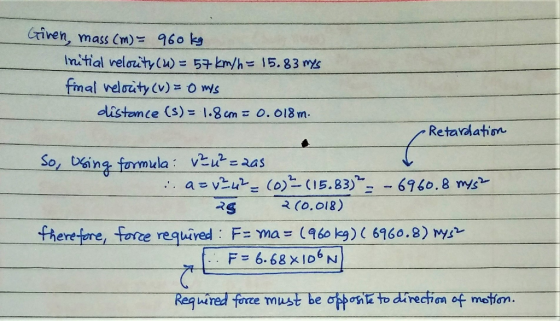
Alright Dude, If that worked for you... dont forget to give THUMBS UP.(that will work for me!)
If I missed something feel free to leave a comment.
atleast before giving downvote.
and, Thanks for using homeworklib- Smarter way to study.
Add Answer to:
An advertisement claims that a particular automobile can "stop
on a dime". What net force would...
Can cars stop on a dime? Calculate the acceleration of a 1400-kg car if it can...
 Can cars stop on a dime? Calculate the acceleration of a 1400-kg car if it can stop from 35 km/h on a dime (diameter = 1.7 cm). How many g?s is this? What is the force felt by the 68-kg occupant of the car?
(a) What is the kinetic energy in joules of a 960-kg automobile traveling at 76 km/h?...
(a) What is the kinetic energy in joules of a 960-kg automobile traveling at 76 km/h? J (b) How much work would have to be done to bring a 960-kg automobile traveling at 76 km/h to a stop? J
suppose it takes 2 seconds to stop a particular object when applying a given net force....
suppose it takes 2 seconds to stop a particular object when applying a given net force. How long would it take to stop an object with triple the mass assuming it was initially moving at the same speed if the magnitude of the net force is doubled?
The friction force (including air friction and rolling friction) acting on an automobile traveling at 65...
The friction force (including air friction and rolling friction) acting on an automobile traveling at 65 km/h amounts to 500 N.What slope must a road have if the automobile is to roll down this road at a constant speed of 65 km/h (with its gears in neutral)? The mass of the automobile is 1.5*10^3 kg.
An automobile traveling 58.0 km/h has tires of 68.0 cm diameter. (a) What is the angular...
An automobile traveling 58.0 km/h has tires of 68.0 cm diameter. (a) What is the angular speed of the tires about their axles? (b) If the car is brought to a stop uniformly in 32.0 complete turns of the tires, what is the magnitude of the angular acceleration of the wheels? (c) How far does the car move during the braking? (Note: automobile moves without sliding)
An automobile traveling 74.0 km/h has tires of 71.0 cm diameter. (a) What is the angular...
An automobile traveling 74.0 km/h has tires of 71.0 cm diameter. (a) What is the angular speed of the tires about their axles? (b) If the car is brought to a stop uniformly in 33.0 complete turns of the tires, what is the magnitude of the angular acceleration of the wheels? (c) How far does the car move during the braking? (Note: automobile moves without sliding)
An automobile traveling 87.0 km/h has tires of 68.0 cm diameter. (a) What is the angular...
An automobile traveling 87.0 km/h has tires of 68.0 cm diameter. (a) What is the angular speed of the tires about their axles? (b) If the car is brought to a stop uniformly in 19.0 complete turns of the tires, what is the magnitude of the angular acceleration of the wheels? (c) How far does the car move during the braking? (Note: automobile moves without sliding)
An automobile traveling 110 km/h has tires of 75.0 cm diameter. (a) What is the angular...
An automobile traveling 110 km/h has tires of 75.0 cm diameter. (a) What is the angular speed of the tires about their axles? (b) If the car is brought to a stop uniformly in 21.0 complete turns of the tires, what is the magnitude of the angular acceleration of the wheels? (c) How far does the car move during the braking? (Note: automobile moves without sliding)
An automobile traveling 110 km/h has tires of 79.0 cm diameter. (a) What is the angular...
An automobile traveling 110 km/h has tires of 79.0 cm diameter. (a) What is the angular speed of the tires about their axles? (b) If the car is brought to a stop uniformly in 36.0 complete turns of the tires, what is the magnitude of the angular acceleration of the wheels? (c) How far does the car move during the braking? (Note: automobile moves without sliding)
An automobile traveling at 50 km/h has tires of 75.0 cm diameter. A) What is the...
An automobile traveling at 50 km/h has tires of 75.0 cm diameter. A) What is the angular speed of the tires on the wheels? B) If the car is brought to a stop uniformly in 15 complete turns of the tire (without skidding), what is the magnitude of the angular acceleration of the wheels? C) How far does the car move during the braking?
 Can cars stop on a dime? Calculate the acceleration of a 1400-kg car if it can stop from 35 km/h on a dime (diameter = 1.7 cm). How many g?s is this? What is the force felt by the 68-kg occupant of the car?
Most questions answered within 3 hours.
-
Where is the error in this code sequence?
String s1 = "Hello";
String s2 = "ello";...
asked 10 months ago -
Financial data for Joel de Paris, Inc., for last year
follow:
Joel de Paris, Inc.
Balance...
asked 10 months ago -
Consider this reaction:
Al2(SO4)3 (aq)+ BaCl3
(aq) Al2Cl6 (aq)- +
3BaSO4(s) . What is the...
asked 10 months ago -
Suppose that Savneet is considering increasing her
recent random sample from 20 car rentals to 40...
asked 10 months ago -
Trucks arrive at an unloading terminal at an average rate of 120
per hour.
Trucks arrive...
asked 10 months ago -
Why are methanol and ethanol completely soluble in water while
octanol is not very little soluble....
asked 10 months ago -
A facilities manager at a university reads in a research report
that the mean amount of...
asked 10 months ago -
When the CuSO4 is rehydrated by adding water to the anhydrous
compound, is this an endothermic...
asked 10 months ago -
A ray of sunlight is passing from diamond into crown glass; the
angle of incidence is...
asked 10 months ago -
A block of mass 0.249 kg is placed on top of a light, vertical
spring of...
asked 10 months ago -
how do the kidneys compensate in the presences of acidosis
a) trigger hyperventilate
b) reserve acid...
asked 10 months ago -
Question 501 pts
The rental rate of capital to the firm increases. Which of the
following...
asked 10 months ago