
Homework Answers
Add Answer to:
In 10 ml beaker, add around 1 ml of 0.5m oxafic acid Ito around s ml...
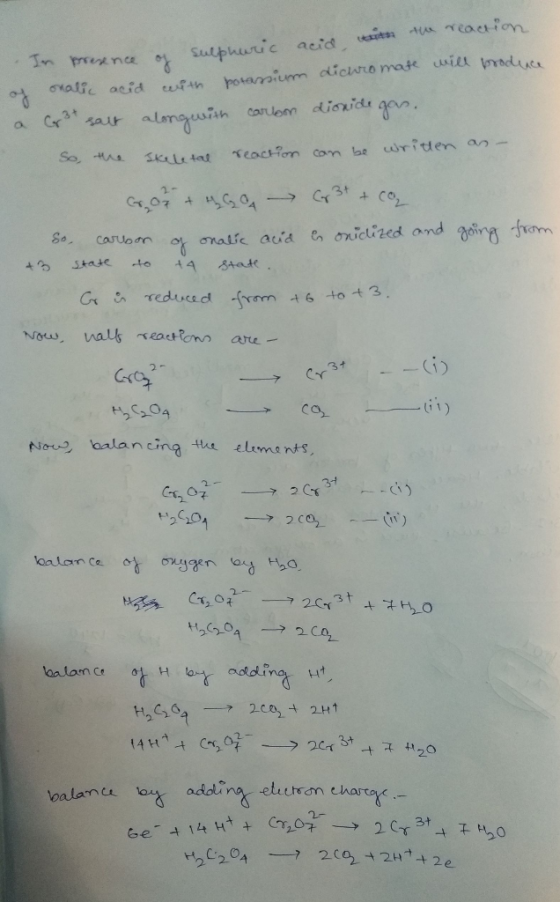
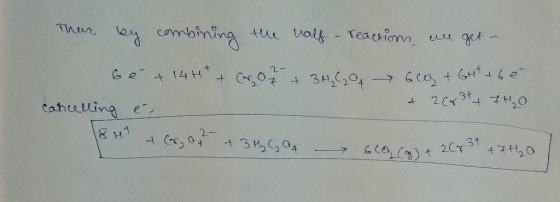
In 10ml beaker, add around 1ml of 0.5M oxalic acid to around 1ml of 3M sulfuric...
In 10ml beaker, add around 1ml of 0.5M oxalic acid to around 1ml of 3M sulfuric acid solution(only act as acidify the solution) 1ml of 0.1M potassium dichromate solution.carefully heat the solution and then test for any suspect gas. - predict the products forms and the half reaction method to balance it.
Balance the equation for the reaction observed: _ Cu(s) + HNO3(aq) → Cu(NO3)2(aq) +_ NO2(g) + H2O(1) 3. Add 40 mL...
 Balance the equation for the reaction observed: _ Cu(s) + HNO3(aq) → Cu(NO3)2(aq) +_ NO2(g) + H2O(1) 3. Add 40 mL of 3.0 M NaOH (sodium hydroxide) to the solution in your beaker. Write the balanced equation for the reaction observed: 4. Add 2-3 boiling chips to your beaker and carefully heat the solution, while stirring with a stirring rod, just to the boiling point. (Do NOT boil. Have a low flame and keep the beaker well above the flame.)...
Fill 10 km It w/ tup water and invert it in a 400 ml beaker billed...
 Fill 10 km It w/ tup water and invert it in a 400 ml beaker billed with 300 - 350 ml of top water so that I the water remain in the test tube obtain a small piece of metallic calcium and rub it on an emery cloth until you can see a shiny metallic surten in one spot. place the metal gas, test the gas for Combusion by letting it out of the bealker, and with it mouth poinlect...
I really just need all the equations, please and thank you. MATERIALS: cene nitric acid, HNO,...
 I really just need all the equations, please and thank you.
MATERIALS: cene nitric acid, HNO, 3.0M sodium hydroxide, NaOH 6.0 M sulfuric acid, H2SO4 zine metal DI water PROCEDURE: Make sure you record detailed observations after almost every step. You will also need to write the balanced chemical equations for almost every step. Make sure you answer any questions associated with a step 1. Weigh approximately 0.5 g of copper metal and record the weight. Place the copper in...
I really just need all the equations, please and thank you.
MATERIALS: cene nitric acid, HNO, 3.0M sodium hydroxide, NaOH 6.0 M sulfuric acid, H2SO4 zine metal DI water PROCEDURE: Make sure you record detailed observations after almost every step. You will also need to write the balanced chemical equations for almost every step. Make sure you answer any questions associated with a step 1. Weigh approximately 0.5 g of copper metal and record the weight. Place the copper in...
just making sure did I do right in number 10. and im confused at number 11...
 just making sure did I do right in number 10. and im confused at
number 11 and 12 13. becausse we didnt learn in class. please help.
thanks for your patient
PROCEDURE 1. This experiment is to be conducted individually. on the side shelf: small squares of copper, NaOH, HSO in the hood: conc. HNOs, conc. HC 2. The following items will be found 4 Use your brush and some soap solution to wash your casserole dish as well as...
just making sure did I do right in number 10. and im confused at
number 11 and 12 13. becausse we didnt learn in class. please help.
thanks for your patient
PROCEDURE 1. This experiment is to be conducted individually. on the side shelf: small squares of copper, NaOH, HSO in the hood: conc. HNOs, conc. HC 2. The following items will be found 4 Use your brush and some soap solution to wash your casserole dish as well as...
1. Explain why the nitration of methylbenzoate occurs in the meta position 2. Why is it...
1. Explain why the nitration of methylbenzoate occurs in the meta position 2. Why is it important to a synthesis reaction of m-nitromethylbenzoate mixute to be cold? 3. What is the function of sulfuric acid in this synthesis These are the procedures for reference Procedure: Add concentrated Sulfuric acid to a conical vial (CV) to the 0.3 mL line. Perform in a fume hood. Cool the CV in an ice bath to 0-10 oC and then add 0.140 mL of...
for this experiment of syntheis of aspirin, was the product obtained pure (based on color)? how...
 for this experiment of syntheis of aspirin, was the product
obtained pure (based on color)? how do you know? the color was
white
Experimental Procedure HAZARD: Sulfuric acid, acetic anhydride and glacial acetic acid are corrosive to the skin. They are also irritants, and all operations in which these substances are used should be carried out under the hood. Prepare a hot-water bath by heating a 400-ml beaker containing about 200 mL of water. 1. Use a centigram balance and...
for this experiment of syntheis of aspirin, was the product
obtained pure (based on color)? how do you know? the color was
white
Experimental Procedure HAZARD: Sulfuric acid, acetic anhydride and glacial acetic acid are corrosive to the skin. They are also irritants, and all operations in which these substances are used should be carried out under the hood. Prepare a hot-water bath by heating a 400-ml beaker containing about 200 mL of water. 1. Use a centigram balance and...
Step 1. Obtain a 600 mL beaker, andadd 300 mL of water. Step 2. Add 30...
 Step 1. Obtain
a 600 mL beaker, andadd 300 mL of water.
Step 2. Add 30 mL
of HCl (2M) to the beaker, and stir.
Step 3. Add 10 mg
of magnesium metal to the beaker.
Step 4. Allow
thehydrogen gas to evolve. All of the magnesium should be
consumed.
Step 5. Record
the amount of hydrogen gas that has evolved using the chemical
property dialog.
questions:
In your lab report, include the following information in the
Discussion section of...
Step 1. Obtain
a 600 mL beaker, andadd 300 mL of water.
Step 2. Add 30 mL
of HCl (2M) to the beaker, and stir.
Step 3. Add 10 mg
of magnesium metal to the beaker.
Step 4. Allow
thehydrogen gas to evolve. All of the magnesium should be
consumed.
Step 5. Record
the amount of hydrogen gas that has evolved using the chemical
property dialog.
questions:
In your lab report, include the following information in the
Discussion section of...
1. Add hydrochloric acid (HCl) to magnesium metal in a test tube. Observations: &
1. Add hydrochloric acid (HCl) to magnesium metal in a test tube. Observations: Reactants: Products: Chemical Equation: 2. Add calcium nitrate to sodium carbonate in a test tube. Observations: Reactants: Products: Chemical Equation: 3. Add iron (III) nitrate to sodium hydroxide in a test tube. Observations: Reactants: Products: Chemical Equation: 4. Add copper (II) nitrate to ammonium hydroxide in a test tube. For writing the equation, the Roman numeral indicates the charge of copper. Caution: ammonium hydroxide produces very pungent...
Place 3.0 g of salicylic acid in a 125-ml Erlenmeyer flask. Carefully add, stirring constantly, 6...
 Place 3.0 g of salicylic acid in a 125-ml Erlenmeyer flask. Carefully add, stirring constantly, 6 mL of acetic anhydride, followed by 10 drops of concentrated sulfuric acid. Swirl the contents of the flask so that the reactants are thoroughly mixed. Stopper the flask with a one- hole cork fitted with an inverted Pasteur pipet to prevent condensation of water in the reaction flask during heating on the steam bath. Heat the flask in a boiling-water or steam bath for...
 Balance the equation for the reaction observed: _ Cu(s) + HNO3(aq) → Cu(NO3)2(aq) +_ NO2(g) + H2O(1) 3. Add 40 mL of 3.0 M NaOH (sodium hydroxide) to the solution in your beaker. Write the balanced equation for the reaction observed: 4. Add 2-3 boiling chips to your beaker and carefully heat the solution, while stirring with a stirring rod, just to the boiling point. (Do NOT boil. Have a low flame and keep the beaker well above the flame.)...
 Fill 10 km It w/ tup water and invert it in a 400 ml beaker billed with 300 - 350 ml of top water so that I the water remain in the test tube obtain a small piece of metallic calcium and rub it on an emery cloth until you can see a shiny metallic surten in one spot. place the metal gas, test the gas for Combusion by letting it out of the bealker, and with it mouth poinlect...
 I really just need all the equations, please and thank you.
MATERIALS: cene nitric acid, HNO, 3.0M sodium hydroxide, NaOH 6.0 M sulfuric acid, H2SO4 zine metal DI water PROCEDURE: Make sure you record detailed observations after almost every step. You will also need to write the balanced chemical equations for almost every step. Make sure you answer any questions associated with a step 1. Weigh approximately 0.5 g of copper metal and record the weight. Place the copper in...
I really just need all the equations, please and thank you.
MATERIALS: cene nitric acid, HNO, 3.0M sodium hydroxide, NaOH 6.0 M sulfuric acid, H2SO4 zine metal DI water PROCEDURE: Make sure you record detailed observations after almost every step. You will also need to write the balanced chemical equations for almost every step. Make sure you answer any questions associated with a step 1. Weigh approximately 0.5 g of copper metal and record the weight. Place the copper in...
 just making sure did I do right in number 10. and im confused at
number 11 and 12 13. becausse we didnt learn in class. please help.
thanks for your patient
PROCEDURE 1. This experiment is to be conducted individually. on the side shelf: small squares of copper, NaOH, HSO in the hood: conc. HNOs, conc. HC 2. The following items will be found 4 Use your brush and some soap solution to wash your casserole dish as well as...
just making sure did I do right in number 10. and im confused at
number 11 and 12 13. becausse we didnt learn in class. please help.
thanks for your patient
PROCEDURE 1. This experiment is to be conducted individually. on the side shelf: small squares of copper, NaOH, HSO in the hood: conc. HNOs, conc. HC 2. The following items will be found 4 Use your brush and some soap solution to wash your casserole dish as well as...
 for this experiment of syntheis of aspirin, was the product
obtained pure (based on color)? how do you know? the color was
white
Experimental Procedure HAZARD: Sulfuric acid, acetic anhydride and glacial acetic acid are corrosive to the skin. They are also irritants, and all operations in which these substances are used should be carried out under the hood. Prepare a hot-water bath by heating a 400-ml beaker containing about 200 mL of water. 1. Use a centigram balance and...
for this experiment of syntheis of aspirin, was the product
obtained pure (based on color)? how do you know? the color was
white
Experimental Procedure HAZARD: Sulfuric acid, acetic anhydride and glacial acetic acid are corrosive to the skin. They are also irritants, and all operations in which these substances are used should be carried out under the hood. Prepare a hot-water bath by heating a 400-ml beaker containing about 200 mL of water. 1. Use a centigram balance and...
 Step 1. Obtain
a 600 mL beaker, andadd 300 mL of water.
Step 2. Add 30 mL
of HCl (2M) to the beaker, and stir.
Step 3. Add 10 mg
of magnesium metal to the beaker.
Step 4. Allow
thehydrogen gas to evolve. All of the magnesium should be
consumed.
Step 5. Record
the amount of hydrogen gas that has evolved using the chemical
property dialog.
questions:
In your lab report, include the following information in the
Discussion section of...
Step 1. Obtain
a 600 mL beaker, andadd 300 mL of water.
Step 2. Add 30 mL
of HCl (2M) to the beaker, and stir.
Step 3. Add 10 mg
of magnesium metal to the beaker.
Step 4. Allow
thehydrogen gas to evolve. All of the magnesium should be
consumed.
Step 5. Record
the amount of hydrogen gas that has evolved using the chemical
property dialog.
questions:
In your lab report, include the following information in the
Discussion section of...
 Place 3.0 g of salicylic acid in a 125-ml Erlenmeyer flask. Carefully add, stirring constantly, 6 mL of acetic anhydride, followed by 10 drops of concentrated sulfuric acid. Swirl the contents of the flask so that the reactants are thoroughly mixed. Stopper the flask with a one- hole cork fitted with an inverted Pasteur pipet to prevent condensation of water in the reaction flask during heating on the steam bath. Heat the flask in a boiling-water or steam bath for...
Most questions answered within 3 hours.
-
Where is the error in this code sequence?
String s1 = "Hello";
String s2 = "ello";...
asked 11 months ago -
Financial data for Joel de Paris, Inc., for last year
follow:
Joel de Paris, Inc.
Balance...
asked 11 months ago -
Consider this reaction:
Al2(SO4)3 (aq)+ BaCl3
(aq) Al2Cl6 (aq)- +
3BaSO4(s) . What is the...
asked 11 months ago -
Suppose that Savneet is considering increasing her
recent random sample from 20 car rentals to 40...
asked 11 months ago -
Trucks arrive at an unloading terminal at an average rate of 120
per hour.
Trucks arrive...
asked 11 months ago -
Why are methanol and ethanol completely soluble in water while
octanol is not very little soluble....
asked 11 months ago -
A facilities manager at a university reads in a research report
that the mean amount of...
asked 11 months ago -
When the CuSO4 is rehydrated by adding water to the anhydrous
compound, is this an endothermic...
asked 11 months ago -
A ray of sunlight is passing from diamond into crown glass; the
angle of incidence is...
asked 11 months ago -
A block of mass 0.249 kg is placed on top of a light, vertical
spring of...
asked 11 months ago -
how do the kidneys compensate in the presences of acidosis
a) trigger hyperventilate
b) reserve acid...
asked 11 months ago -
Question 501 pts
The rental rate of capital to the firm increases. Which of the
following...
asked 11 months ago