Economics Apartment Question: Inner and Outer Ring
![» There are two types of apartments, inner ring and outer ring » The price of outer ring apartments is fixed and equal to po. » There is a fixed supply of inner ring apartments equal to N8. The cost to the land-lord of renting an apartment in the short run is zero, up until Ns. Then it is infinite. . The total possible number of renters that would live in the inner ring is Nd> N*. This is the maximum number that might want to live in the inner ring ·Apartments in the inner ring and outer ring are identical, except that the cost of transportation to the University is lower by the amount ci = t0, for renter i· 0, is the type of person i and a higher θ reflects higher costs of transport, while t is a scaling paramter. The only reason to pay more for an inner ring apartment is to save on transportation costs . The distribution of types is uniformly distributed and ranges from [0,1]. In English this means that the type of an individual ranges from 0 and 1, inclusive. A consumer with type 0 has no transport costs; a consumer of type 1 has the maximum transport costs of t; a consumer of type 1/2 has transport costs of t/2, and so on. Uniform distribution simply means that the proportion of people of any type is the same. It also means that the cumulative proportion of renters with a type less than θ is θ. So if θ .25 then 25% of renters are type 0.25 or less and 75% of renters have a type greater than 0.25](http://img.homeworklib.com/questions/ad09e6a0-72cb-11ea-8cda-f79ee9d9bd4c.png?x-oss-process=image/resize,w_560)
Homework Answers
Let us infer a few things from your question which will help us in subparts of the question.
- From point 2, it is clear that the price of outer ring apartment is an exogenous variable. This means that the price of the outer-ring apartments is taken as determined by factors not mentioned in the problem.
- From point 3, it is a short run case and supply is fixed for the inner-ring apartment, hence the supply curve is vertical
- From point 4, the inner-ring apartment market attains an equilibrium price.
- From the last point,
is continuously increasing from 0 to 1 as we move from the inner apartment to the outer-ring apartment.
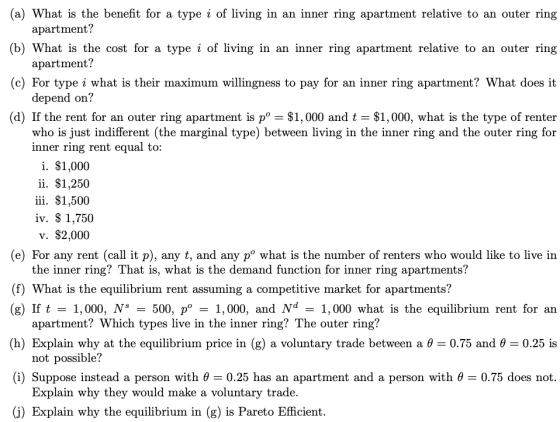
a) The person who lives in the inner-ring apartment will have low transportation cost than the one who lives in the outer-ring apartment. The reason is as we move from inner-ring apartment to outer-ring one cost of transportation increases.
b) For the inner ring apartment, the demand of the apartment is greater than supply, hence renter has to pay higher rent than the outer-ring apartment.
c) Maximum willingness to pay for the inner-ring apartment can be written as
willingness to pay =
i.e; rent of the outer-ring apartment + cost of
transportation.
For maximum willingness; = 1, hence the
above equation became
.
It depends on the rent of outer-ring apartment and scaling parameter.
d) If a person is indifferent between apartments it means his maximum willingness to pay matches the equation we derive in the above part.
Therefore, the maximum willingness to pay is 1000+ 1000 = $ 2000.
Hence, option (v) is correct.
e) The demand function for inner ring apartment; =
This is the demand function because demand negatively related to the price of inner ring apartment and positively related to outer ring apartment.
f) If we assume a competitive market then equilibrium exists where the demand of apartment is equal to the supply of apartment.
g) From the equation, we derive in part (e); putting the respective values
1000 = (1000+1000) - p
gives, p = 1000
At equilibrium, Demand = Supply, p-1000 = 500
which gives
Rent for the inner ring apartment is p = 1000 * (1/2) = $500
Rent for the outer ring apartment = $ 1000 and $500 for transportation.
h) The voluntary trade at and
is
not possible because at this
rent of the outer-ring apartment = 1000 + 250 = $1250; at
;
rent of outer-ring apartment = $1750
rent of inner-ring apartment = 1000*(0.25) = $250 ; at ;
rent of inner-ring apartment = $ 750
because it creates large gap between what they are paying versus what they have to pay after trade,
Add Answer to:
Economics Apartment Question: Inner and Outer Ring
» There are two types of apartments, inner ring...
Part III: Problems Chapter 1 e There are two types of apartments, inner ring and outer...
 Part III: Problems Chapter 1 e There are two types of apartments, inner ring and outer ring. . The price of outer ring apartments is fixed and equal to po. . There is a fixed supply of inner ring apartments equal to N". The cost to the land-lord of renting the short run is zero, up until N. Then it is infinite. . The total possible number of renters that would live in the inner ring is Nd N. This...
6. The rental market for apartments in a University town. The assumptions follow Varian's model in...
 6. The rental market for apartments in a University town. The assumptions follow Varian's model in Chapter 1: . There are two types of apartments, inner ring and outer ring. . The price of outer ring apartments is fixed and equal to po There is a fixed supply of inner ring apartments equal to N*. The cost to the land-lord of renting an apartment in the short run is zero, up until N*. Then it is infinite. . The total...
 Part III: Problems Chapter 1 e There are two types of apartments, inner ring and outer ring. . The price of outer ring apartments is fixed and equal to po. . There is a fixed supply of inner ring apartments equal to N". The cost to the land-lord of renting the short run is zero, up until N. Then it is infinite. . The total possible number of renters that would live in the inner ring is Nd N. This...
 6. The rental market for apartments in a University town. The assumptions follow Varian's model in Chapter 1: . There are two types of apartments, inner ring and outer ring. . The price of outer ring apartments is fixed and equal to po There is a fixed supply of inner ring apartments equal to N*. The cost to the land-lord of renting an apartment in the short run is zero, up until N*. Then it is infinite. . The total...
Most questions answered within 3 hours.
-
Where is the error in this code sequence?
String s1 = "Hello";
String s2 = "ello";...
asked 10 months ago -
Financial data for Joel de Paris, Inc., for last year
follow:
Joel de Paris, Inc.
Balance...
asked 10 months ago -
Consider this reaction:
Al2(SO4)3 (aq)+ BaCl3
(aq) Al2Cl6 (aq)- +
3BaSO4(s) . What is the...
asked 10 months ago -
Suppose that Savneet is considering increasing her
recent random sample from 20 car rentals to 40...
asked 10 months ago -
Trucks arrive at an unloading terminal at an average rate of 120
per hour.
Trucks arrive...
asked 10 months ago -
Why are methanol and ethanol completely soluble in water while
octanol is not very little soluble....
asked 10 months ago -
A facilities manager at a university reads in a research report
that the mean amount of...
asked 10 months ago -
When the CuSO4 is rehydrated by adding water to the anhydrous
compound, is this an endothermic...
asked 10 months ago -
A ray of sunlight is passing from diamond into crown glass; the
angle of incidence is...
asked 10 months ago -
A block of mass 0.249 kg is placed on top of a light, vertical
spring of...
asked 10 months ago -
how do the kidneys compensate in the presences of acidosis
a) trigger hyperventilate
b) reserve acid...
asked 10 months ago -
Question 501 pts
The rental rate of capital to the firm increases. Which of the
following...
asked 10 months ago