
Homework Answers
Add Answer to:
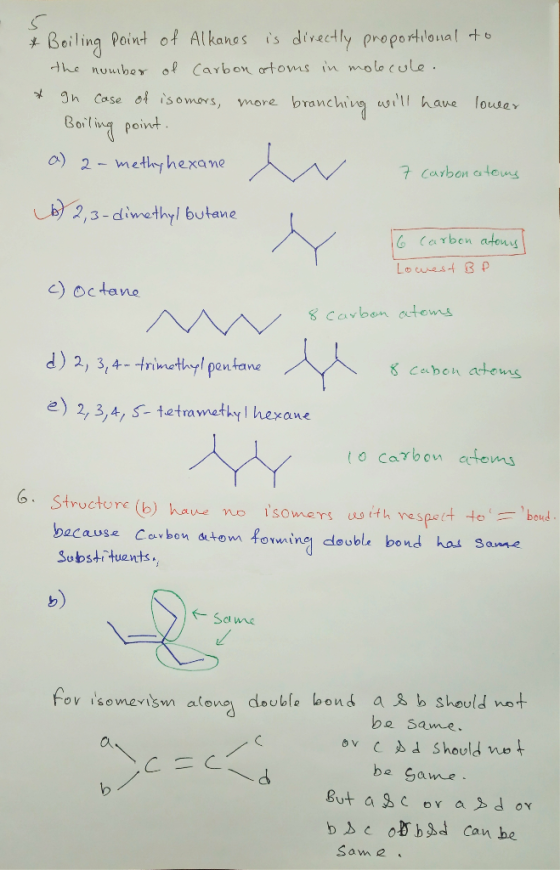
can anyone explain and answer 5 and 6 please
4. Which of the following properties is...
1. Indicate which of the following would be considered physical properties (P) and which would be...
 1. Indicate which of the following would be considered physical properties (P) and which would be considered chemical properties (C) of iron. ー-a. Iron reacts with oxygen to form iron oxides. b. Iron is a good conductor of heat and electricity. C. Iron melts at 1535°C. d. When iron is immersed in a solution of hydrochloric acid, hydrogen gas is produced. e. Iron becomes red-hot when heated. __ f. A500-cc volume of iron has a mass of 3930 g. Iron...
Please choose best answer. QUESTION 5 Which of the following has the highest boiling point? a....
 Please choose best answer.
QUESTION 5 Which of the following has the highest boiling point? a. pentanal O b. 1-pentanol O c. hexane O d. butanoic acid QUESTION 6 Which of the following is the most soluble in water? a. 1-pentanol b. pentanal c. butanoic acid O d. hexane
Please choose best answer.
QUESTION 5 Which of the following has the highest boiling point? a. pentanal O b. 1-pentanol O c. hexane O d. butanoic acid QUESTION 6 Which of the following is the most soluble in water? a. 1-pentanol b. pentanal c. butanoic acid O d. hexane
The identity of the gas is diethyl ether (C), which has molar of 74.12p/mol and a...
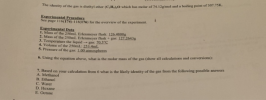 The identity of the gas is diethyl ether (C), which has molar of 74.12p/mol and a boiling point of 307.75K. Experimental Procedure See page 116(174)-118(176) for the overview of the experiment. Experimental Data 1. Mass of the 250ml. Erlenmeyer flask: 126.4800g 2. Mass of the 250mL. Erlenmeyer flask + gas: 127.26435 3. Temperature the liquid-gas: 70.3°C 4. Volume of the 250mL: 253.4mL 5. Pressure of the gas: 100 atmospheres 6. Using the equation above, what is the molar mass of...
5. Which of the following statements is not true regarding the properties of alkanes? a. The...
 5. Which of the following statements is not true regarding the properties of alkanes? a. The bp/mp increases with increase in length of the carbon chain b. The bp/mp increases with increase in branching in the isomeric alkanes c. Alkanes undergo combustion reaction with O2 releasing energy d. Alkanes are called paraffins, meaning little affinity, and are chemically inert to most laboratory reagents. 6. In the structure shown below, identify the functional groups circled, in order, from left to right...
b. Which of the following alkanes has the highest bolling point? 2,3-dimethylbutane: 2-methylpentane; 3-methylpentane; hexane c....
 b. Which of the following alkanes has the highest bolling point? 2,3-dimethylbutane: 2-methylpentane; 3-methylpentane; hexane c. Which of the following compounds can adopt a chair conformation in which there are no axial methyl groups? 1,1-dimethylcyclohexane; cis-1,2-dimethylcyclohexane; trans-1,2-dimethylcyclohexane; trans-1,3-di methylcyclohexane d. Which of the following compounds can adopt a chair conformation which there are no axial methyl groups? cis-1,2-dimethylcyclohexane; cis-1,3-dimethylcyclohexane; trans-1,3-dimethylcyclohexane; cis-1.4-dimethylcyclohexane cis-1,2-dimethvcyclohexane (Enter the numerical value only, without any units)? e. What is the approximate di hedral angle between the...
***Please explain why you chose your answer*** Which of the following is NOT true? a)...
***Please explain why you chose your answer*** Which of the following is NOT true? a) The surface tension of CH3CH2NH3 is higher than that of both CH3CHO and CCl4. b) Water has a higher viscosity at a given temperature than does CH3CH2CH2CH2CH3, and for both substances, the viscosity decreases when the temperature is raised. c) The cohesive forces between water molecules are stronger than the adhesive forces of water molecules to glass, which leads to...
Please answer all questions for chemistry!! Place the following compounds in order of decreasing strength of...
 Please answer all questions for chemistry!!
Place the following compounds in order of decreasing strength of intermolecular forces. I. CH_3CH_2CH_2CH_2CH_2CH_3 II. (CH_3)_3CCH_3 III. (CH_3)_3CCH_2CH_3 A) III > II > I B) I > III > I C) I > II > III D) II > III > I E) III > I > II Identify the place which has the lowest boiling point of water A) Death Valley, 282 feet below sea level B) New Orleans, sea level C) Mt....
Please answer all questions for chemistry!!
Place the following compounds in order of decreasing strength of intermolecular forces. I. CH_3CH_2CH_2CH_2CH_2CH_3 II. (CH_3)_3CCH_3 III. (CH_3)_3CCH_2CH_3 A) III > II > I B) I > III > I C) I > II > III D) II > III > I E) III > I > II Identify the place which has the lowest boiling point of water A) Death Valley, 282 feet below sea level B) New Orleans, sea level C) Mt....
please answer sll questions, i have to keep reposting due to partial answers 26-53 26-30. Determine...
 please answer sll questions, i have to keep reposting due to
partial answers 26-53
26-30. Determine the relationship in the following pairs of compounds HC CH.CH CH, CH,CH2 CH2CH2CH3 A) same molecule B) structural isomers C) Enantiomers D) not related E) geometrical (cis/trans) isomers H CH₃CH₂ H CH₂ CHO OOH / CH2OH CH OH - HOH HOH HoH HOH HOH HOH H-OH HOH CH2OH CH OH 2 28. HD HO-C-H H-C-OH CH2OH 29 CH2OH 31-35. Match the number to the...
please answer sll questions, i have to keep reposting due to
partial answers 26-53
26-30. Determine the relationship in the following pairs of compounds HC CH.CH CH, CH,CH2 CH2CH2CH3 A) same molecule B) structural isomers C) Enantiomers D) not related E) geometrical (cis/trans) isomers H CH₃CH₂ H CH₂ CHO OOH / CH2OH CH OH - HOH HOH HoH HOH HOH HOH H-OH HOH CH2OH CH OH 2 28. HD HO-C-H H-C-OH CH2OH 29 CH2OH 31-35. Match the number to the...
answer 1-4 Which of the following (a-d) is TRUE regarding solid NaCl dissolving in water The...
 answer 1-4
Which of the following (a-d) is TRUE regarding solid NaCl dissolving in water The attraction of the water to the ions in NaCl is through dipole-dipole IFs. Water is considered the solute and NaCl the solvent. The partially positive oxygen in water is attracted to the chloride ion. d. The process of separating the sodium ions from the chloride ions is endothermic. All of these statements are true. polar For the following solution, describe the deviation with respect...
answer 1-4
Which of the following (a-d) is TRUE regarding solid NaCl dissolving in water The attraction of the water to the ions in NaCl is through dipole-dipole IFs. Water is considered the solute and NaCl the solvent. The partially positive oxygen in water is attracted to the chloride ion. d. The process of separating the sodium ions from the chloride ions is endothermic. All of these statements are true. polar For the following solution, describe the deviation with respect...
(6 bris (5 (obne (do 17. For which of the following compounds do cis- and trans-isomers...
 (6 bris (5 (obne (do 17. For which of the following compounds do cis- and trans-isomers exist? F F F H H H FC - C. H Hslom F H F F Н H (1) (2) (3) A. 3 only B. 1 and 2 C. 2 and 3 so D. 2 only E. 1 only HH Dovem 13. Which of the pairs of molecules below can only have dipole-dipole interactions (as well as London Dispersion Forces)? a) O=C=0 and O=C=O...
 1. Indicate which of the following would be considered physical properties (P) and which would be considered chemical properties (C) of iron. ー-a. Iron reacts with oxygen to form iron oxides. b. Iron is a good conductor of heat and electricity. C. Iron melts at 1535°C. d. When iron is immersed in a solution of hydrochloric acid, hydrogen gas is produced. e. Iron becomes red-hot when heated. __ f. A500-cc volume of iron has a mass of 3930 g. Iron...
 Please choose best answer.
QUESTION 5 Which of the following has the highest boiling point? a. pentanal O b. 1-pentanol O c. hexane O d. butanoic acid QUESTION 6 Which of the following is the most soluble in water? a. 1-pentanol b. pentanal c. butanoic acid O d. hexane
Please choose best answer.
QUESTION 5 Which of the following has the highest boiling point? a. pentanal O b. 1-pentanol O c. hexane O d. butanoic acid QUESTION 6 Which of the following is the most soluble in water? a. 1-pentanol b. pentanal c. butanoic acid O d. hexane
 The identity of the gas is diethyl ether (C), which has molar of 74.12p/mol and a boiling point of 307.75K. Experimental Procedure See page 116(174)-118(176) for the overview of the experiment. Experimental Data 1. Mass of the 250ml. Erlenmeyer flask: 126.4800g 2. Mass of the 250mL. Erlenmeyer flask + gas: 127.26435 3. Temperature the liquid-gas: 70.3°C 4. Volume of the 250mL: 253.4mL 5. Pressure of the gas: 100 atmospheres 6. Using the equation above, what is the molar mass of...
 5. Which of the following statements is not true regarding the properties of alkanes? a. The bp/mp increases with increase in length of the carbon chain b. The bp/mp increases with increase in branching in the isomeric alkanes c. Alkanes undergo combustion reaction with O2 releasing energy d. Alkanes are called paraffins, meaning little affinity, and are chemically inert to most laboratory reagents. 6. In the structure shown below, identify the functional groups circled, in order, from left to right...
 b. Which of the following alkanes has the highest bolling point? 2,3-dimethylbutane: 2-methylpentane; 3-methylpentane; hexane c. Which of the following compounds can adopt a chair conformation in which there are no axial methyl groups? 1,1-dimethylcyclohexane; cis-1,2-dimethylcyclohexane; trans-1,2-dimethylcyclohexane; trans-1,3-di methylcyclohexane d. Which of the following compounds can adopt a chair conformation which there are no axial methyl groups? cis-1,2-dimethylcyclohexane; cis-1,3-dimethylcyclohexane; trans-1,3-dimethylcyclohexane; cis-1.4-dimethylcyclohexane cis-1,2-dimethvcyclohexane (Enter the numerical value only, without any units)? e. What is the approximate di hedral angle between the...
 Please answer all questions for chemistry!!
Place the following compounds in order of decreasing strength of intermolecular forces. I. CH_3CH_2CH_2CH_2CH_2CH_3 II. (CH_3)_3CCH_3 III. (CH_3)_3CCH_2CH_3 A) III > II > I B) I > III > I C) I > II > III D) II > III > I E) III > I > II Identify the place which has the lowest boiling point of water A) Death Valley, 282 feet below sea level B) New Orleans, sea level C) Mt....
Please answer all questions for chemistry!!
Place the following compounds in order of decreasing strength of intermolecular forces. I. CH_3CH_2CH_2CH_2CH_2CH_3 II. (CH_3)_3CCH_3 III. (CH_3)_3CCH_2CH_3 A) III > II > I B) I > III > I C) I > II > III D) II > III > I E) III > I > II Identify the place which has the lowest boiling point of water A) Death Valley, 282 feet below sea level B) New Orleans, sea level C) Mt....
 please answer sll questions, i have to keep reposting due to
partial answers 26-53
26-30. Determine the relationship in the following pairs of compounds HC CH.CH CH, CH,CH2 CH2CH2CH3 A) same molecule B) structural isomers C) Enantiomers D) not related E) geometrical (cis/trans) isomers H CH₃CH₂ H CH₂ CHO OOH / CH2OH CH OH - HOH HOH HoH HOH HOH HOH H-OH HOH CH2OH CH OH 2 28. HD HO-C-H H-C-OH CH2OH 29 CH2OH 31-35. Match the number to the...
please answer sll questions, i have to keep reposting due to
partial answers 26-53
26-30. Determine the relationship in the following pairs of compounds HC CH.CH CH, CH,CH2 CH2CH2CH3 A) same molecule B) structural isomers C) Enantiomers D) not related E) geometrical (cis/trans) isomers H CH₃CH₂ H CH₂ CHO OOH / CH2OH CH OH - HOH HOH HoH HOH HOH HOH H-OH HOH CH2OH CH OH 2 28. HD HO-C-H H-C-OH CH2OH 29 CH2OH 31-35. Match the number to the...
 answer 1-4
Which of the following (a-d) is TRUE regarding solid NaCl dissolving in water The attraction of the water to the ions in NaCl is through dipole-dipole IFs. Water is considered the solute and NaCl the solvent. The partially positive oxygen in water is attracted to the chloride ion. d. The process of separating the sodium ions from the chloride ions is endothermic. All of these statements are true. polar For the following solution, describe the deviation with respect...
answer 1-4
Which of the following (a-d) is TRUE regarding solid NaCl dissolving in water The attraction of the water to the ions in NaCl is through dipole-dipole IFs. Water is considered the solute and NaCl the solvent. The partially positive oxygen in water is attracted to the chloride ion. d. The process of separating the sodium ions from the chloride ions is endothermic. All of these statements are true. polar For the following solution, describe the deviation with respect...
 (6 bris (5 (obne (do 17. For which of the following compounds do cis- and trans-isomers exist? F F F H H H FC - C. H Hslom F H F F Н H (1) (2) (3) A. 3 only B. 1 and 2 C. 2 and 3 so D. 2 only E. 1 only HH Dovem 13. Which of the pairs of molecules below can only have dipole-dipole interactions (as well as London Dispersion Forces)? a) O=C=0 and O=C=O...
Most questions answered within 3 hours.
-
Where is the error in this code sequence?
String s1 = "Hello";
String s2 = "ello";...
asked 10 months ago -
Financial data for Joel de Paris, Inc., for last year
follow:
Joel de Paris, Inc.
Balance...
asked 10 months ago -
Consider this reaction:
Al2(SO4)3 (aq)+ BaCl3
(aq) Al2Cl6 (aq)- +
3BaSO4(s) . What is the...
asked 10 months ago -
Suppose that Savneet is considering increasing her
recent random sample from 20 car rentals to 40...
asked 10 months ago -
Trucks arrive at an unloading terminal at an average rate of 120
per hour.
Trucks arrive...
asked 10 months ago -
Why are methanol and ethanol completely soluble in water while
octanol is not very little soluble....
asked 10 months ago -
A facilities manager at a university reads in a research report
that the mean amount of...
asked 10 months ago -
When the CuSO4 is rehydrated by adding water to the anhydrous
compound, is this an endothermic...
asked 10 months ago -
A ray of sunlight is passing from diamond into crown glass; the
angle of incidence is...
asked 10 months ago -
A block of mass 0.249 kg is placed on top of a light, vertical
spring of...
asked 10 months ago -
how do the kidneys compensate in the presences of acidosis
a) trigger hyperventilate
b) reserve acid...
asked 10 months ago -
Question 501 pts
The rental rate of capital to the firm increases. Which of the
following...
asked 10 months ago