
Homework Answers
A) if mechanic works for 0 hours then I can maximize my profit because at 0 hours difference between MC and MB is minimum. And profit maximisation occur when MC =MB.
B) in this case the net benefit maximisation occur when mechanic works for 6 hours because difference between MC and MB is minimum at 6 Hour of work.
Add Answer to:
5. Suppose you can hire a mechanic to work on your car for up to six...
5. Suppose you can hire a mechanic to work on your car for up to six...
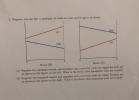 5. Suppose you can hire a mechanic to work on your car for up to six hours. MC I MBİ NIC ; 6 0 Hours (H) Hours (H) (a) Suppose the marginal benefit and marginal cost curves for your car repair decision are as shown in the figure on the left. What is the choice that maximizes your net benefit? (b) Suppose the marginal benefit and marginal cost curves for your car repair decision are as shown in the figure...
4. Suppose you can hire a mechanic to work on your car for up to six...
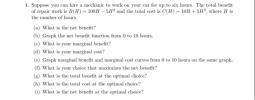 4. Suppose you can hire a mechanic to work on your car for up to six hours. The total benefit of repair work is B(H)-100H-5H2 and the total cost is C(H) = 10H + 5H2, where H is the number of hours. (a) What is the net benefit? (b) Graph the net benefit function from 0 to 10 hours (c) What is your marginal benefit? (d) What is your marginal cost? (e) Graph marginal benefit and marginal cost curves from...
4. Suppose you can hire a mechanic to work on your car for up to six...
 4. Suppose you can hire a mechanic to work on your car for up to six hours. The total benefit of repair work is B(H) 100H-5H2 and the total cost is C(H) 10H +5H2, where H is the number of hours. (a) What is the net benefit? (b) Graph the net benefit function from 0 to 10 hours. (c) What is your marginal benefit? (d) What is your marginal cost? (e) Graph marginal benefit and marginal cost curves from 0...
“If the cost of repairing your car goes up, you should do less of it.” Is...
 “If the cost of repairing your car goes up, you should do less
of it.” Is this statement correct? If you think the answer is yes,
explain why. If you think the answer is no, give an example in
which the best choice is higher when costs are higher.
電器3. MB MC Hours (H) Figure 1: Marginal Benefit versus Marginal Cost
“If the cost of repairing your car goes up, you should do less
of it.” Is this statement correct? If you think the answer is yes,
explain why. If you think the answer is no, give an example in
which the best choice is higher when costs are higher.
電器3. MB MC Hours (H) Figure 1: Marginal Benefit versus Marginal Cost
Question 2: Working with Marginal Benefits and Costs Suppose the total benefit derived from a continuous...
 Question 2: Working with Marginal Benefits and Costs Suppose the total benefit derived from a continuous decisions, Q, is B() 200-202 and the total cost from deciding Q is C(Q)-4Q +20. The marginal benefit (MB) and marginal cost (MC) is the first order derivative of these functions. MB)2040 and MC() 4 +40 (1) (4 points, 2 each) What is the total benefit when Q-2? Q-10? (2) (4 points, 2 each) What is the marginal benefit when Q-2? Q 10? (3)...
Suppose the total benefit derived from a continuous decisions, Q, is B(Q) = 20Q − 2Q...
Suppose the total benefit derived from a continuous decisions, Q, is B(Q) = 20Q − 2Q and the 2 total cost from deciding Q is C(Q) = 4Q + 2Q . The marginal benefit (MB) and marginal cost (MC) 2 is the first order derivative of these functions. MB(Q) = 20 − 4Q and MC(Q) = 4 + 4Q . (1) (4 points, 2 each) What is the total benefit when Q=2? Q=10? (2) (4 points, 2 each) What is...
Suppose that you bring your car to an auto mechanic. The auto mechanic, to get a...
Suppose that you bring your car to an auto mechanic. The auto mechanic, to get a better look at what’s broke, puts your car on a hydraulic lift, shown below in which there is an incompressible fluid of density € ρ = 900 kg m3 . A force € F1 is applied to a piston of area € A1 . This supports the weight of the car € F2 on the second piston of area € A2. Assume that both...
Question 2: Working with Marginal Benefits and Costs Suppose the total benefit derived from a continuous...
 Question 2: Working with Marginal Benefits and Costs Suppose the total benefit derived from a continuous decisions, Q, ís B(Q) = 200-202 and the total cost from deciding Q is C(O) 4+2Q. The marginal benefit (MB) and marginal cost (MC) is the first order derivative of these functions. MBO) 20-4 and MC(O) 4+40 (1) (4 points, 2 each) What is the total benefit when Q-2? Q-10? (2) (4 points, 2 each) What is the marginal benefit when Q-2? Q-10? (3)...
(1) Suppose that Ralf enjoys collecting morel mushrooms from the forest. The marginal benefit that he...
(1) Suppose that Ralf enjoys collecting morel mushrooms from the forest. The marginal benefit that he receives (in dollar terms) from each additional mushroom can be represented by the function MB = 42 – 4m (where m represents the quantity of mushrooms). Ralf’s marginal cost of collecting mushrooms is given (in dollar terms) by the function MC = 2m. A.How many morel mushrooms will Ralf optimally collect? In other words, what quantity of mushrooms maximizes Ralf's net benefits? Show your...
Suppose that Ralf enjoys collecting morel mushrooms from the forest. The marginal benefit that he receives...
Suppose that Ralf enjoys collecting morel mushrooms from the forest. The marginal benefit that he receives (in dollar terms) from each additional mushroom can be represented by the function MB = 42 – 4m (where m represents the quantity of mushrooms). Ralf’s marginal cost of collecting mushrooms is given (in dollar terms) by the function MC = 2m. How many morel mushrooms will Ralf optimally collect? In other words, what quantity of mushrooms maximizes Ralf's net benefits? Show your work...
 5. Suppose you can hire a mechanic to work on your car for up to six hours. MC I MBİ NIC ; 6 0 Hours (H) Hours (H) (a) Suppose the marginal benefit and marginal cost curves for your car repair decision are as shown in the figure on the left. What is the choice that maximizes your net benefit? (b) Suppose the marginal benefit and marginal cost curves for your car repair decision are as shown in the figure...
 4. Suppose you can hire a mechanic to work on your car for up to six hours. The total benefit of repair work is B(H)-100H-5H2 and the total cost is C(H) = 10H + 5H2, where H is the number of hours. (a) What is the net benefit? (b) Graph the net benefit function from 0 to 10 hours (c) What is your marginal benefit? (d) What is your marginal cost? (e) Graph marginal benefit and marginal cost curves from...
 4. Suppose you can hire a mechanic to work on your car for up to six hours. The total benefit of repair work is B(H) 100H-5H2 and the total cost is C(H) 10H +5H2, where H is the number of hours. (a) What is the net benefit? (b) Graph the net benefit function from 0 to 10 hours. (c) What is your marginal benefit? (d) What is your marginal cost? (e) Graph marginal benefit and marginal cost curves from 0...
 “If the cost of repairing your car goes up, you should do less
of it.” Is this statement correct? If you think the answer is yes,
explain why. If you think the answer is no, give an example in
which the best choice is higher when costs are higher.
電器3. MB MC Hours (H) Figure 1: Marginal Benefit versus Marginal Cost
“If the cost of repairing your car goes up, you should do less
of it.” Is this statement correct? If you think the answer is yes,
explain why. If you think the answer is no, give an example in
which the best choice is higher when costs are higher.
電器3. MB MC Hours (H) Figure 1: Marginal Benefit versus Marginal Cost
 Question 2: Working with Marginal Benefits and Costs Suppose the total benefit derived from a continuous decisions, Q, is B() 200-202 and the total cost from deciding Q is C(Q)-4Q +20. The marginal benefit (MB) and marginal cost (MC) is the first order derivative of these functions. MB)2040 and MC() 4 +40 (1) (4 points, 2 each) What is the total benefit when Q-2? Q-10? (2) (4 points, 2 each) What is the marginal benefit when Q-2? Q 10? (3)...
 Question 2: Working with Marginal Benefits and Costs Suppose the total benefit derived from a continuous decisions, Q, ís B(Q) = 200-202 and the total cost from deciding Q is C(O) 4+2Q. The marginal benefit (MB) and marginal cost (MC) is the first order derivative of these functions. MBO) 20-4 and MC(O) 4+40 (1) (4 points, 2 each) What is the total benefit when Q-2? Q-10? (2) (4 points, 2 each) What is the marginal benefit when Q-2? Q-10? (3)...
Most questions answered within 3 hours.
-
Where is the error in this code sequence?
String s1 = "Hello";
String s2 = "ello";...
asked 11 months ago -
Financial data for Joel de Paris, Inc., for last year
follow:
Joel de Paris, Inc.
Balance...
asked 11 months ago -
Consider this reaction:
Al2(SO4)3 (aq)+ BaCl3
(aq) Al2Cl6 (aq)- +
3BaSO4(s) . What is the...
asked 11 months ago -
Suppose that Savneet is considering increasing her
recent random sample from 20 car rentals to 40...
asked 11 months ago -
Trucks arrive at an unloading terminal at an average rate of 120
per hour.
Trucks arrive...
asked 11 months ago -
Why are methanol and ethanol completely soluble in water while
octanol is not very little soluble....
asked 11 months ago -
A facilities manager at a university reads in a research report
that the mean amount of...
asked 11 months ago -
When the CuSO4 is rehydrated by adding water to the anhydrous
compound, is this an endothermic...
asked 11 months ago -
A ray of sunlight is passing from diamond into crown glass; the
angle of incidence is...
asked 11 months ago -
A block of mass 0.249 kg is placed on top of a light, vertical
spring of...
asked 11 months ago -
how do the kidneys compensate in the presences of acidosis
a) trigger hyperventilate
b) reserve acid...
asked 11 months ago -
Question 501 pts
The rental rate of capital to the firm increases. Which of the
following...
asked 11 months ago