factors that don't precipitate am angina attack?
factors that don't precipitate am angina attack?
Homework Answers
Ans) Angina is chest pain or discomfort caused when your heart muscle doesn't get enough oxygen-rich blood. It may feel like pressure or squeezing in your chest. The discomfort also can occur in your shoulders, arms, neck, jaw, or back. Angina pain may even feel like indigestion. But, angina is not a disease.
- Factors that precipitate to angina attack:
These include factors such as severe anemia, fever, tachyarrhythmias, catecholamines, emotional stress, and hyperthyroidism, which increase myocardial oxygen demand.
- Other factors than this will surely not lead to angina.
Exercises (Class and homework) In a study of risk factors for angina (a chronic condition subjects...
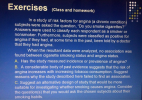 Exercises (Class and homework) In a study of risk factors for angina (a chronic condition subjects were asked the question, "Do you smoke cigarettes?" Answers were used to classify each respondent as a smoker or nonsmoker. Furthermore, subjects were classified as positive for angina if they had, at some time in the past, been told by a doctor that they had angina. When the resultant data were analyzed, no association was found between cigarette smoking status and angina status A....
11. A large international study of risk factors for heart attack showed that a. workplace stress...
11. A large international study of risk factors for heart attack showed that a. workplace stress was the only type of stress that predicted heart attack. b. several demographic factors were related to heart attack but no psychosocial factors. c. several types of stress were related to increased risk for heart attack. d. None of the above.
Five risk factors related to Transient Ischemic attack (mini stoke) disease process.
Five risk factors related to Transient Ischemic attack (mini stoke) disease process.
Defeating authentication follows the method-opportunity-motive paradigm .Discuss how these three factors apply to an attack on...
Defeating authentication follows the method-opportunity-motive paradigm .Discuss how these three factors apply to an attack on authentication.
Please Use your keyboard (Don't use handwriting) PHC 271 I need new and unique answers, please....
Please Use your keyboard (Don't use handwriting) PHC 271 I need new and unique answers, please. (Use your own words, don't copy and paste) Case Study A 55-year-old man presents to the clinic with complaints of chest pain. He states that for the past 5 months he has noted intermittent substernal chest pressure radiating to the left arm. The pain occurs primarily when exercising vigorously and is relieved with rest. He denies associated shortness of breath, nausea, vomiting, or diaphoresis....
drug choices to treat angina in older adults differ from those of younger adults only in...
drug choices to treat angina in older adults differ from those of younger adults only in a. consideration of risk factors associated with and increased in aging b. the placement of drug therapy as a treatment choice before lifestyle changes are tried c. the need for at least three drugs in the treatment regimen because of the complexity of angina in the older adult d. those with higher risk for silent myocardial infarction
I am proving this theorem and I don't understand this part.
 I am proving this theorem and I don't understand this
part.
We were unable to transcribe this imageヱdon't get-Hms part why is mTs correc+2
ヱdon't get-Hms part why is mTs correc+2
I am proving this theorem and I don't understand this
part.
We were unable to transcribe this imageヱdon't get-Hms part why is mTs correc+2
ヱdon't get-Hms part why is mTs correc+2
To prevent attacks of angina, isosorbide mononitrate is given twice daily typically at doses of 20...
To prevent attacks of angina, isosorbide mononitrate is given twice daily typically at doses of 20 mg. It is administered at specific times, such as 8 AM and 3 PM, to prevent nitrate tolerance, which causes the drug to be less effective. How many 10-mg tablets are required for 30 days of treatment? To prevent attacks of angina, isosorbide dinitrate is given typically at doses of 120 mg/day, divided into three separate doses. For one week’s regimen, how many 10-mg...
Following a heart attack, a physician orders a patient to begin taking a beta-blocker to treat...
Following a heart attack, a physician orders a patient to begin taking a beta-blocker to treat angina and hypertension. The tablets are available in 50 mg. If the physician gradually increases the patient's dosage, calculate the number of tablets required if the doctor requests 150 mg/day, 200 mg/day, and 225 mg/day.
To prevent attacks of angina, isosorbide mononitrate is given twice daily typically at doses of 20...
To prevent attacks of angina, isosorbide mononitrate is given twice daily typically at doses of 20 mg. It is administered at specific times, such as 8 AM and 3 PM, to prevent nitrate tolerance, which causes the drug to be less effective. How many 10-mg tablets are required for 30 days of treatment?
 Exercises (Class and homework) In a study of risk factors for angina (a chronic condition subjects were asked the question, "Do you smoke cigarettes?" Answers were used to classify each respondent as a smoker or nonsmoker. Furthermore, subjects were classified as positive for angina if they had, at some time in the past, been told by a doctor that they had angina. When the resultant data were analyzed, no association was found between cigarette smoking status and angina status A....
 I am proving this theorem and I don't understand this
part.
We were unable to transcribe this imageヱdon't get-Hms part why is mTs correc+2
ヱdon't get-Hms part why is mTs correc+2
I am proving this theorem and I don't understand this
part.
We were unable to transcribe this imageヱdon't get-Hms part why is mTs correc+2
ヱdon't get-Hms part why is mTs correc+2
Most questions answered within 3 hours.
-
Where is the error in this code sequence?
String s1 = "Hello";
String s2 = "ello";...
asked 10 months ago -
Financial data for Joel de Paris, Inc., for last year
follow:
Joel de Paris, Inc.
Balance...
asked 10 months ago -
Consider this reaction:
Al2(SO4)3 (aq)+ BaCl3
(aq) Al2Cl6 (aq)- +
3BaSO4(s) . What is the...
asked 10 months ago -
Suppose that Savneet is considering increasing her
recent random sample from 20 car rentals to 40...
asked 10 months ago -
Trucks arrive at an unloading terminal at an average rate of 120
per hour.
Trucks arrive...
asked 10 months ago -
Why are methanol and ethanol completely soluble in water while
octanol is not very little soluble....
asked 10 months ago -
A facilities manager at a university reads in a research report
that the mean amount of...
asked 10 months ago -
When the CuSO4 is rehydrated by adding water to the anhydrous
compound, is this an endothermic...
asked 10 months ago -
A ray of sunlight is passing from diamond into crown glass; the
angle of incidence is...
asked 10 months ago -
A block of mass 0.249 kg is placed on top of a light, vertical
spring of...
asked 10 months ago -
how do the kidneys compensate in the presences of acidosis
a) trigger hyperventilate
b) reserve acid...
asked 10 months ago -
Question 501 pts
The rental rate of capital to the firm increases. Which of the
following...
asked 10 months ago