
Homework Answers


Add Answer to:
A blob of putty of mass m moves with a speed 2v to the right, while...
A putty ball of inertia m moving at speed v slides on a slick surface along...
A putty ball of inertia m moving at speed v slides on a slick surface along a path that is perpendicular to the long axis of a rod of length ?and inertia 2m that is at rest on the surface. The ball collides with one end of the rod and sticks to it. Ignore any effects due to friction and use the notation l for the length of the rod ?. Part A: Just as the ball sticks, what is...
> m 3 M d 0 A projectile of mass m moves to the right with...
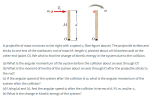 > m 3 M d 0 A projectile of mass m moves to the right with a speed v; (See figure above). The projectile strikes and sticks to one end of the stationary rod of mass M, length d, pivoted about a frictionless axle at the other end (point O). We wish to find the change of kinetic energy in the system due to the collision. (a) What is the angular momentum of the system before the collision about an...
Angular Momentum and Inelastic Collisions Two balls, each with mass M/2, are attached to the ends...
 Angular Momentum and Inelastic Collisions Two balls, each with mass M/2, are attached to the ends of a thin rod of length L = 0.45 m and negligible mass. The rod is free to rotate in a horizontal plane without friction about a fixed vertical axis through its center. With the rod initially at rest (as shown), two wads of wet putty hit the balls at the same time and stick to them. Assume that the wads of putty have...
An object of mass m moves to the right with speed v it collides head on...
An object of mass m moves to the right with speed v it collides head on with an object of mass 2m moving with speed v/3 in the opposite edirection. if the two objects stick together what is the speed and direction of the combined object of mass 3m after collision
Mass m = 0,1 kg moves to the right with speed v = 0.39 m/s and...
 Mass m = 0,1 kg moves to the right with speed v = 0.39 m/s and collides with an equal mass initially at rest. After this inelastic collision the system retains a fraction = 0.63 of its original kinetic energy. What is the speed VR (in m/s) of the mass which was originally at rest before the collision?
A projectile of mass m moves to the right with a speed vi (Fig. P11.50a). The projectile strikes and sticks to the en...
 A projectile of mass m moves to the right with a speed vi
(Fig. P11.50a). The projectile strikes and sticks to the end of a
stationary rod of mass M, of length d, that is pivoted about a
frictionless axle through its center (Fig. P11.50b).
a) Find the angular speed of the system right after the
collision. (Use vi, m, M, and d as appropriate in your
equation.)
(b) Determine the fractional loss in mechanical energy due to
the collision....
A projectile of mass m moves to the right with a speed vi
(Fig. P11.50a). The projectile strikes and sticks to the end of a
stationary rod of mass M, of length d, that is pivoted about a
frictionless axle through its center (Fig. P11.50b).
a) Find the angular speed of the system right after the
collision. (Use vi, m, M, and d as appropriate in your
equation.)
(b) Determine the fractional loss in mechanical energy due to
the collision....
A ball of mass m made of playdough moves with speed v. Another ball, of the...
 A ball of mass m made of playdough moves with speed v. Another ball, of the same mass, chases the first one with the speed 2v. Eventually, they collide and stick together after the collision. What is the speed of the combined object? Ov O 3mv/2 O 3v/2 O v/2
Mass m = 0.1 kg moves to the right with speed v = 0.57 m/s and...
Mass m = 0.1 kg moves to the right with speed v = 0.57 m/s and collides with an equal mass initially at rest. After this inelastic collision the system retains a fraction = 0.75 of its original kinetic energy. How much impulse (in units of N sec) does the mass originally at rest receive during the collision?
Mass m = 0.1 kg moves to the right with speed v = 0.52 m/s and...
 Mass m = 0.1 kg moves to the right with speed v = 0.52 m/s and collides with an equal mass initially at rest. After this inelastic collision the system retains a fraction=0.77 of its original kinetic energy. If the masses remain in contact for 0.01 secs while colliding, what is the magnitude of the average force in N between the masses during the collision? Hints: All motion is in 1D. Ignore friction between the masses and the horizontal surface....
Mass m = 0.1 kg moves to the right with speed v = 0.52 m/s and...
 Mass m = 0.1 kg moves to the right with speed v = 0.52 m/s and collides with an equal mass initially at rest. After this inelastic collision the system retains a fraction = 0.77 of its original kinetic energy. If the masses remain in contact for 0.01 secs while colliding, what is the magnitude of the average force in N between the masses during the collision? Hints: All motion is in 1D. Ignore friction between une masses and the...
 > m 3 M d 0 A projectile of mass m moves to the right with a speed v; (See figure above). The projectile strikes and sticks to one end of the stationary rod of mass M, length d, pivoted about a frictionless axle at the other end (point O). We wish to find the change of kinetic energy in the system due to the collision. (a) What is the angular momentum of the system before the collision about an...
 Angular Momentum and Inelastic Collisions Two balls, each with mass M/2, are attached to the ends of a thin rod of length L = 0.45 m and negligible mass. The rod is free to rotate in a horizontal plane without friction about a fixed vertical axis through its center. With the rod initially at rest (as shown), two wads of wet putty hit the balls at the same time and stick to them. Assume that the wads of putty have...
 Mass m = 0,1 kg moves to the right with speed v = 0.39 m/s and collides with an equal mass initially at rest. After this inelastic collision the system retains a fraction = 0.63 of its original kinetic energy. What is the speed VR (in m/s) of the mass which was originally at rest before the collision?
 A projectile of mass m moves to the right with a speed vi
(Fig. P11.50a). The projectile strikes and sticks to the end of a
stationary rod of mass M, of length d, that is pivoted about a
frictionless axle through its center (Fig. P11.50b).
a) Find the angular speed of the system right after the
collision. (Use vi, m, M, and d as appropriate in your
equation.)
(b) Determine the fractional loss in mechanical energy due to
the collision....
A projectile of mass m moves to the right with a speed vi
(Fig. P11.50a). The projectile strikes and sticks to the end of a
stationary rod of mass M, of length d, that is pivoted about a
frictionless axle through its center (Fig. P11.50b).
a) Find the angular speed of the system right after the
collision. (Use vi, m, M, and d as appropriate in your
equation.)
(b) Determine the fractional loss in mechanical energy due to
the collision....
 A ball of mass m made of playdough moves with speed v. Another ball, of the same mass, chases the first one with the speed 2v. Eventually, they collide and stick together after the collision. What is the speed of the combined object? Ov O 3mv/2 O 3v/2 O v/2
 Mass m = 0.1 kg moves to the right with speed v = 0.52 m/s and collides with an equal mass initially at rest. After this inelastic collision the system retains a fraction=0.77 of its original kinetic energy. If the masses remain in contact for 0.01 secs while colliding, what is the magnitude of the average force in N between the masses during the collision? Hints: All motion is in 1D. Ignore friction between the masses and the horizontal surface....
 Mass m = 0.1 kg moves to the right with speed v = 0.52 m/s and collides with an equal mass initially at rest. After this inelastic collision the system retains a fraction = 0.77 of its original kinetic energy. If the masses remain in contact for 0.01 secs while colliding, what is the magnitude of the average force in N between the masses during the collision? Hints: All motion is in 1D. Ignore friction between une masses and the...
Most questions answered within 3 hours.
-
Where is the error in this code sequence?
String s1 = "Hello";
String s2 = "ello";...
asked 11 months ago -
Financial data for Joel de Paris, Inc., for last year
follow:
Joel de Paris, Inc.
Balance...
asked 11 months ago -
Consider this reaction:
Al2(SO4)3 (aq)+ BaCl3
(aq) Al2Cl6 (aq)- +
3BaSO4(s) . What is the...
asked 11 months ago -
Suppose that Savneet is considering increasing her
recent random sample from 20 car rentals to 40...
asked 11 months ago -
Trucks arrive at an unloading terminal at an average rate of 120
per hour.
Trucks arrive...
asked 11 months ago -
Why are methanol and ethanol completely soluble in water while
octanol is not very little soluble....
asked 11 months ago -
A facilities manager at a university reads in a research report
that the mean amount of...
asked 11 months ago -
When the CuSO4 is rehydrated by adding water to the anhydrous
compound, is this an endothermic...
asked 11 months ago -
A ray of sunlight is passing from diamond into crown glass; the
angle of incidence is...
asked 11 months ago -
A block of mass 0.249 kg is placed on top of a light, vertical
spring of...
asked 11 months ago -
how do the kidneys compensate in the presences of acidosis
a) trigger hyperventilate
b) reserve acid...
asked 11 months ago -
Question 501 pts
The rental rate of capital to the firm increases. Which of the
following...
asked 11 months ago