
Homework Answers
Your final answers are towards the end of the solution:
Alternative B has the least capital investment, hence set B as base alternative. Alternative C is next low on capital investment. Hence, C is second choice alternative. We will calculate the incremental cash flows of C - B and find its IRR. Please see the table below. The last row contains IRR. Figures in parenthesis, if any, mean negative values. All financials are in $. Adjacent cells in blue contain the formula in excel I have used to get the final output.
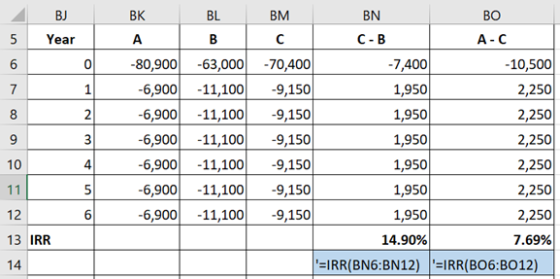
Please see the IRR of C - B. It's 14.90% > MARR of 10%. Hence, C should be selected over B and it is the current base alternative. In the last column, calculate the incremental cash flow of A over C, i.e. A - C. It's IRR is 7.69% < MARR of 10%. Hence, choose alternative C over A.
Hence your final answers should be:
Analyze the difference between the base alternative and the second-choice alternative.
IRR Δ(C - B) 14.90%. (Round to two decimal places.)
Analyze the difference between the current base alternative and the third -choice alternative.
IRR Δ(A - C) = 7.69%. (Round to two decimal places.)
Which alternative should be selected?
Option B. Alternative C
Add Answer to:
site The estimated negative cash flows for three design alternatives are shown below. The MARR is...
A firm is considering three mutually exclusive alternatives as part of an upgrade to an existing...
 A firm is considering three mutually exclusive alternatives as part of an upgrade to an existing transportation network. At EOY 10, alternative III would be replaced with another alternative Ill having the same installed cost and net annual revenues. If MARR is 10% per year, which alternative (if any) should be chosen? Use the incremental IRR procedure. $40,000 $6,500 $20,000 $5,200 Installed cost Net annual revenue Salvage value Useful life Calculated IRR $30,000 $5,600 0 20 years 18.0% 20 years...
Xanadu Mining is considering three mutually exclusive alternatives, as shown in the table below. MARR is...
 Xanadu Mining is considering three mutually exclusive alternatives, as shown in the table below. MARR is 10%/year. EOY A001 B002 2003 0 1 -$210 -$110 -$160 $80 $60 $80 $90 $60 $80 $100 $60 $80 $110 $70 $80 3 4 Clickhere to access the TVM Factor Table Calculator What is the future worth of each alternative? A001: $ B002: $ C003: $ Carry all interim calculations to 5 decimal places and then round your final answer to the nearest dollar....
The cash flows for three different alternatives are given in the table below. Assume n =...
 The cash flows for three different alternatives are given in the
table below. Assume n = 8 years. Develop a choice table. What is
the best alternative if MARR = 8%?
The cash flows for three different alternatives are given in the table below. Assume n 8 years. Develop a choice table. what is the best alternative if MARR-7% PLACE CHOICE TABLE BELOW First cost S2,000 6,000 5,000 enefit 75400 750 Salvage 150 Value 0
The cash flows for three different alternatives are given in the
table below. Assume n = 8 years. Develop a choice table. What is
the best alternative if MARR = 8%?
The cash flows for three different alternatives are given in the table below. Assume n 8 years. Develop a choice table. what is the best alternative if MARR-7% PLACE CHOICE TABLE BELOW First cost S2,000 6,000 5,000 enefit 75400 750 Salvage 150 Value 0
The question is comparing two alternatives with different IRR’s and PW’s with a general MARR of...
 The
question is comparing two alternatives with different IRR’s and
PW’s with a general MARR of 17%. The options are to choose
alternative A, B, or to do nothing. I got this question wrong when
working on it and don’t understand how to choose one alternative
over the other, or when to eliminate both.
4 of 4 (4 complete) This Question: 1 pt Given a MARR of 17%, which alternative should the company select? Alternative RR PW (17) 9899 13.7...
The
question is comparing two alternatives with different IRR’s and
PW’s with a general MARR of 17%. The options are to choose
alternative A, B, or to do nothing. I got this question wrong when
working on it and don’t understand how to choose one alternative
over the other, or when to eliminate both.
4 of 4 (4 complete) This Question: 1 pt Given a MARR of 17%, which alternative should the company select? Alternative RR PW (17) 9899 13.7...
Consider the following EOY cash flows for two mutually exclusive alternatives (one must be chosen). The...
 Consider the following EOY cash flows for two mutually exclusive alternatives (one must be chosen). The MARR is 12% per year. Capital Investment Annual expenses Useful life Market value at end of useful life Lead Acid $8,000 $2,250 12 years $0 Lithium lon $13,000 $2,300 18 years $2,800 Click the icon to view the interest and annuity table for discrete compounding when /= 12% per year. (a) Determine which altemative should be selected based on the PW method. Assume repeatabllity...
Three mutually exclusive investment alternatives are being considered. The estimated cash flows for each wernative we...
 Three mutually exclusive investment alternatives are being considered. The estimated cash flows for each wernative we given below. The study period is 30 years and the firm's MARR is 6% per year. Assume repeatability and reinvestment of positive cash balances at 6 per year a. What is the simple payback period for Alternative 1? b. What is the annual worth of Alternative 2? c. What is the IRR of the incremental cash flows of Alternative 2 compared to Aheative 1?...
Problems 4 The cash flows for three mutually exclusive alternatives are given in table below use...
 Problems 4 The cash flows for three mutually exclusive alternatives are given in table below use MARR = 4% Initial cost Annual benefits RoR Life in years Alt. A $11,000 $3.500 15% Alt. B $23,000 $6,500 13% Alt. C $20,000 $5,500 11% Which alternative should be selected based on a Payback period and () Net Future Worth analyses
One of the mutually exclusive alternatives below must be selected. Base your recommendation on A(Sauer-Glock) cash...
 One of the mutually exclusive alternatives below must be selected. Base your recommendation on A(Sauer-Glock) cash flows when the MARR = 8% per year. EOY EOY P/4 | 10 20 0 0 10 Glock 40 Sauer 45 The IRR on A(Sauer-Glock) is % (Round to two decimal places.)
Consider the following EOY cash flows for two mutually exclusive alternatives (one must be chosen). The...
 Consider the following EOY cash flows for two mutually
exclusive alternatives (one must be chosen). The MARR is 5% per
year.
I need the PW of the Lead Acid and Lithium Ion.
Problem 6-28 (algorithmic) EQuestion Help Consider the following EOY cash flows for two mutually exclusive alternatives (one must be chosen) The MARR is 5% per year ead Acid $7,000 thium lon Capital investment Annual expenses Useful life Market value at end of useful life $13,000 $2.500 $2,750 12...
Consider the following EOY cash flows for two mutually
exclusive alternatives (one must be chosen). The MARR is 5% per
year.
I need the PW of the Lead Acid and Lithium Ion.
Problem 6-28 (algorithmic) EQuestion Help Consider the following EOY cash flows for two mutually exclusive alternatives (one must be chosen) The MARR is 5% per year ead Acid $7,000 thium lon Capital investment Annual expenses Useful life Market value at end of useful life $13,000 $2.500 $2,750 12...
The following mutually exclusive investment alternatives have been presented to you. The life of all alternatives...
 The following mutually exclusive investment alternatives have been presented to you. The life of all alternatives is 10 years. A В C Capital investment Annual expenses $60,000 $90,000 $40,000 $30,000 $70,000 35,000 45,000 15,000 30,000 40,000 25,000 16,000 Annual revenues 50,000 52.000 38,000 28,000 Market value at EOY 10 15,000 10,000 10,000 39.0% 10,000 IRR ??? 7.4% 30.8% 9.2% After the base alternative has been identified, the first comparison to be made in an incremental analysis should be which of...
 A firm is considering three mutually exclusive alternatives as part of an upgrade to an existing transportation network. At EOY 10, alternative III would be replaced with another alternative Ill having the same installed cost and net annual revenues. If MARR is 10% per year, which alternative (if any) should be chosen? Use the incremental IRR procedure. $40,000 $6,500 $20,000 $5,200 Installed cost Net annual revenue Salvage value Useful life Calculated IRR $30,000 $5,600 0 20 years 18.0% 20 years...
 Xanadu Mining is considering three mutually exclusive alternatives, as shown in the table below. MARR is 10%/year. EOY A001 B002 2003 0 1 -$210 -$110 -$160 $80 $60 $80 $90 $60 $80 $100 $60 $80 $110 $70 $80 3 4 Clickhere to access the TVM Factor Table Calculator What is the future worth of each alternative? A001: $ B002: $ C003: $ Carry all interim calculations to 5 decimal places and then round your final answer to the nearest dollar....
 The cash flows for three different alternatives are given in the
table below. Assume n = 8 years. Develop a choice table. What is
the best alternative if MARR = 8%?
The cash flows for three different alternatives are given in the table below. Assume n 8 years. Develop a choice table. what is the best alternative if MARR-7% PLACE CHOICE TABLE BELOW First cost S2,000 6,000 5,000 enefit 75400 750 Salvage 150 Value 0
The cash flows for three different alternatives are given in the
table below. Assume n = 8 years. Develop a choice table. What is
the best alternative if MARR = 8%?
The cash flows for three different alternatives are given in the table below. Assume n 8 years. Develop a choice table. what is the best alternative if MARR-7% PLACE CHOICE TABLE BELOW First cost S2,000 6,000 5,000 enefit 75400 750 Salvage 150 Value 0
 The
question is comparing two alternatives with different IRR’s and
PW’s with a general MARR of 17%. The options are to choose
alternative A, B, or to do nothing. I got this question wrong when
working on it and don’t understand how to choose one alternative
over the other, or when to eliminate both.
4 of 4 (4 complete) This Question: 1 pt Given a MARR of 17%, which alternative should the company select? Alternative RR PW (17) 9899 13.7...
The
question is comparing two alternatives with different IRR’s and
PW’s with a general MARR of 17%. The options are to choose
alternative A, B, or to do nothing. I got this question wrong when
working on it and don’t understand how to choose one alternative
over the other, or when to eliminate both.
4 of 4 (4 complete) This Question: 1 pt Given a MARR of 17%, which alternative should the company select? Alternative RR PW (17) 9899 13.7...
 Consider the following EOY cash flows for two mutually exclusive alternatives (one must be chosen). The MARR is 12% per year. Capital Investment Annual expenses Useful life Market value at end of useful life Lead Acid $8,000 $2,250 12 years $0 Lithium lon $13,000 $2,300 18 years $2,800 Click the icon to view the interest and annuity table for discrete compounding when /= 12% per year. (a) Determine which altemative should be selected based on the PW method. Assume repeatabllity...
 Three mutually exclusive investment alternatives are being considered. The estimated cash flows for each wernative we given below. The study period is 30 years and the firm's MARR is 6% per year. Assume repeatability and reinvestment of positive cash balances at 6 per year a. What is the simple payback period for Alternative 1? b. What is the annual worth of Alternative 2? c. What is the IRR of the incremental cash flows of Alternative 2 compared to Aheative 1?...
 Problems 4 The cash flows for three mutually exclusive alternatives are given in table below use MARR = 4% Initial cost Annual benefits RoR Life in years Alt. A $11,000 $3.500 15% Alt. B $23,000 $6,500 13% Alt. C $20,000 $5,500 11% Which alternative should be selected based on a Payback period and () Net Future Worth analyses
 One of the mutually exclusive alternatives below must be selected. Base your recommendation on A(Sauer-Glock) cash flows when the MARR = 8% per year. EOY EOY P/4 | 10 20 0 0 10 Glock 40 Sauer 45 The IRR on A(Sauer-Glock) is % (Round to two decimal places.)
 Consider the following EOY cash flows for two mutually
exclusive alternatives (one must be chosen). The MARR is 5% per
year.
I need the PW of the Lead Acid and Lithium Ion.
Problem 6-28 (algorithmic) EQuestion Help Consider the following EOY cash flows for two mutually exclusive alternatives (one must be chosen) The MARR is 5% per year ead Acid $7,000 thium lon Capital investment Annual expenses Useful life Market value at end of useful life $13,000 $2.500 $2,750 12...
Consider the following EOY cash flows for two mutually
exclusive alternatives (one must be chosen). The MARR is 5% per
year.
I need the PW of the Lead Acid and Lithium Ion.
Problem 6-28 (algorithmic) EQuestion Help Consider the following EOY cash flows for two mutually exclusive alternatives (one must be chosen) The MARR is 5% per year ead Acid $7,000 thium lon Capital investment Annual expenses Useful life Market value at end of useful life $13,000 $2.500 $2,750 12...
 The following mutually exclusive investment alternatives have been presented to you. The life of all alternatives is 10 years. A В C Capital investment Annual expenses $60,000 $90,000 $40,000 $30,000 $70,000 35,000 45,000 15,000 30,000 40,000 25,000 16,000 Annual revenues 50,000 52.000 38,000 28,000 Market value at EOY 10 15,000 10,000 10,000 39.0% 10,000 IRR ??? 7.4% 30.8% 9.2% After the base alternative has been identified, the first comparison to be made in an incremental analysis should be which of...
Most questions answered within 3 hours.
-
Where is the error in this code sequence?
String s1 = "Hello";
String s2 = "ello";...
asked 10 months ago -
Financial data for Joel de Paris, Inc., for last year
follow:
Joel de Paris, Inc.
Balance...
asked 10 months ago -
Consider this reaction:
Al2(SO4)3 (aq)+ BaCl3
(aq) Al2Cl6 (aq)- +
3BaSO4(s) . What is the...
asked 10 months ago -
Suppose that Savneet is considering increasing her
recent random sample from 20 car rentals to 40...
asked 10 months ago -
Trucks arrive at an unloading terminal at an average rate of 120
per hour.
Trucks arrive...
asked 10 months ago -
Why are methanol and ethanol completely soluble in water while
octanol is not very little soluble....
asked 10 months ago -
A facilities manager at a university reads in a research report
that the mean amount of...
asked 10 months ago -
When the CuSO4 is rehydrated by adding water to the anhydrous
compound, is this an endothermic...
asked 10 months ago -
A ray of sunlight is passing from diamond into crown glass; the
angle of incidence is...
asked 10 months ago -
A block of mass 0.249 kg is placed on top of a light, vertical
spring of...
asked 10 months ago -
how do the kidneys compensate in the presences of acidosis
a) trigger hyperventilate
b) reserve acid...
asked 10 months ago -
Question 501 pts
The rental rate of capital to the firm increases. Which of the
following...
asked 10 months ago