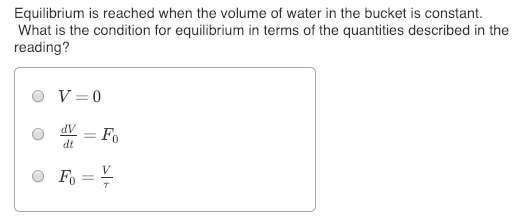
Equilibrium is reached when the volume of water in the bucket is constant. What is the condition for equilibrium in terms of the quantities described in the reading?
Homework Answers
The equilibrium takes place when volume is constant, that means the time derivative of volume should be zero. Hence 2nd option is not valid.
For 1st option, zero volume doesn't corresponds to any system at equilibrium, hence 1st option is also not true.
For the third option, volume is constant as F nut is a constant value and tau is the initial time which is constant. Hence 3rd option is true .
Add Answer to:
Equilibrium is reached when the volume of water in the bucket is constant. What is the...
A Styrofoam bucket of negligible mass contains 1.55 kg of water and 0.435 kg of ice....
A Styrofoam bucket of negligible mass contains 1.55 kg of water and 0.435 kg of ice. More ice, from a refrigerator at -15.0 ∘C, is added to the mixture in the bucket, and when thermal equilibrium has been reached, the total mass of ice in the bucket is 0.772 kg . Assuming no heat exchange with the surroundings, what mass of ice was added?
a. water is to be raised from a well 40 feet deep by means of a bucket attached to a rope. When the bucket is Ib 12. Water is wder it weighs 50 lb, but the bucket has a leak that causes it to l...
 a. water is to be raised from a well 40 feet deep by means of a bucket attached to a rope. When the bucket is Ib 12. Water is wder it weighs 50 lb, but the bucket has a leak that causes it to lose water at a constant rate of 3 for every 7 feet that the i full of water it wei bucket is raised.. Neglecting the weight of the rope, set up and evaluate fthe he work...
please explain briefly, step by step. z() Consider a bucket of water spinning with constant angular...
 please explain briefly, step by step.
z() Consider a bucket of water spinning with constant angular speed w. We interested in finding the shape of the water's surface, z(r). We do this by first noting that in the rotating frame of the bucket, a small water elem mass m on the surface of the water is in static equilibrium. The figure shows the three forces acting on the water element: Centrifugal force Fc, gravity Fg and the normal force n...
please explain briefly, step by step.
z() Consider a bucket of water spinning with constant angular speed w. We interested in finding the shape of the water's surface, z(r). We do this by first noting that in the rotating frame of the bucket, a small water elem mass m on the surface of the water is in static equilibrium. The figure shows the three forces acting on the water element: Centrifugal force Fc, gravity Fg and the normal force n...
A 3.2 kg block of copper at a temperature of 82°C is dropped into a bucket...
A 3.2 kg block of copper at a temperature of 82°C is dropped into a bucket containing a mixture of ice and water whose total mass is 1.2 kg. When thermal equilibrium is reached the temperature of the water is 8°C. How much ice was in the bucket before the copper block was placed in it? (Neglect the heat capacity of the bucket.) answer in kg
Classical Mechanics problem: A bucket of water is set spinning about its symmetry axis with an...
Classical Mechanics problem: A bucket of water is set spinning about its symmetry axis with an angular velocity of magnitude Ω. What is the shape of the water surface after it has reached equilibrium? HINT: The surface of the water is an equipotential under the combined effects of gravity and the centrifugal force. The shape is one you are familiar with and using cylindrical polar coordinates
A block is suspended from a scale and then lowered into a bucket of water. The...
A block is suspended from a scale and then lowered into a bucket of water. The density of the water is 1 gm/cm3. The initial reading on the scale is 19N and one complete revolution after 3 min of the scale is a change of 10N. 1. What is the volume of the block? 750 cm3 850 cm3 1100 cm3 1425 cm3 2400 cm3 2. What is the density of the block? 1.2 gm/cm3 1.8 gm/cm3 2.4 gm/cm3 3.5 gm/cm3...
A 6kg bucket of water is being pulled straight up by a string at a constant speed. I determined that the tension on the...
A 6kg bucket of water is being pulled straight up by a string at a constant speed. I determined that the tension on the string was F = ma F = (6kg * 9.8 m/s2) * 0a F = 58.8 N Now its asking At a certain point the speed of the bucket begins to change. The bucket now has an upward constant acceleration of magnitude 3 m/s2. What is the tension in the rope now? The correct answer was...
2NOBr(g) - 2NO (g) + Br2 (g) Reached equilibrium when the concentrations were: [NOBr] = 0.10...
2NOBr(g) - 2NO (g) + Br2 (g) Reached equilibrium when the concentrations were: [NOBr] = 0.10 M, [NO] = 0.010 M, and [Br2] = 0.0050 M . What Is the equilibrium constant for this reaction
Write the equilibrium constant for the dissociation of water. Rewrite it in terms of the ionization...
Write the equilibrium constant for the dissociation of water. Rewrite it in terms of the ionization of water constant Kw. The concentration of hydronium and hydroxide equals what value?
A 6-kg bucket of water is being pulled straight up by a string at a constant...
A 6-kg bucket of water is being pulled straight up by a string at a constant speed. What is the tension in the rope? A) about 42 N B) about 60 N C) about 78 N
 a. water is to be raised from a well 40 feet deep by means of a bucket attached to a rope. When the bucket is Ib 12. Water is wder it weighs 50 lb, but the bucket has a leak that causes it to lose water at a constant rate of 3 for every 7 feet that the i full of water it wei bucket is raised.. Neglecting the weight of the rope, set up and evaluate fthe he work...
 please explain briefly, step by step.
z() Consider a bucket of water spinning with constant angular speed w. We interested in finding the shape of the water's surface, z(r). We do this by first noting that in the rotating frame of the bucket, a small water elem mass m on the surface of the water is in static equilibrium. The figure shows the three forces acting on the water element: Centrifugal force Fc, gravity Fg and the normal force n...
please explain briefly, step by step.
z() Consider a bucket of water spinning with constant angular speed w. We interested in finding the shape of the water's surface, z(r). We do this by first noting that in the rotating frame of the bucket, a small water elem mass m on the surface of the water is in static equilibrium. The figure shows the three forces acting on the water element: Centrifugal force Fc, gravity Fg and the normal force n...
Most questions answered within 3 hours.
-
Where is the error in this code sequence?
String s1 = "Hello";
String s2 = "ello";...
asked 11 months ago -
Financial data for Joel de Paris, Inc., for last year
follow:
Joel de Paris, Inc.
Balance...
asked 11 months ago -
Consider this reaction:
Al2(SO4)3 (aq)+ BaCl3
(aq) Al2Cl6 (aq)- +
3BaSO4(s) . What is the...
asked 11 months ago -
Suppose that Savneet is considering increasing her
recent random sample from 20 car rentals to 40...
asked 11 months ago -
Trucks arrive at an unloading terminal at an average rate of 120
per hour.
Trucks arrive...
asked 11 months ago -
Why are methanol and ethanol completely soluble in water while
octanol is not very little soluble....
asked 11 months ago -
A facilities manager at a university reads in a research report
that the mean amount of...
asked 11 months ago -
When the CuSO4 is rehydrated by adding water to the anhydrous
compound, is this an endothermic...
asked 11 months ago -
A ray of sunlight is passing from diamond into crown glass; the
angle of incidence is...
asked 11 months ago -
A block of mass 0.249 kg is placed on top of a light, vertical
spring of...
asked 11 months ago -
how do the kidneys compensate in the presences of acidosis
a) trigger hyperventilate
b) reserve acid...
asked 11 months ago -
Question 501 pts
The rental rate of capital to the firm increases. Which of the
following...
asked 11 months ago