![In the estimation of the chloride why is excess silver nitrate added to the sample?[2] Excess AgNO3](http://img.homeworklib.com/questions/09b3b280-72f6-11ea-8f11-f59a7e1d631b.png?x-oss-process=image/resize,w_560)
Homework Answers
Excess AgNO3 is added so that all chloride ions react with it and remaining Ag+ ions are back titrated to determine the concentration of chloride ions reacted.
Add Answer to:
In the estimation of the chloride why is excess silver nitrate added to the sample?[2] Excess...
Silver nitrate is reacted with excess copper (II) chloride, producing solid silver chloride precipitate. If 25.5g...
Silver nitrate is reacted with excess copper (II) chloride, producing solid silver chloride precipitate. If 25.5g of silver nitrate is reacted and there is a 77.0% yield of silver chloride, how much silver was initially present? AgNO3 (s) + CuCl2 (aq) → AgCl (s) + Cu(NO3)2 (aq)
When solutions of calcium chloride and silver nitrate are mixed, silver chloride and calcium nitrate are...
 When solutions of calcium chloride and silver nitrate are mixed, silver chloride and calcium nitrate are produced. CaCl2 + 2 AgNO3 --> 2 AgCl + Ca(NO3)2 How many grams of silver chloride are formed when 59 grams of AgNO3 react with excess calcium chloride? Please include units in your answer and round to 2 decimal places. Answer: Check Next page
For the following reaction, 5.09 grams of iron(II) chloride are mixed with excess silver nitrate Assume...
 For the following reaction, 5.09 grams of iron(II) chloride are mixed with excess silver nitrate Assume that the percent yield of iron(II) nitrate is 93.4% Iron(II) chloride(aq) + silver nitrate(aq) iron(II) nitrate(aq) + silver chloride(s) What is the ideal yield of iron(II) nitrate? What is the actual yield of iron(II) nitrate? grams grams Submit ANSWER Retry Entire Group 2 more group attempts remaining The equation for this reaction is: FeCl2(aq) + 2 AgNO3(aq) - Fe(NO3)2(aq) + 2 AgCl(s)
Silver nitrate is a reagent used to suppress chloride interference in the estimation of organic content...
Silver nitrate is a reagent used to suppress chloride interference in the estimation of organic content in waste water samples. Silver sulfate is produced using silver nitrate. Determine whether any precipitate is formed when 0.025 L of 0.010 M silver nitrate is mixed with 170.0 mL of 0.003 M magnesium sulfate.
solid silver nitrate, AgNO3 is slowly added to a solution containing 0.2M chloride ion and 0.3M...
solid silver nitrate, AgNO3 is slowly added to a solution containing 0.2M chloride ion and 0.3M chromate ion. Assume that the addition of the solid causes no volume change. Which will precipitate first, the silver chloride or the silver chromate? For AgCl, Ksp = 1.81x10⁻¹⁰, for Ag2CrO4 Ksp = 1.12x10⁻¹²
046. 0.12 g of sample containing chloride ions requires 20 mls of O.IM KSCN when 25...
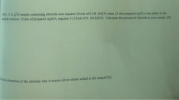 046. 0.12 g of sample containing chloride ions requires 20 mls of O.IM KSCN when 25 mis prepared AgNO, was added to the Sample solution. 25mls of prepared AgNO, requires 31.25mls of 0. IM KSCN. Calculate the percent of chloride in your sample. [8] In the estimation of the chlo on of the chloride why is excess silver nitrate added to the sample?[2]
I need help with questions 3 and 4!! 3. Calculate the normality of the silver nitrate...
 I need help with questions 3 and 4!!
3. Calculate the normality of the silver nitrate solution and percent chloride in the sample: 352.4 mg pure KCl require 48.33 ml AgNO3 solution 323.3 mg of unknown requires 32.02 ml AgNO3 solution Calculate the titration error. 4. A sample of silver alloy weighing 984.6 mg was dissolved in nitric acid. The solution was neutralized, and 252.2 mg of pure NaCl added. The excess chloride required 19.09 ml of 0.0935 N AgNO3...
I need help with questions 3 and 4!!
3. Calculate the normality of the silver nitrate solution and percent chloride in the sample: 352.4 mg pure KCl require 48.33 ml AgNO3 solution 323.3 mg of unknown requires 32.02 ml AgNO3 solution Calculate the titration error. 4. A sample of silver alloy weighing 984.6 mg was dissolved in nitric acid. The solution was neutralized, and 252.2 mg of pure NaCl added. The excess chloride required 19.09 ml of 0.0935 N AgNO3...
For the following reaction, 4.96 grams of iron(II) chloride are mixed with excess silver nitrate. The...
For the following reaction, 4.96 grams of iron(II) chloride are mixed with excess silver nitrate. The reaction yields 5.72 grams of iron(II) nitrate. iron(II) chloride (aq) + silver nitrate (aq) ---> iron(II) nitrate (aq) + silver chloride (s) a. What is the theoretical yield of iron (ll) nitrate? b. What is the percent yield of iron (ll) nitrate?
if 12.58 mL of silver nitrate soluation combines with an excess of potassium chloride solution to...
if 12.58 mL of silver nitrate soluation combines with an excess of potassium chloride solution to yield 0.05885 mol of precipitate, what is the molarity of the silver nitrate solution?
a When solutions of silver nitrate and sodium chloride are mixed, silver chloride precipitates out of...
a When solutions of silver nitrate and sodium chloride are mixed, silver chloride precipitates out of solution according to the equation AgNO3(aq)+NaCl(aq)→AgCl(s)+NaNO3(aq) Part A What mass of silver chloride can be produced from 1.51 L of a 0.293 M solution of silver nitrate? Express your answer with the appropriate units. b. The reaction described in Part A required 3.54 L of sodium chloride. What is the concentration of this sodium chloride solution? Express your answer with the appropriate units.
 When solutions of calcium chloride and silver nitrate are mixed, silver chloride and calcium nitrate are produced. CaCl2 + 2 AgNO3 --> 2 AgCl + Ca(NO3)2 How many grams of silver chloride are formed when 59 grams of AgNO3 react with excess calcium chloride? Please include units in your answer and round to 2 decimal places. Answer: Check Next page
 For the following reaction, 5.09 grams of iron(II) chloride are mixed with excess silver nitrate Assume that the percent yield of iron(II) nitrate is 93.4% Iron(II) chloride(aq) + silver nitrate(aq) iron(II) nitrate(aq) + silver chloride(s) What is the ideal yield of iron(II) nitrate? What is the actual yield of iron(II) nitrate? grams grams Submit ANSWER Retry Entire Group 2 more group attempts remaining The equation for this reaction is: FeCl2(aq) + 2 AgNO3(aq) - Fe(NO3)2(aq) + 2 AgCl(s)
 046. 0.12 g of sample containing chloride ions requires 20 mls of O.IM KSCN when 25 mis prepared AgNO, was added to the Sample solution. 25mls of prepared AgNO, requires 31.25mls of 0. IM KSCN. Calculate the percent of chloride in your sample. [8] In the estimation of the chlo on of the chloride why is excess silver nitrate added to the sample?[2]
 I need help with questions 3 and 4!!
3. Calculate the normality of the silver nitrate solution and percent chloride in the sample: 352.4 mg pure KCl require 48.33 ml AgNO3 solution 323.3 mg of unknown requires 32.02 ml AgNO3 solution Calculate the titration error. 4. A sample of silver alloy weighing 984.6 mg was dissolved in nitric acid. The solution was neutralized, and 252.2 mg of pure NaCl added. The excess chloride required 19.09 ml of 0.0935 N AgNO3...
I need help with questions 3 and 4!!
3. Calculate the normality of the silver nitrate solution and percent chloride in the sample: 352.4 mg pure KCl require 48.33 ml AgNO3 solution 323.3 mg of unknown requires 32.02 ml AgNO3 solution Calculate the titration error. 4. A sample of silver alloy weighing 984.6 mg was dissolved in nitric acid. The solution was neutralized, and 252.2 mg of pure NaCl added. The excess chloride required 19.09 ml of 0.0935 N AgNO3...
Most questions answered within 3 hours.
-
Where is the error in this code sequence?
String s1 = "Hello";
String s2 = "ello";...
asked 11 months ago -
Financial data for Joel de Paris, Inc., for last year
follow:
Joel de Paris, Inc.
Balance...
asked 11 months ago -
Consider this reaction:
Al2(SO4)3 (aq)+ BaCl3
(aq) Al2Cl6 (aq)- +
3BaSO4(s) . What is the...
asked 11 months ago -
Suppose that Savneet is considering increasing her
recent random sample from 20 car rentals to 40...
asked 11 months ago -
Trucks arrive at an unloading terminal at an average rate of 120
per hour.
Trucks arrive...
asked 11 months ago -
Why are methanol and ethanol completely soluble in water while
octanol is not very little soluble....
asked 11 months ago -
A facilities manager at a university reads in a research report
that the mean amount of...
asked 11 months ago -
When the CuSO4 is rehydrated by adding water to the anhydrous
compound, is this an endothermic...
asked 11 months ago -
A ray of sunlight is passing from diamond into crown glass; the
angle of incidence is...
asked 11 months ago -
A block of mass 0.249 kg is placed on top of a light, vertical
spring of...
asked 11 months ago -
how do the kidneys compensate in the presences of acidosis
a) trigger hyperventilate
b) reserve acid...
asked 11 months ago -
Question 501 pts
The rental rate of capital to the firm increases. Which of the
following...
asked 11 months ago