

Homework Answers
Add Answer to:
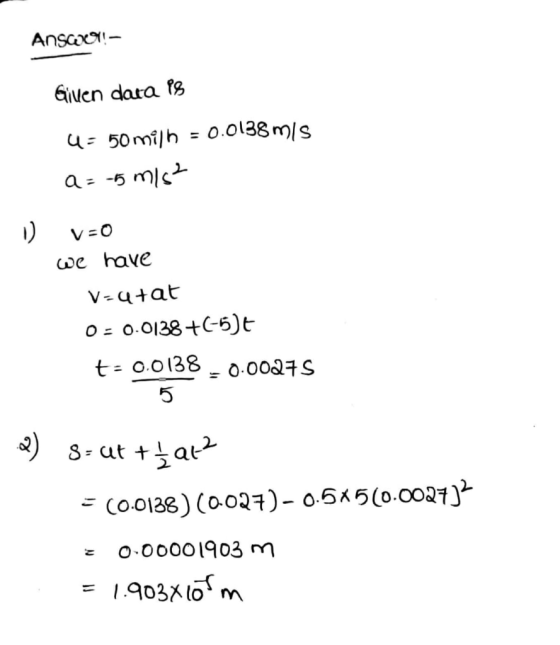
1 If you are moving at 50mila and you brake with a=-5m/s , how long does...
Assume that the driver of a car has to panic brake to a dead stop. If...
 Assume that the driver of a car has to panic brake to a dead stop. If the car is capable of sustaining a 2g deceleration, and the car travels 200 feet before stopping, how fast, in nds, did it take the car to come to a complete stop? (2 points)
A bullet moving at 393.06 m/s strikes a tree and penetrates a distance of 21.36 mm...
A bullet moving at 393.06 m/s strikes a tree and penetrates a distance of 21.36 mm before stopping. Assuming a constant acceleration, how long did it take the bullet to stop?
The distance required for a car to come to a stop will vary depending on how...
 The distance required for a car to come to a stop will vary depending on how fast the car is moving. Suppose that a certain car traveling down the road at a speed of 20 m/s can come to a complete stop within a distance of 80 m. Assuming the road conditions remain the same, what would be the stopping distance required for the same car if it were moving at speeds of 10 m/s, 40 m/s, or 5 m/s...
1. A bullet moving at 200 m/sec strikes a tree and penetrates a distance of 0.75...
 1. A bullet moving at 200 m/sec strikes a tree and penetrates a distance of 0.75 cm into the tree before stopping. What was the deceleration of the bullet? How long did it take the bullet to stop? Assume constant deceleration.
A 2 kg mass traveling at 5m/s undergoes a constant acceleration and comes to a stop...
A 2 kg mass traveling at 5m/s undergoes a constant acceleration and comes to a stop in 10 seconds. a) what acceleration does it experience? b) how far does it go during the time it is coming to a stop? c) What net force does the mass experience as it comes to a stop? A 75 kg mass accelerates from rest at a rate of 2m/s2 over a distance of 50m a) How fast is it going after covering a...
On a dry road a car with good tires may be able to brake with a...
 On a dry road a car with good tires may be able to brake with a deceleration of 5.50 m/s2. How long does it take this car initially traveling at 22.9 m/s to come to 4.1636 s You are correct. receipt no. is 157-1237 Previous Tries How far does the car travel in this time? Submit Answer Tries 0/10
How do it? 88.8% Give Up? Resources Hint 27.0 m/s begins to brake by applying a...
 How
do it?
88.8% Give Up? Resources Hint 27.0 m/s begins to brake by applying a velocity-dependent instantaneous acceleration A train traveling at vo m/s U+u a(u) = where a -21.0 m2/s', v is the instantaneous velocity of the train, and u = 0.8 m/s. Determine the distance D traveled by the train before it comes to a complete stop. D= help tems of use contact us privacy polcy about us careers ASUS VivoBook
How
do it?
88.8% Give Up? Resources Hint 27.0 m/s begins to brake by applying a velocity-dependent instantaneous acceleration A train traveling at vo m/s U+u a(u) = where a -21.0 m2/s', v is the instantaneous velocity of the train, and u = 0.8 m/s. Determine the distance D traveled by the train before it comes to a complete stop. D= help tems of use contact us privacy polcy about us careers ASUS VivoBook
You are traveling at 50 mph (22 m/s) when you see that far ahead traffic has...
You are traveling at 50 mph (22 m/s) when you see that far ahead traffic has come to a stop. You press on the brake causing an acceleration (deceleration) of -3.3 m/s^2 until you come to a stop. How much time does it take to come to a stop after you began braking? (answer to the nearest 0.1 second, giving the numerical value without units)
A ball is thrown directly upward with initial velocity 35.2 m/s. How long does it take...
A ball is thrown directly upward with initial velocity 35.2 m/s. How long does it take for the ball to come to a stop, in seconds?
You are traveling at 50 mph (22 m/s) when you see that far ahead traffic has...
You are traveling at 50 mph (22 m/s) when you see that far ahead traffic has come to a stop. You press on the brake causing an acceleration (deceleration) of -3.6 until you come to a stop. How much time does it take to come to a stop after you began braking? (answer to the nearest 0.1 second, giving the numerical value without units)
 Assume that the driver of a car has to panic brake to a dead stop. If the car is capable of sustaining a 2g deceleration, and the car travels 200 feet before stopping, how fast, in nds, did it take the car to come to a complete stop? (2 points)
 The distance required for a car to come to a stop will vary depending on how fast the car is moving. Suppose that a certain car traveling down the road at a speed of 20 m/s can come to a complete stop within a distance of 80 m. Assuming the road conditions remain the same, what would be the stopping distance required for the same car if it were moving at speeds of 10 m/s, 40 m/s, or 5 m/s...
 1. A bullet moving at 200 m/sec strikes a tree and penetrates a distance of 0.75 cm into the tree before stopping. What was the deceleration of the bullet? How long did it take the bullet to stop? Assume constant deceleration.
 On a dry road a car with good tires may be able to brake with a deceleration of 5.50 m/s2. How long does it take this car initially traveling at 22.9 m/s to come to 4.1636 s You are correct. receipt no. is 157-1237 Previous Tries How far does the car travel in this time? Submit Answer Tries 0/10
 How
do it?
88.8% Give Up? Resources Hint 27.0 m/s begins to brake by applying a velocity-dependent instantaneous acceleration A train traveling at vo m/s U+u a(u) = where a -21.0 m2/s', v is the instantaneous velocity of the train, and u = 0.8 m/s. Determine the distance D traveled by the train before it comes to a complete stop. D= help tems of use contact us privacy polcy about us careers ASUS VivoBook
How
do it?
88.8% Give Up? Resources Hint 27.0 m/s begins to brake by applying a velocity-dependent instantaneous acceleration A train traveling at vo m/s U+u a(u) = where a -21.0 m2/s', v is the instantaneous velocity of the train, and u = 0.8 m/s. Determine the distance D traveled by the train before it comes to a complete stop. D= help tems of use contact us privacy polcy about us careers ASUS VivoBook
Most questions answered within 3 hours.
-
Where is the error in this code sequence?
String s1 = "Hello";
String s2 = "ello";...
asked 11 months ago -
Financial data for Joel de Paris, Inc., for last year
follow:
Joel de Paris, Inc.
Balance...
asked 11 months ago -
Consider this reaction:
Al2(SO4)3 (aq)+ BaCl3
(aq) Al2Cl6 (aq)- +
3BaSO4(s) . What is the...
asked 11 months ago -
Suppose that Savneet is considering increasing her
recent random sample from 20 car rentals to 40...
asked 11 months ago -
Trucks arrive at an unloading terminal at an average rate of 120
per hour.
Trucks arrive...
asked 11 months ago -
Why are methanol and ethanol completely soluble in water while
octanol is not very little soluble....
asked 11 months ago -
A facilities manager at a university reads in a research report
that the mean amount of...
asked 11 months ago -
When the CuSO4 is rehydrated by adding water to the anhydrous
compound, is this an endothermic...
asked 11 months ago -
A ray of sunlight is passing from diamond into crown glass; the
angle of incidence is...
asked 11 months ago -
A block of mass 0.249 kg is placed on top of a light, vertical
spring of...
asked 11 months ago -
how do the kidneys compensate in the presences of acidosis
a) trigger hyperventilate
b) reserve acid...
asked 11 months ago -
Question 501 pts
The rental rate of capital to the firm increases. Which of the
following...
asked 11 months ago