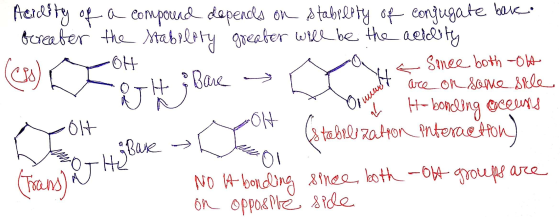
cis-cyclohexane-1,2-diol is more acidic than trans-cyclohexane-1,2-diol. Based on charge stability, explain why this is the case?
cis-cyclohexane-1,2-diol is more acidic than trans-cyclohexane-1,2-diol. Based on charge stability, explain why this is the case?
Homework Answers
Add Answer to:
cis-cyclohexane-1,2-diol is more acidic than
trans-cyclohexane-1,2-diol. Based on charge stability, explain why
this is the case?
PART B: Cyclohexane Procedures: 1. Make a model of cis-1,2-dimethylcyclohexane and trans-1,2-dimethylcyclohexane. Do a ring flip...
PART B: Cyclohexane Procedures: 1. Make a model of cis-1,2-dimethylcyclohexane and trans-1,2-dimethylcyclohexane. Do a ring flip of both *Draw the two conformation of the cis and trans cyclohexane structures above *List the number of axial and equatorial substituents for both the cis and trans *Which isomer is more stable overall, cis or trans? Why? 2. Make a model cis-1,3-dimethylcyclohexane and trans-1,3-dimethylcyclohexane. Do a ring flip *Draw the two conformation of the cis and trans cyclohexane structures above *List the number...
We learned that to create vicinal diols from alkenes, the cis-1,2-diol or trans-1,2 diol required very...
 We learned that to create vicinal diols from alkenes, the cis-1,2-diol or trans-1,2 diol required very different reagents. This isn't always the case and one notable reaction that defies this convention is the Prévost reaction! (4 points) To make the cis-diol, we typically use osmium tetroxide (catalytic amounts!). What other reagent combination would work for this particular transformation? a. OH OH (rac b. (4 points) To make the trans-diol, what reagent combination would be employed? ?? 1F2 OH (4 points)...
The heat of combustion of cis-1,2-dimethylcyclopropane is larger than that of the trans-1,2- dimethylcyclopropane. Which isomer...
 The heat of combustion of cis-1,2-dimethylcyclopropane is larger than that of the trans-1,2- dimethylcyclopropane. Which isomer is more stable? Use drawings to explain this difference in stability.
Explain why 3-methylcyclohexene is more stable than methylcyclohexane. ОН HA -H20 2-Methylcyclohexanol cis, and trans) 3-Methyl-...
 Explain why 3-methylcyclohexene is more stable than
methylcyclohexane.
ОН HA -H20 2-Methylcyclohexanol cis, and trans) 3-Methyl- 1-Methyl Methylene- cyclohexene cyclohexene cyclohexane
Explain why 3-methylcyclohexene is more stable than
methylcyclohexane.
ОН HA -H20 2-Methylcyclohexanol cis, and trans) 3-Methyl- 1-Methyl Methylene- cyclohexene cyclohexene cyclohexane
draw arrow-pushing mechanism to support the stereochemistry in the permanganate reaction conditions product cis cyclohexane-1,2-diol но...
 draw arrow-pushing mechanism to support the stereochemistry in
the permanganate reaction conditions
product cis cyclohexane-1,2-diol
но Permanganate reaction KMпОд NaOH ОН cyclohexene
draw arrow-pushing mechanism to support the stereochemistry in
the permanganate reaction conditions
product cis cyclohexane-1,2-diol
но Permanganate reaction KMпОд NaOH ОН cyclohexene
**WRITTEN WORK** Would the cis or trans isomer be more stable for the following disubstituted cyclohexane?...
 **WRITTEN WORK** Would the cis or trans isomer be more stable for the following disubstituted cyclohexane? Explain.
**WRITTEN WORK** Would the cis or trans isomer be more stable for the following disubstituted cyclohexane?...
 **WRITTEN WORK** Would the cis or trans isomer be more stable for the following disubstituted cyclohexane? Explain.
Why is trans trans 1,4-Diphenyl-1,3-Butadiene thermodynamically more stable than cis trans 1,4-Diphenyl-1,3-Butadiene?
Why is trans trans 1,4-Diphenyl-1,3-Butadiene thermodynamically more stable than cis trans 1,4-Diphenyl-1,3-Butadiene?
In Organic lab we are enabling trans to cis isomerizaton of E-1,2-dibenzoylethylene by irradiating the alkene...
In Organic lab we are enabling trans to cis isomerizaton of E-1,2-dibenzoylethylene by irradiating the alkene with UV light. What is the overall equation for this reaction? And which is more polar the trans or the cis? Why?
Can someone explain why the answer is not cis-1,2-cyclohexanediol and ethanol? Question 7 What are the...
 Can someone explain why the answer is not
cis-1,2-cyclohexanediol and ethanol?
Question 7 What are the products of the reaction shown below? O CH heat O IH OA. cyclohexanone and ethanol O B. cis-1,2-cyclohexanediol and ethanol O C. trans-1,2-cyclohexanediol and ethanol O D. cyclohexanone and ethanal 0 E. cis-1,2-cyclohexanediol and ethanal
Can someone explain why the answer is not
cis-1,2-cyclohexanediol and ethanol?
Question 7 What are the products of the reaction shown below? O CH heat O IH OA. cyclohexanone and ethanol O B. cis-1,2-cyclohexanediol and ethanol O C. trans-1,2-cyclohexanediol and ethanol O D. cyclohexanone and ethanal 0 E. cis-1,2-cyclohexanediol and ethanal
 We learned that to create vicinal diols from alkenes, the cis-1,2-diol or trans-1,2 diol required very different reagents. This isn't always the case and one notable reaction that defies this convention is the Prévost reaction! (4 points) To make the cis-diol, we typically use osmium tetroxide (catalytic amounts!). What other reagent combination would work for this particular transformation? a. OH OH (rac b. (4 points) To make the trans-diol, what reagent combination would be employed? ?? 1F2 OH (4 points)...
 The heat of combustion of cis-1,2-dimethylcyclopropane is larger than that of the trans-1,2- dimethylcyclopropane. Which isomer is more stable? Use drawings to explain this difference in stability.
 Explain why 3-methylcyclohexene is more stable than
methylcyclohexane.
ОН HA -H20 2-Methylcyclohexanol cis, and trans) 3-Methyl- 1-Methyl Methylene- cyclohexene cyclohexene cyclohexane
Explain why 3-methylcyclohexene is more stable than
methylcyclohexane.
ОН HA -H20 2-Methylcyclohexanol cis, and trans) 3-Methyl- 1-Methyl Methylene- cyclohexene cyclohexene cyclohexane
 draw arrow-pushing mechanism to support the stereochemistry in
the permanganate reaction conditions
product cis cyclohexane-1,2-diol
но Permanganate reaction KMпОд NaOH ОН cyclohexene
draw arrow-pushing mechanism to support the stereochemistry in
the permanganate reaction conditions
product cis cyclohexane-1,2-diol
но Permanganate reaction KMпОд NaOH ОН cyclohexene
 **WRITTEN WORK** Would the cis or trans isomer be more stable for the following disubstituted cyclohexane? Explain.
 **WRITTEN WORK** Would the cis or trans isomer be more stable for the following disubstituted cyclohexane? Explain.
 Can someone explain why the answer is not
cis-1,2-cyclohexanediol and ethanol?
Question 7 What are the products of the reaction shown below? O CH heat O IH OA. cyclohexanone and ethanol O B. cis-1,2-cyclohexanediol and ethanol O C. trans-1,2-cyclohexanediol and ethanol O D. cyclohexanone and ethanal 0 E. cis-1,2-cyclohexanediol and ethanal
Can someone explain why the answer is not
cis-1,2-cyclohexanediol and ethanol?
Question 7 What are the products of the reaction shown below? O CH heat O IH OA. cyclohexanone and ethanol O B. cis-1,2-cyclohexanediol and ethanol O C. trans-1,2-cyclohexanediol and ethanol O D. cyclohexanone and ethanal 0 E. cis-1,2-cyclohexanediol and ethanal
Most questions answered within 3 hours.
-
Where is the error in this code sequence?
String s1 = "Hello";
String s2 = "ello";...
asked 10 months ago -
Financial data for Joel de Paris, Inc., for last year
follow:
Joel de Paris, Inc.
Balance...
asked 10 months ago -
Consider this reaction:
Al2(SO4)3 (aq)+ BaCl3
(aq) Al2Cl6 (aq)- +
3BaSO4(s) . What is the...
asked 10 months ago -
Suppose that Savneet is considering increasing her
recent random sample from 20 car rentals to 40...
asked 10 months ago -
Trucks arrive at an unloading terminal at an average rate of 120
per hour.
Trucks arrive...
asked 10 months ago -
Why are methanol and ethanol completely soluble in water while
octanol is not very little soluble....
asked 10 months ago -
A facilities manager at a university reads in a research report
that the mean amount of...
asked 10 months ago -
When the CuSO4 is rehydrated by adding water to the anhydrous
compound, is this an endothermic...
asked 10 months ago -
A ray of sunlight is passing from diamond into crown glass; the
angle of incidence is...
asked 10 months ago -
A block of mass 0.249 kg is placed on top of a light, vertical
spring of...
asked 10 months ago -
how do the kidneys compensate in the presences of acidosis
a) trigger hyperventilate
b) reserve acid...
asked 10 months ago -
Question 501 pts
The rental rate of capital to the firm increases. Which of the
following...
asked 10 months ago