
Homework Answers
Add Answer to:
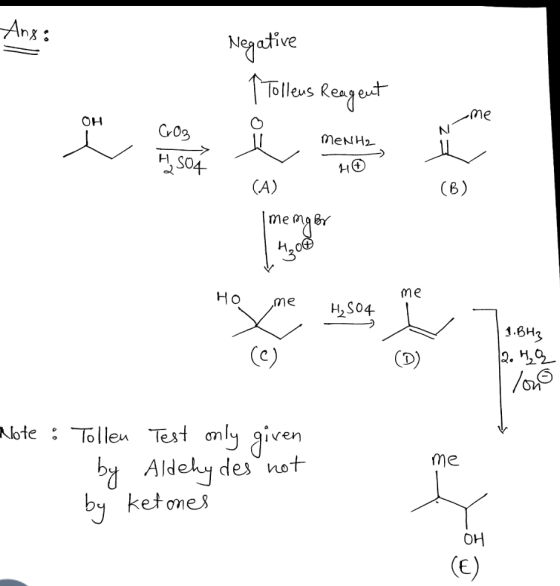
20. Predict the structure A-E from the synthetic scheme beto positive/negative? Tollens reagent Cro, MeNH H2SO...
Give the missing reagent(s). Matching H2SO., H30 Cl2 1) Br, H;O 2) NaH KMnO Cold, Dilute,Basic...
 Give the missing reagent(s). Matching H2SO., H30 Cl2 1) Br, H;O 2) NaH KMnO Cold, Dilute,Basic HCI 1) BH THE 2) H2O2, OH 1) Hg(OAc), H:0 2) NaBH, OH 1) Os 2) (CH3)2S H20, H SO. mCPBA 1) mCPBA 2) H30 Na. 1) OsO. 2) NaHSO; Liquid NH; 1) mCPBA 2) H30, OH Lindlar's Catalyst
Identify the reagents to be used in the following synthetic schemes: (Specify the reagents you would use to carry o...
 Identify the reagents to be used in the following synthetic schemes: (Specify the reagents you would use to carry out the conversion by using letters from the table. Write the letters in the order that they are used, c.g..abc.) Scheme 1: Scheme 2: a- -0- Reagents Available a. BH, THF then H2O2, OH h. NBS, CCL b. PBr3 HBO c. Mg. ether then H30 1. H2, Lindlar's catalyst d. (CH), Culi k. RCOOOH e. Brz I. O, then Zn, H30*...
For each reagent, predict the major product(s). 1) MCPBA n 1) Os04 H OH HO H...
 For each reagent, predict the major product(s). 1) MCPBA n 1) Os04 H OH HO H A. 2) H30* D. 2) NaHSO3/H2O 3. TOM B. Os04 (catalytic), NMO E. KMnO4, NaOH, cold H OH HO H HO HoT F. OsO4 (catalytic) c.) J OH 2) H30+ ????, NaOH <mo ? ????
15. Predict the structure A -D from the synthetic scheme below: 1. MeNH2 С 2. NaBH CI Со, 1. Hg(OAc)2, H20 В A Н,о"...
 15. Predict the structure A -D from the synthetic scheme below: 1. MeNH2 С 2. NaBH CI Со, 1. Hg(OAc)2, H20 В A Н,о" AICI 2. NABH4
10. A synthetic scheme is shown, with reaction conditions in the box. Each arrow in the...
 10. A synthetic scheme is shown, with reaction conditions in the box. Each arrow in the scheme has a Roman numeral. Match the correct conditions to each reaction by placing the appropriate letter after each Roman numeral on the answer page. Use each set of conditions no more than once. ii. ОН ili. HO ОН iv. HO Br Br2 H2SO4 heat a.) CHCI b.) NaBH4 c.) ethanol H20 1. LIAIH4, ether 2. H30 HBr d.) NaOCH3 e.) H2O f.) 8.)...
Complete the following synthesis by selecting from the list of 10 reagents below. Each reagent (or...
 Complete the following synthesis by selecting from the list of 10 reagents below. Each reagent (or set of reagents) is labeled as a letter. In the answer box, simply place the order of reagents used as uppercase letters. For example, if your synthesis involves using reagent A followed by B and then c, and then D, your answer would be: ABCD. ubiri NaBH4 1. CHgMgBr 1. LiAlH4 PCC OH HO CH,OH 2. H20 2. H20 p-TSOH A B с D...
1. PREDICT THE PRODUCT: Provide the structure of the major product expected from the following reactions...
 1. PREDICT THE PRODUCT: Provide the structure of the major product expected from the following reactions or reaction sequences. Make sure you account for any regio- and/or stereochemistry! (24 pts.) H2O 1. Hg(OAC), CH, OH 2. NaBH H2SO4 H20 1) BH-THF 2) H202, KOH HBr Bry, H2O HBr ROOR 1. BH3-THF 2. H2O2, NaOH H20, H2SO4 1. NaNH2 H2 H-CEC-CH2 CH2 CH3 2. CH CH Br Lindlar cat 1. Sia BH-THF 2. H2O2, H2O
10. Complete the following synthesis by selecting from the list of 10 reagents below. Each reagent...
 10. Complete the following synthesis by selecting from the list of 10 reagents below. Each reagent (or set of reagents) is labeled as a letter. In the answer box, simply place the order of reagents used as uppercase letters. For example, if your synthesis involves using reagent A followed by B, followed by C, and then D, your answer would be: ABCD. ? 'H Nang H2 1. LIAIH4 PCC OH HO Pd-C 2. H20 H* A B с D E...
(14 pts.) 2. A spectroscopic road map. Provide the missing reactants, intermediates, and reagents for the following synthetic scheme, based on the initial spectroscopic data. C: CeH20 IR: 1720 cm...
 (14 pts.) 2. A spectroscopic road map. Provide the missing reactants, intermediates, and reagents for the following synthetic scheme, based on the initial spectroscopic data. C: CeH20 IR: 1720 cm-1, strong HNMR 9.72 ppm, 1H, SE 2.40 ppm, 2H, t IR: 3300 cm1, sharp HNMR: 2.83 ppm, 1H, s 1.99 ppm, 2H, d 1.80 ppm, 1H, m 0.91 ppm, 6H, d MgBr 1) H2CrO4 2) dil. H,o 1.62 ppm, 1H, m 1.50 ppm, 2H, m 0.91 ppm, 6H, d PPh3...
1 points Predict the product from the following sequence the reagent over the first arrow from...
 1 points Predict the product from the following sequence the reagent over the first arrow from the left is hydroxide; the minus charge on OH may not be showing dearly CH 10 2 CH.COM ( mu AN S 4 % 5 & 7 8 0 E R Т. Y U Р S D F G L H V Z Х С V B M om # command option and
 Give the missing reagent(s). Matching H2SO., H30 Cl2 1) Br, H;O 2) NaH KMnO Cold, Dilute,Basic HCI 1) BH THE 2) H2O2, OH 1) Hg(OAc), H:0 2) NaBH, OH 1) Os 2) (CH3)2S H20, H SO. mCPBA 1) mCPBA 2) H30 Na. 1) OsO. 2) NaHSO; Liquid NH; 1) mCPBA 2) H30, OH Lindlar's Catalyst
 Identify the reagents to be used in the following synthetic schemes: (Specify the reagents you would use to carry out the conversion by using letters from the table. Write the letters in the order that they are used, c.g..abc.) Scheme 1: Scheme 2: a- -0- Reagents Available a. BH, THF then H2O2, OH h. NBS, CCL b. PBr3 HBO c. Mg. ether then H30 1. H2, Lindlar's catalyst d. (CH), Culi k. RCOOOH e. Brz I. O, then Zn, H30*...
 For each reagent, predict the major product(s). 1) MCPBA n 1) Os04 H OH HO H A. 2) H30* D. 2) NaHSO3/H2O 3. TOM B. Os04 (catalytic), NMO E. KMnO4, NaOH, cold H OH HO H HO HoT F. OsO4 (catalytic) c.) J OH 2) H30+ ????, NaOH <mo ? ????
 15. Predict the structure A -D from the synthetic scheme below: 1. MeNH2 С 2. NaBH CI Со, 1. Hg(OAc)2, H20 В A Н,о" AICI 2. NABH4
 10. A synthetic scheme is shown, with reaction conditions in the box. Each arrow in the scheme has a Roman numeral. Match the correct conditions to each reaction by placing the appropriate letter after each Roman numeral on the answer page. Use each set of conditions no more than once. ii. ОН ili. HO ОН iv. HO Br Br2 H2SO4 heat a.) CHCI b.) NaBH4 c.) ethanol H20 1. LIAIH4, ether 2. H30 HBr d.) NaOCH3 e.) H2O f.) 8.)...
 Complete the following synthesis by selecting from the list of 10 reagents below. Each reagent (or set of reagents) is labeled as a letter. In the answer box, simply place the order of reagents used as uppercase letters. For example, if your synthesis involves using reagent A followed by B and then c, and then D, your answer would be: ABCD. ubiri NaBH4 1. CHgMgBr 1. LiAlH4 PCC OH HO CH,OH 2. H20 2. H20 p-TSOH A B с D...
 1. PREDICT THE PRODUCT: Provide the structure of the major product expected from the following reactions or reaction sequences. Make sure you account for any regio- and/or stereochemistry! (24 pts.) H2O 1. Hg(OAC), CH, OH 2. NaBH H2SO4 H20 1) BH-THF 2) H202, KOH HBr Bry, H2O HBr ROOR 1. BH3-THF 2. H2O2, NaOH H20, H2SO4 1. NaNH2 H2 H-CEC-CH2 CH2 CH3 2. CH CH Br Lindlar cat 1. Sia BH-THF 2. H2O2, H2O
 10. Complete the following synthesis by selecting from the list of 10 reagents below. Each reagent (or set of reagents) is labeled as a letter. In the answer box, simply place the order of reagents used as uppercase letters. For example, if your synthesis involves using reagent A followed by B, followed by C, and then D, your answer would be: ABCD. ? 'H Nang H2 1. LIAIH4 PCC OH HO Pd-C 2. H20 H* A B с D E...
 (14 pts.) 2. A spectroscopic road map. Provide the missing reactants, intermediates, and reagents for the following synthetic scheme, based on the initial spectroscopic data. C: CeH20 IR: 1720 cm-1, strong HNMR 9.72 ppm, 1H, SE 2.40 ppm, 2H, t IR: 3300 cm1, sharp HNMR: 2.83 ppm, 1H, s 1.99 ppm, 2H, d 1.80 ppm, 1H, m 0.91 ppm, 6H, d MgBr 1) H2CrO4 2) dil. H,o 1.62 ppm, 1H, m 1.50 ppm, 2H, m 0.91 ppm, 6H, d PPh3...
 1 points Predict the product from the following sequence the reagent over the first arrow from the left is hydroxide; the minus charge on OH may not be showing dearly CH 10 2 CH.COM ( mu AN S 4 % 5 & 7 8 0 E R Т. Y U Р S D F G L H V Z Х С V B M om # command option and
Most questions answered within 3 hours.
-
Where is the error in this code sequence?
String s1 = "Hello";
String s2 = "ello";...
asked 10 months ago -
Financial data for Joel de Paris, Inc., for last year
follow:
Joel de Paris, Inc.
Balance...
asked 10 months ago -
Consider this reaction:
Al2(SO4)3 (aq)+ BaCl3
(aq) Al2Cl6 (aq)- +
3BaSO4(s) . What is the...
asked 10 months ago -
Suppose that Savneet is considering increasing her
recent random sample from 20 car rentals to 40...
asked 10 months ago -
Trucks arrive at an unloading terminal at an average rate of 120
per hour.
Trucks arrive...
asked 10 months ago -
Why are methanol and ethanol completely soluble in water while
octanol is not very little soluble....
asked 10 months ago -
A facilities manager at a university reads in a research report
that the mean amount of...
asked 10 months ago -
When the CuSO4 is rehydrated by adding water to the anhydrous
compound, is this an endothermic...
asked 10 months ago -
A ray of sunlight is passing from diamond into crown glass; the
angle of incidence is...
asked 10 months ago -
A block of mass 0.249 kg is placed on top of a light, vertical
spring of...
asked 10 months ago -
how do the kidneys compensate in the presences of acidosis
a) trigger hyperventilate
b) reserve acid...
asked 10 months ago -
Question 501 pts
The rental rate of capital to the firm increases. Which of the
following...
asked 10 months ago