Interpret the IR and NMR spectra for an unknown substance. Label all peaks and protons. Correctly Identify the compound and draw its structure.
The unknown compound may be one of the following:
1,2-dichloropropane 2-chloro-2-methylpropane 1-bromobutane
2-bromobutane 1-bromo-3-methylbutane bromocyclohexane
ethanol 1-propanol 2-propanol
1-butanol 2-butanol 2-methyl-2-propanol
n-pentane 2,2,4-tri-methylpentane toluene
1,2-dimethylbenzene 1,3-dimethylbenzene 1,4-dimethylbenzene
ethylbenzene n-butylbenzene 2-butylbenzene
isobutylbenzene cyclohexene alpha-methylstyrene
Homework Answers
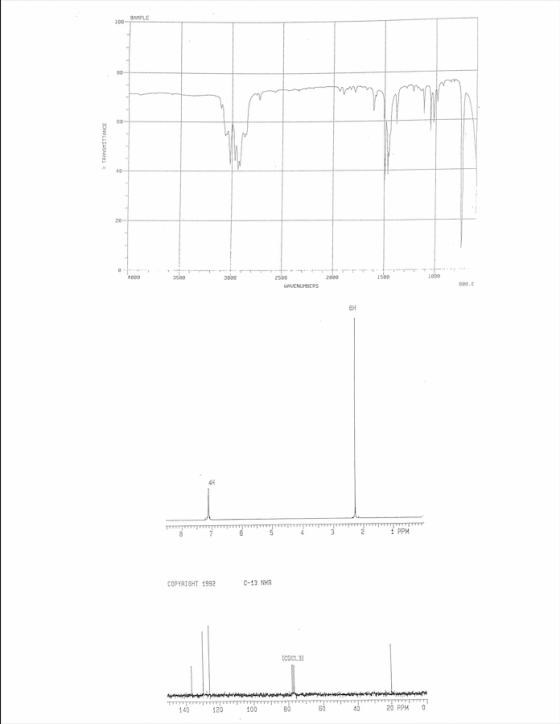
IR data
750 cm-1 indicates C-H wag stretch observed in ortho substituted benzene ring
1500 cm-1 indicates C=C stretch
2900 cm-1 indicates aliphatic C-H stretch
1H NMR data:
7.1-7.2 (4H)
2.3 (s, 6H) two equivalent CH3
13C NMR data:
138 ppm presence of quaternary aromatic carbon
130 ppm presence of aromatic carbon
128 ppm presence of aromatic carbon
20 ppm presence of aliphatic carbon
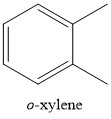
All above data indicates following structure
Add Answer to:
Interpret the IR and NMR spectra for an unknown substance.
Label all peaks and protons. Correctly...
Explain why the IR corresponds to a particular compound of those that are possible based on BP and why it couldn't be...
 Explain why the
IR corresponds to a particular compound of those that are possible
based on BP and why it couldn't be any of the others -mention at
least 3 IR peaks that are present that correspond to functional
groups in your molecule, and discuss specific peaks that were
either present or absent that allowed you to rule out the other
compounds possible based on the boiling point. Reference your IR
spectra as figures.
the boiling
point for unkown 2:...
Explain why the
IR corresponds to a particular compound of those that are possible
based on BP and why it couldn't be any of the others -mention at
least 3 IR peaks that are present that correspond to functional
groups in your molecule, and discuss specific peaks that were
either present or absent that allowed you to rule out the other
compounds possible based on the boiling point. Reference your IR
spectra as figures.
the boiling
point for unkown 2:...
 Explain why the
IR corresponds to a particular compound of those that are possible
based on BP and why it couldn't be any of the others -mention at
least 3 IR peaks that are present that correspond to functional
groups in your molecule, and discuss specific peaks that were
either present or absent that allowed you to rule out the other
compounds possible based on the boiling point. Reference your IR
spectra as figures.
the boiling
point for unkown 2:...
Explain why the
IR corresponds to a particular compound of those that are possible
based on BP and why it couldn't be any of the others -mention at
least 3 IR peaks that are present that correspond to functional
groups in your molecule, and discuss specific peaks that were
either present or absent that allowed you to rule out the other
compounds possible based on the boiling point. Reference your IR
spectra as figures.
the boiling
point for unkown 2:...
Most questions answered within 3 hours.
-
Where is the error in this code sequence?
String s1 = "Hello";
String s2 = "ello";...
asked 10 months ago -
Financial data for Joel de Paris, Inc., for last year
follow:
Joel de Paris, Inc.
Balance...
asked 10 months ago -
Consider this reaction:
Al2(SO4)3 (aq)+ BaCl3
(aq) Al2Cl6 (aq)- +
3BaSO4(s) . What is the...
asked 10 months ago -
Suppose that Savneet is considering increasing her
recent random sample from 20 car rentals to 40...
asked 10 months ago -
Trucks arrive at an unloading terminal at an average rate of 120
per hour.
Trucks arrive...
asked 10 months ago -
Why are methanol and ethanol completely soluble in water while
octanol is not very little soluble....
asked 10 months ago -
A facilities manager at a university reads in a research report
that the mean amount of...
asked 10 months ago -
When the CuSO4 is rehydrated by adding water to the anhydrous
compound, is this an endothermic...
asked 10 months ago -
A ray of sunlight is passing from diamond into crown glass; the
angle of incidence is...
asked 10 months ago -
A block of mass 0.249 kg is placed on top of a light, vertical
spring of...
asked 10 months ago -
how do the kidneys compensate in the presences of acidosis
a) trigger hyperventilate
b) reserve acid...
asked 10 months ago -
Question 501 pts
The rental rate of capital to the firm increases. Which of the
following...
asked 10 months ago