All else equal, will an increase in the productivity of capital always decrease the quantity of...
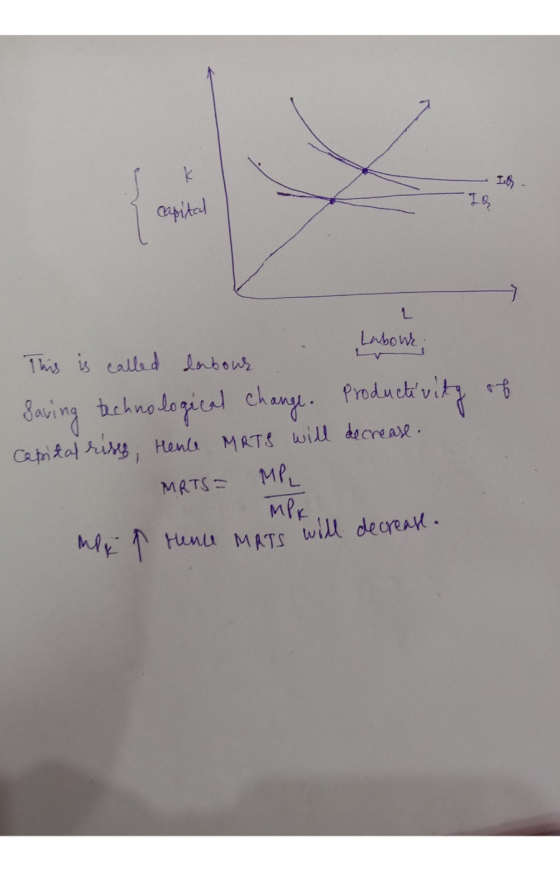
All else equal, will an increase in the productivity of capital always decrease the quantity of labour that a firm hires? Illustrate and explain using isoquant / isocost analysis.
Homework Answers
Add Answer to:
All else equal, will an increase in the productivity of capital
always decrease the quantity of...
1. Suppose that, for the production process for quarks, labour and capital are gross complements. Using...
1. Suppose that, for the production process for quarks, labour and capital are gross complements. Using isoquant / isocost analysis, illustrate how the long-run quantity-demanded for labour would be affected by a decrease in the cost of capital. Illustrate both the “substitution effect” and the “scale effect.” 2. Suppose capital and labour are perfect substitutes for producing widgets and that it takes 1 unit of capital or 3 units of labour to produce one widget. If the price of labour...
24. All else equal, which of the following will increase the demand for labor in a...
24. All else equal, which of the following will increase the demand for labor in a particular market? a. An increase in the price of labor. b. A decrease in the wage paid to another occupation for which these workers are qualified c. A decrease in worker productivity d. An improvement in the nonwage aspects of the job e. An increase in the price of the product produced in that market. 25. Human capital theory predicts that the proportion of...
An increase in which one of the following will decrease the cash cycle, all else equal?...
An increase in which one of the following will decrease the cash cycle, all else equal? O Operating cycle O Accounts receivable period O Days sales in inventory O Inventory turnover rate O Payables turnover
Keeping all else constant, which of the following will decrease net working capital: I. decrease in...
Keeping all else constant, which of the following will decrease net working capital: I. decrease in accounts receivable II. increase in inventory III. decrease in cash IV. increase in accounts payable
Which of the following factors, all else equal, is most likely to decrease a firm's cash...
Which of the following factors, all else equal, is most likely to decrease a firm's cash cycle? A. Increase to accounts receivable turnover. B. Increase speed of paying suppliers. C. Increase the operating cycle. D. Decrease average payables period
All else held constant, which one of these is most apt to decrease the average cost...
All else held constant, which one of these is most apt to decrease the average cost of capital (WACC) of a leveraged firm? a) An increase in a market's average return b) A decrease in the tax rate c) An increase in the treasure rate when the firm's equity beta > 1 d) An increase in the firm's risk and equity beta
Question 5 0.2 pts All else equal, which of the following would cause an increase in...
 Question 5 0.2 pts All else equal, which of the following would cause an increase in output per effective worker? an increase in population an increase in technology a doubling of both capital and labor a doubling of capital and technology an increase in capital per effective worker
9. A firm uses capital and labor to produce a single output good. The production function...
9. A firm uses capital and labor to produce a single output good. The production function is given by F(K,L)=K^0.5L, where K is the amount of capital and L is the amount of labor employed by the firm. The unit prices of capital and labor are given by, respectively r=$5 and w=$6. Based on this information, characterize the optimal (output maximizing) allocation of inputs given that the firm decided to limit its total cost to $12,000. Illustrate your solution graphically:...
All else being equal, if a firm issues $100 million in 10% bonds and uses the...
All else being equal, if a firm issues $100 million in 10% bonds and uses the proceeds to repurchase common stock that pays dividends of $10 million per year, all of the following will occur, except: 1)income taxes will decrease 2) net income will decrease 3)interest expense will increase 4)net cash available for other needs will decrease
Explain fully the difference between an increase in demand and an increase in quantity demanded. Be...
Explain fully the difference between an increase in demand and an increase in quantity demanded. Be sure to explain increase, not change or decrease. Provide at least four reasons for an increase in demand. Use appropriate graphs to illustrate your answer. Compute the price elasticity of demand if price increases from $10 to $12 and quantity demanded falls from 600 to 400. Use the value obtained and a specific example to determine whether price must be increased or decreased to...
 Question 5 0.2 pts All else equal, which of the following would cause an increase in output per effective worker? an increase in population an increase in technology a doubling of both capital and labor a doubling of capital and technology an increase in capital per effective worker
Most questions answered within 3 hours.
-
Where is the error in this code sequence?
String s1 = "Hello";
String s2 = "ello";...
asked 10 months ago -
Financial data for Joel de Paris, Inc., for last year
follow:
Joel de Paris, Inc.
Balance...
asked 10 months ago -
Consider this reaction:
Al2(SO4)3 (aq)+ BaCl3
(aq) Al2Cl6 (aq)- +
3BaSO4(s) . What is the...
asked 10 months ago -
Suppose that Savneet is considering increasing her
recent random sample from 20 car rentals to 40...
asked 10 months ago -
Trucks arrive at an unloading terminal at an average rate of 120
per hour.
Trucks arrive...
asked 10 months ago -
Why are methanol and ethanol completely soluble in water while
octanol is not very little soluble....
asked 10 months ago -
A facilities manager at a university reads in a research report
that the mean amount of...
asked 10 months ago -
When the CuSO4 is rehydrated by adding water to the anhydrous
compound, is this an endothermic...
asked 10 months ago -
A ray of sunlight is passing from diamond into crown glass; the
angle of incidence is...
asked 10 months ago -
A block of mass 0.249 kg is placed on top of a light, vertical
spring of...
asked 10 months ago -
how do the kidneys compensate in the presences of acidosis
a) trigger hyperventilate
b) reserve acid...
asked 10 months ago -
Question 501 pts
The rental rate of capital to the firm increases. Which of the
following...
asked 10 months ago