
Homework Answers
Answer
Equation for demand is the form of
Q=a+bP
a=x-axis intercept=6000
and b=slope
Using the point the curve (0, 60)
0=6000+b60
b60=-6000
b=-6000/60=-100
Then the equation is
Q=6000-100P
The inverse of the curve is
Q=6000-100P
100P=6000-Q
P=60-0.01Q
So the curve is
P=60-0.01Q
Option 3
Add Answer to:
Refer to the graph below: Price (Dollars) 6,000 Quantity The equation for demand is O Q=6,000...
Refer to the graph below: Price (Dollars) 6,000 Quantity Demand is unitary elastic at P =...
 Refer to the graph below: Price (Dollars) 6,000 Quantity Demand is unitary elastic at P = $_ ооооо
Refer to the graph below: Price (Dollars) 6.000 Quantity The equation for marginal revenue is OMR...
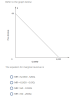 Refer to the graph below: Price (Dollars) 6.000 Quantity The equation for marginal revenue is OMR = 12,000 - 1200 OMR = 6,000 -0.010 OMR = 60 -0.020 OMR = 60 - 2000
Refer to the graph below: Price (Dollars) 6,000 Quantity Marginal revenue is zero at Q= 0 1,00 units O O 3,000 units 6,...
 Refer to the graph below: Price (Dollars) 6,000 Quantity Marginal revenue is zero at Q= 0 1,00 units O O 3,000 units 6,000 units 2,000 units
Graph A Graph B Price . (dollars) P Price (dollars) N: D HT Quantity (units per...
 Graph A Graph B Price . (dollars) P Price (dollars) N: D HT Quantity (units per time period) Quantity (units per time period) Graph C Graph D P1-11 Price (dollars) Price (dollars) - --- QQ Quantity (units per time period) Q Q Quantity (units per time period) 5) Refer to the above diagrams. Which of the graphs depicts the effect of a decrease in the price of domestic cars on the demand for foreign cars? A) Graph D. B) Graph...
QUESTION 3 Figure Price Supply P K I P" P B M N Demand Quantity Refer...
 QUESTION 3 Figure Price Supply P K I P" P B M N Demand Quantity Refer to Figure. If the government imposes a tax size of P- P" in the above market then the area L+M+Y represents a. consumer surplus after the tax. producer surplus after the tax. Cconsumer surplus before the tax. producer surplus before the tax. QUESTION 4 4 point Figure Supply Dennd Quantity Q1 02 Q3 Q Qs Refer to Figure. If the government impose a tax...
Refer to the graph below: Price or Cost (dollars per unit) Demand ML 2 4 6...
 Refer to the graph below: Price or Cost (dollars per unit) Demand ML 2 4 6 8 10 12 14 16 18 Quantity (units per period) Instructions: Enter your responses as a whole number a. b. Identify the short-run equilibrium of a monopolistically competitive firm. (Hint Think about the difference between "initial' and later' demand.) At that equilibrium, what is: Price? (ii) Output? D units Cili) Total Profit? $ profit c, d. Identify the long-run equilibrium of the same firm....
1. Refer to the graph below to answer the following questions Price A. Quantity a. What...
 1. Refer to the graph below to answer the following questions Price A. Quantity a. What is the producer surplus at the equilibrium price? b. What is the consumer surplus at the equilibrium price? c. What is the producer surplus of new manufacturers when the product price changes from P to P? d. Will consumer surplus increase or decrease (circle your answer) when the product's price decreases from Ps to P? What is the size of the change in consumer...
The demand for a product can be approximated by q=D(p)=80e−0.01p, where p represents the price of...
The demand for a product can be approximated by q=D(p)=80e−0.01p, where p represents the price of the product, in dollars, and q is the quantity demanded. (a) Find the elasticity function: E(p)= (b) Evaluate the elasticity at 5. E(5)= (c) Should the unit price be raised slightly from 5 in order to increase revenue? ? yes no (d) Use the elasticity of demand to find the price pp which maximizes revenue for this product. p=p= Round to three decimal places as needed.
Q=100,000-10,000P solve for the consumer surplus at the equilibrium price and quantity Demand: Let the Market...
 Q=100,000-10,000P solve for the consumer surplus at the
equilibrium price and quantity
Demand: Let the Market Demand curve for soybeans be given by the following equation: Q=100,000 -10,000P where the quantity of soybeans in kilograms P = the price of soybeans in dollars per kilogram. Supply: Let the Market Supply curve for soybeans be given by the equation: Q=-5,000+ 5,000P 3) Consumer Surplus: The Consumer Surplus (CS) is the triangular area under the demand curve and above the equilibrium price....
Q=100,000-10,000P solve for the consumer surplus at the
equilibrium price and quantity
Demand: Let the Market Demand curve for soybeans be given by the following equation: Q=100,000 -10,000P where the quantity of soybeans in kilograms P = the price of soybeans in dollars per kilogram. Supply: Let the Market Supply curve for soybeans be given by the equation: Q=-5,000+ 5,000P 3) Consumer Surplus: The Consumer Surplus (CS) is the triangular area under the demand curve and above the equilibrium price....
Suppose that the relationship between price, P, and quantity, Q, is given by the equation Q=60−3P....
Suppose that the relationship between price, P, and quantity, Q, is given by the equation Q=60−3P. Which of the following equations correctly represents solving Q=60−3P for P? P=20−13Q P=20−3Q P=60−3Q P=60+Q P=60−Q Plot the relationship between P and Q on the following graph. Note: Price (P) is on the vertical axis and quantity (Q) is on the horizontal axis. 0 5 10 15 20 25 30 35 40 40 35 30 25 20 15 10 5 0 PRICE QUANTITY The...
 Refer to the graph below: Price (Dollars) 6,000 Quantity Demand is unitary elastic at P = $_ ооооо
 Refer to the graph below: Price (Dollars) 6.000 Quantity The equation for marginal revenue is OMR = 12,000 - 1200 OMR = 6,000 -0.010 OMR = 60 -0.020 OMR = 60 - 2000
 Refer to the graph below: Price (Dollars) 6,000 Quantity Marginal revenue is zero at Q= 0 1,00 units O O 3,000 units 6,000 units 2,000 units
 Graph A Graph B Price . (dollars) P Price (dollars) N: D HT Quantity (units per time period) Quantity (units per time period) Graph C Graph D P1-11 Price (dollars) Price (dollars) - --- QQ Quantity (units per time period) Q Q Quantity (units per time period) 5) Refer to the above diagrams. Which of the graphs depicts the effect of a decrease in the price of domestic cars on the demand for foreign cars? A) Graph D. B) Graph...
 QUESTION 3 Figure Price Supply P K I P" P B M N Demand Quantity Refer to Figure. If the government imposes a tax size of P- P" in the above market then the area L+M+Y represents a. consumer surplus after the tax. producer surplus after the tax. Cconsumer surplus before the tax. producer surplus before the tax. QUESTION 4 4 point Figure Supply Dennd Quantity Q1 02 Q3 Q Qs Refer to Figure. If the government impose a tax...
 Refer to the graph below: Price or Cost (dollars per unit) Demand ML 2 4 6 8 10 12 14 16 18 Quantity (units per period) Instructions: Enter your responses as a whole number a. b. Identify the short-run equilibrium of a monopolistically competitive firm. (Hint Think about the difference between "initial' and later' demand.) At that equilibrium, what is: Price? (ii) Output? D units Cili) Total Profit? $ profit c, d. Identify the long-run equilibrium of the same firm....
 1. Refer to the graph below to answer the following questions Price A. Quantity a. What is the producer surplus at the equilibrium price? b. What is the consumer surplus at the equilibrium price? c. What is the producer surplus of new manufacturers when the product price changes from P to P? d. Will consumer surplus increase or decrease (circle your answer) when the product's price decreases from Ps to P? What is the size of the change in consumer...
 Q=100,000-10,000P solve for the consumer surplus at the
equilibrium price and quantity
Demand: Let the Market Demand curve for soybeans be given by the following equation: Q=100,000 -10,000P where the quantity of soybeans in kilograms P = the price of soybeans in dollars per kilogram. Supply: Let the Market Supply curve for soybeans be given by the equation: Q=-5,000+ 5,000P 3) Consumer Surplus: The Consumer Surplus (CS) is the triangular area under the demand curve and above the equilibrium price....
Q=100,000-10,000P solve for the consumer surplus at the
equilibrium price and quantity
Demand: Let the Market Demand curve for soybeans be given by the following equation: Q=100,000 -10,000P where the quantity of soybeans in kilograms P = the price of soybeans in dollars per kilogram. Supply: Let the Market Supply curve for soybeans be given by the equation: Q=-5,000+ 5,000P 3) Consumer Surplus: The Consumer Surplus (CS) is the triangular area under the demand curve and above the equilibrium price....
Most questions answered within 3 hours.
-
Where is the error in this code sequence?
String s1 = "Hello";
String s2 = "ello";...
asked 10 months ago -
Financial data for Joel de Paris, Inc., for last year
follow:
Joel de Paris, Inc.
Balance...
asked 10 months ago -
Consider this reaction:
Al2(SO4)3 (aq)+ BaCl3
(aq) Al2Cl6 (aq)- +
3BaSO4(s) . What is the...
asked 10 months ago -
Suppose that Savneet is considering increasing her
recent random sample from 20 car rentals to 40...
asked 10 months ago -
Trucks arrive at an unloading terminal at an average rate of 120
per hour.
Trucks arrive...
asked 10 months ago -
Why are methanol and ethanol completely soluble in water while
octanol is not very little soluble....
asked 10 months ago -
A facilities manager at a university reads in a research report
that the mean amount of...
asked 10 months ago -
When the CuSO4 is rehydrated by adding water to the anhydrous
compound, is this an endothermic...
asked 10 months ago -
A ray of sunlight is passing from diamond into crown glass; the
angle of incidence is...
asked 10 months ago -
A block of mass 0.249 kg is placed on top of a light, vertical
spring of...
asked 10 months ago -
how do the kidneys compensate in the presences of acidosis
a) trigger hyperventilate
b) reserve acid...
asked 10 months ago -
Question 501 pts
The rental rate of capital to the firm increases. Which of the
following...
asked 10 months ago