1. Using the monetary policy tool the Fed employs most often, the Fed closes an inflationary...
1. Using the monetary policy tool the Fed employs most often, the Fed closes an inflationary gap. Describe the steps the economy goes through to move to the new equilibrium output and price level. Use graphs with your answer and be sure to label everything completely.
2.Explain and show on a graph the short-run and long-run equilibrium changes in the AD/AS model from expansionary monetary policy. How does this support an anti-monetary policy stance?
3. What is the equation of exchange? Explain.
Homework Answers
(1)
An inflationary gap exists when aggregate demand is so high than real GDP exceeds potential GDP, leading to high inflation. Fed can close the inflationary gap with contractionary monetary policy by decreasing money supply by open market sale of federal securities. When money supply decreases, interest rate increases which decreases investment and decreases the portion of consumption demand funded by borrowing. As a result, aggregate demand falls, shifting AD curve leftward, lowering price level and real GDP.
In following graph, during inflationary period, the economy is at point B where aggregate demand (AD1) intersects short-run aggregate supply curve (SRAS0) to the right of long-run aggregate supply curve (LRAS0) with price level P1 and real GDP Y1, creating an inflationary gap equal to (Y1 - Y0). When Fed lowers money supply, aggregate demand falls, shifting AD1 leftward to AD0 where it intersects SRAS0 and LRAS0 at point A with lower price level P0 and restoring real GDP to potential GDP of Y0, eliminating inflationary gap.
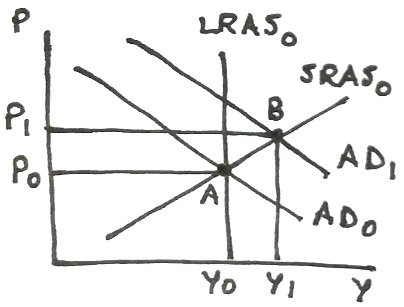
NOTE: As per Answering Policy, 1st question is answered.
Add Answer to:
1. Using the monetary policy tool the Fed employs most often,
the Fed closes an inflationary...
the economy is experiencing a recession and high unemployment a. Use an AD-AS model together with the Fed Funds market to represent ther short ran equilibrium in b. What types of monetary policy...
 the economy is experiencing a recession and high unemployment a. Use an AD-AS model together with the Fed Funds market to represent ther short ran equilibrium in b. What types of monetary policy (i.e.. expansionary or restrictive) should the Fed implement? c. In implementing the policy you suggest. which actions (please give at least two actions) should the Fed take to achieve this policy? Explain how t he y policy would address this problem and the consequence of the monetar...
l 6. Monetary policy and the problem of inflationary and recessionary gaps On the following graph,...
 l
6. Monetary policy and the problem of inflationary and recessionary gaps On the following graph, the economy is producing at point A (grey star symbol), which corresponds to the intersection of the AD, and SRAS curves. The Federal Reserve ("the Fed") is considering whether to intervene in an effort to bring the economy back to its potential. ? LRAS SRAS, 165 160 No Intervention SRAS2 155 150 If Fed Intervenes PRICE LEVEL 145 140 AD2 135 ADA 130 125...
l
6. Monetary policy and the problem of inflationary and recessionary gaps On the following graph, the economy is producing at point A (grey star symbol), which corresponds to the intersection of the AD, and SRAS curves. The Federal Reserve ("the Fed") is considering whether to intervene in an effort to bring the economy back to its potential. ? LRAS SRAS, 165 160 No Intervention SRAS2 155 150 If Fed Intervenes PRICE LEVEL 145 140 AD2 135 ADA 130 125...
2001, the Fed pursued an expansionary monetary policy and reduced interest rates. At the same time, President Georg...
 2001, the Fed pursued an expansionary monetary policy and reduced interest rates. At the same time, President George W. Bush pushed through legislation that lowered Income taxes. "he accompanying IS-LM diagram describes the situation prior to any such policy changes. Initially the economy is at equilibrium point A. .) Using the line drawing tool, draw a new LM curve to illustrate the effect of an expansionary monetary policy. Property abel your curve. 2.) Using the 3-point curve drawing tool, draw...
2) In 2001, the Fed pursued a very expansionary monetary policy. At the sametime, President George...
 2) In 2001, the Fed pursued a very expansionary monetary policy. At the sametime, President George W. Bush pushed through legislation that lowered income taxes. a. Use the IS-LM diagram to describe the situation prior to any such policy changes labeling the economy initially at the equilibrium at point A. b. Now show the combined effect of the two policies. Label the new equilibrium point B. Explain what you have done - which curve shifts which way and why! c....
8. a) Explain what the Fed will do when implementing an expansionary monetary policy using open...
8. a) Explain what the Fed will do when implementing an expansionary monetary policy using open market operations. b) Be as specific as possible about the ways in which this policy will conditions in our economy.
Monetary Policy: Keynesian model a. Draw graphs for the IS-LM-FE model, the AD-AS model, and labor...
Monetary Policy: Keynesian model a. Draw graphs for the IS-LM-FE model, the AD-AS model, and labor market equilibrium for the Keynesian model with efficiency wages for an economy in a long-run equilibrium. Label equilibrium points.
Monetary Policy and Money Markets a. Graph the demand and supply of money at equilibrium. Identify...
Monetary Policy and Money Markets a. Graph the demand and supply of money at equilibrium. Identify the area of excess supply of money and excess demand for money. b.Graph the impact of contractionary monetary policy on Aggregate Demand through monetary policy transmission into the economy- use 3 graphs to illustrate the impact. Graph and list all contractionary monetary policy. c. Explain the transmission of expansionary monetary policy transmission and list all expansionary monetary policy tools d. Define the equation of...
6. The long-run effects of monetary policy Aa Aa The following graphs show an economy that is cur...
 6. The long-run effects of monetary policy The following graphs show an economy that is currently in long-run equilibrium. The first graph shows the aggregate demand (AD) and long-run aggregate supply (LRAS) curves. The second shows the long-run (LR) and short-run (SR) Phillips curves. The point on each graph shows the economy's current position. According to the graphs, potential output in this economy is _______ and the natural rate of unemployment is _______ .Suppose the central bank of the economy decreases the...
Stabilization policies are often used to bring about economic equilibrium: 1. Monetary policy is implemented by...
 Stabilization policies are often used to bring about economic equilibrium: 1. Monetary policy is implemented by the Bank of Canada (or Central Bank) - Manipulation of short-term interest rates - Management of the money supply 2. Fiscal policy is the responsibility of the Department of Finance and the Treasu Board - Government spending levels - Government deficit and borrowing policies Question: How would each of these policies tools be deployed to address a recessionary gap? An inflationary gap?
Monetary Policy in Keynesian Models of the Macroeconomy (a) The Keynesian consumption function is: C d...
Monetary Policy in Keynesian Models of the Macroeconomy (a) The Keynesian consumption function is: C d = C¯ + c(Y − T) − γcr. Provide an intuitive explanation for this equation. Define all terms. b) Consider the AD-AS model. Assume that an economy is initially in an equilibrium with output equal to potential output. Then suppose the central bank alters its policy reaction function so that for any given inflation rate and output gap it sets a lower real interest...
 the economy is experiencing a recession and high unemployment a. Use an AD-AS model together with the Fed Funds market to represent ther short ran equilibrium in b. What types of monetary policy (i.e.. expansionary or restrictive) should the Fed implement? c. In implementing the policy you suggest. which actions (please give at least two actions) should the Fed take to achieve this policy? Explain how t he y policy would address this problem and the consequence of the monetar...
 l
6. Monetary policy and the problem of inflationary and recessionary gaps On the following graph, the economy is producing at point A (grey star symbol), which corresponds to the intersection of the AD, and SRAS curves. The Federal Reserve ("the Fed") is considering whether to intervene in an effort to bring the economy back to its potential. ? LRAS SRAS, 165 160 No Intervention SRAS2 155 150 If Fed Intervenes PRICE LEVEL 145 140 AD2 135 ADA 130 125...
l
6. Monetary policy and the problem of inflationary and recessionary gaps On the following graph, the economy is producing at point A (grey star symbol), which corresponds to the intersection of the AD, and SRAS curves. The Federal Reserve ("the Fed") is considering whether to intervene in an effort to bring the economy back to its potential. ? LRAS SRAS, 165 160 No Intervention SRAS2 155 150 If Fed Intervenes PRICE LEVEL 145 140 AD2 135 ADA 130 125...
 2001, the Fed pursued an expansionary monetary policy and reduced interest rates. At the same time, President George W. Bush pushed through legislation that lowered Income taxes. "he accompanying IS-LM diagram describes the situation prior to any such policy changes. Initially the economy is at equilibrium point A. .) Using the line drawing tool, draw a new LM curve to illustrate the effect of an expansionary monetary policy. Property abel your curve. 2.) Using the 3-point curve drawing tool, draw...
 2) In 2001, the Fed pursued a very expansionary monetary policy. At the sametime, President George W. Bush pushed through legislation that lowered income taxes. a. Use the IS-LM diagram to describe the situation prior to any such policy changes labeling the economy initially at the equilibrium at point A. b. Now show the combined effect of the two policies. Label the new equilibrium point B. Explain what you have done - which curve shifts which way and why! c....
 Stabilization policies are often used to bring about economic equilibrium: 1. Monetary policy is implemented by the Bank of Canada (or Central Bank) - Manipulation of short-term interest rates - Management of the money supply 2. Fiscal policy is the responsibility of the Department of Finance and the Treasu Board - Government spending levels - Government deficit and borrowing policies Question: How would each of these policies tools be deployed to address a recessionary gap? An inflationary gap?
Most questions answered within 3 hours.
-
Where is the error in this code sequence?
String s1 = "Hello";
String s2 = "ello";...
asked 11 months ago -
Financial data for Joel de Paris, Inc., for last year
follow:
Joel de Paris, Inc.
Balance...
asked 11 months ago -
Consider this reaction:
Al2(SO4)3 (aq)+ BaCl3
(aq) Al2Cl6 (aq)- +
3BaSO4(s) . What is the...
asked 11 months ago -
Suppose that Savneet is considering increasing her
recent random sample from 20 car rentals to 40...
asked 11 months ago -
Trucks arrive at an unloading terminal at an average rate of 120
per hour.
Trucks arrive...
asked 11 months ago -
Why are methanol and ethanol completely soluble in water while
octanol is not very little soluble....
asked 11 months ago -
A facilities manager at a university reads in a research report
that the mean amount of...
asked 11 months ago -
When the CuSO4 is rehydrated by adding water to the anhydrous
compound, is this an endothermic...
asked 11 months ago -
A ray of sunlight is passing from diamond into crown glass; the
angle of incidence is...
asked 11 months ago -
A block of mass 0.249 kg is placed on top of a light, vertical
spring of...
asked 11 months ago -
how do the kidneys compensate in the presences of acidosis
a) trigger hyperventilate
b) reserve acid...
asked 11 months ago -
Question 501 pts
The rental rate of capital to the firm increases. Which of the
following...
asked 11 months ago