

Homework Answers
4)
5) 
6) 
Add Answer to:
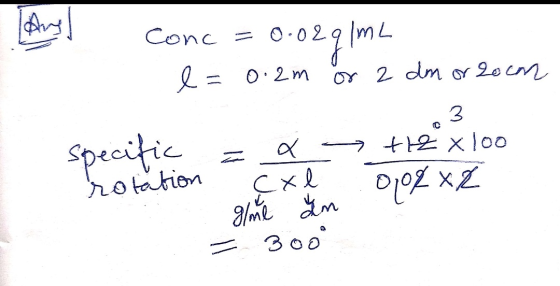
5) 4. Calculate the specific rotation for a substance that is at a conc. of 0.02...
5) 4. Calculate the specific rotation for a substance that is at a conc. of 0.02...
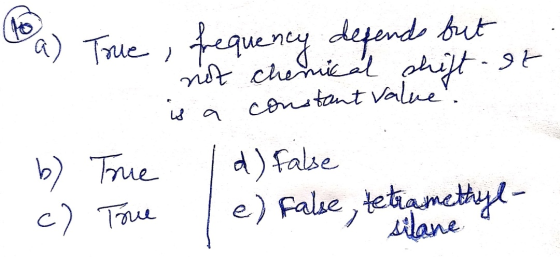
 5) 4. Calculate the specific rotation for a substance that is at a conc. of 0.02 /ml, and in a 2 decimeter tube gives an observed rotation of +12° 15) 5. For this molecule: a. How many chemically different hydrogens? b. How many chemically different carbons? C. What would be the mass of the molecular ion in El-MS? 10) 6. True or False: a. Chemical shifts, in ppm, are independent of the magnetic field strength. T F b. In HNMR,...
Chemical shifts, in ppm, are independent of the magnetic field strength. T F In HNMR, spin-spin...
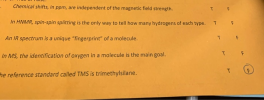 Chemical shifts, in ppm, are independent of the magnetic field strength. T F In HNMR, spin-spin splitting is the only way to tell how many hydrogens of each type. T F An IR spectrum is a unique "fingerprint" of a molecule. TF In MS, the identification of oxygen in a molecule is the main goal. TF he reference standard called TMS is trimethylsilane.
Pur eunnt ptic Rotut F c. Meso compound- A Compuina thestotuins 10) 2. Assign R or...
 Pur eunnt ptic Rotut F c. Meso compound- A Compuina thestotuins 10) 2. Assign R or S to the two asymmetric.carbons shown below. matple Сиси, 5) 3. Place an asterisk (*) next to each asymmetri carbon in the molecule shown below. 5) 4. Calculate the specific rotation for a substance that is at a cqnc. of 0.01 g/ml, and in a 1 decimeter tut O72 (0-01 gim(19 observed rotation of -20° . 15) 5. For this molecule: он How many...
10) 6. True or False: IR is used to tell how many chemically different types of...
 10) 6. True or False: IR is used to tell how many chemically different types of hydrogens F T a. T F CDCI, is commonly used as an NMR solvent. b. T F Compounds with no nitrogen always have an even mass number. C. d. Aldehydes are easy to detect in HNMR. T F Neighboring hydrogens always show spin-spin splitting. T F e.
15) 5. For this molecule: a. How many chemically different hydrogens? b. How many chemically different...
 15) 5. For this molecule: a. How many chemically different hydrogens? b. How many chemically different carbons? c. What would be the mass of the molecular ion in El-MS?
15) 5. For this molecule: a. How many chemically different hydrogens? b. How many chemically different...
 15) 5. For this molecule: a. How many chemically different hydrogens? b. How many chemically different carbons? c. What would be the mass of the molecular ion in El-MS?
15) 5. For this molecule: SHCH a. How many chemically different hydrogens? b. How many chemically...
 15) 5. For this molecule: SHCH a. How many chemically different hydrogens? b. How many chemically different carbons? c. What would be the mass of the molecular ion in El-MS?
please explain how to solve 15) 5. In terms of the molecule shown below: -THESE Ha...
 please explain how to solve
15) 5. In terms of the molecule shown below: -THESE Ha a. How many chemically different hydrogens does it have? _10 (but 9 is acceptable) b. How many chemically different carbons does it have? 11 c. What would be the nominal molecular mass in the El-MS?__190 (C13H130)
please explain how to solve
15) 5. In terms of the molecule shown below: -THESE Ha a. How many chemically different hydrogens does it have? _10 (but 9 is acceptable) b. How many chemically different carbons does it have? 11 c. What would be the nominal molecular mass in the El-MS?__190 (C13H130)
1. Signal Assignment. Below are a set of ranges where a specific H' NMR signal might...
 1. Signal Assignment. Below are a set of ranges where a specific H' NMR signal might be found. 0.5-2.0ppm 2.0-3.0ppm 3.0-5.Oppm 0.5-6.Oppm 5.0-7.0ppm 7.0-8.Oppm 9.0-10.0ppm 10.0-12.0ppm Assign to the slots above where the following highlighted protons might be found. a) CH3-CH2- b) CH-CH2-CH2- c) HC-0 d) H-C(O)-R e) H-O-R ) H-O-C(O)-R g) H;C-Ar h ) H-C-C- j) CH3-CEC ...some groups appear in the same ppm range. [2pts each group correctly assigned) 2. Signal Splitting. Decide what splitting pattern (singlet, doublet,...
PART 3 For each set of data on pages 5-9, calculate and record the degree of...
 PART 3 For each set of data on pages 5-9, calculate and record the degree of unsaturation. Then use your problem solving skills to determine the chemical structure that is consistent with ALL of the data on each page. You are not required to label the spectra (but feel free to do so). This entire assignment is to be completed independently Suggestion for a general method to determine a chemical structure based on the provided molecular formula, IR, H-NMR and...
 5) 4. Calculate the specific rotation for a substance that is at a conc. of 0.02 /ml, and in a 2 decimeter tube gives an observed rotation of +12° 15) 5. For this molecule: a. How many chemically different hydrogens? b. How many chemically different carbons? C. What would be the mass of the molecular ion in El-MS? 10) 6. True or False: a. Chemical shifts, in ppm, are independent of the magnetic field strength. T F b. In HNMR,...
 Chemical shifts, in ppm, are independent of the magnetic field strength. T F In HNMR, spin-spin splitting is the only way to tell how many hydrogens of each type. T F An IR spectrum is a unique "fingerprint" of a molecule. TF In MS, the identification of oxygen in a molecule is the main goal. TF he reference standard called TMS is trimethylsilane.
 Pur eunnt ptic Rotut F c. Meso compound- A Compuina thestotuins 10) 2. Assign R or S to the two asymmetric.carbons shown below. matple Сиси, 5) 3. Place an asterisk (*) next to each asymmetri carbon in the molecule shown below. 5) 4. Calculate the specific rotation for a substance that is at a cqnc. of 0.01 g/ml, and in a 1 decimeter tut O72 (0-01 gim(19 observed rotation of -20° . 15) 5. For this molecule: он How many...
 10) 6. True or False: IR is used to tell how many chemically different types of hydrogens F T a. T F CDCI, is commonly used as an NMR solvent. b. T F Compounds with no nitrogen always have an even mass number. C. d. Aldehydes are easy to detect in HNMR. T F Neighboring hydrogens always show spin-spin splitting. T F e.
 15) 5. For this molecule: a. How many chemically different hydrogens? b. How many chemically different carbons? c. What would be the mass of the molecular ion in El-MS?
 15) 5. For this molecule: a. How many chemically different hydrogens? b. How many chemically different carbons? c. What would be the mass of the molecular ion in El-MS?
 15) 5. For this molecule: SHCH a. How many chemically different hydrogens? b. How many chemically different carbons? c. What would be the mass of the molecular ion in El-MS?
 please explain how to solve
15) 5. In terms of the molecule shown below: -THESE Ha a. How many chemically different hydrogens does it have? _10 (but 9 is acceptable) b. How many chemically different carbons does it have? 11 c. What would be the nominal molecular mass in the El-MS?__190 (C13H130)
please explain how to solve
15) 5. In terms of the molecule shown below: -THESE Ha a. How many chemically different hydrogens does it have? _10 (but 9 is acceptable) b. How many chemically different carbons does it have? 11 c. What would be the nominal molecular mass in the El-MS?__190 (C13H130)
 1. Signal Assignment. Below are a set of ranges where a specific H' NMR signal might be found. 0.5-2.0ppm 2.0-3.0ppm 3.0-5.Oppm 0.5-6.Oppm 5.0-7.0ppm 7.0-8.Oppm 9.0-10.0ppm 10.0-12.0ppm Assign to the slots above where the following highlighted protons might be found. a) CH3-CH2- b) CH-CH2-CH2- c) HC-0 d) H-C(O)-R e) H-O-R ) H-O-C(O)-R g) H;C-Ar h ) H-C-C- j) CH3-CEC ...some groups appear in the same ppm range. [2pts each group correctly assigned) 2. Signal Splitting. Decide what splitting pattern (singlet, doublet,...
 PART 3 For each set of data on pages 5-9, calculate and record the degree of unsaturation. Then use your problem solving skills to determine the chemical structure that is consistent with ALL of the data on each page. You are not required to label the spectra (but feel free to do so). This entire assignment is to be completed independently Suggestion for a general method to determine a chemical structure based on the provided molecular formula, IR, H-NMR and...
Most questions answered within 3 hours.
-
Where is the error in this code sequence?
String s1 = "Hello";
String s2 = "ello";...
asked 10 months ago -
Financial data for Joel de Paris, Inc., for last year
follow:
Joel de Paris, Inc.
Balance...
asked 10 months ago -
Consider this reaction:
Al2(SO4)3 (aq)+ BaCl3
(aq) Al2Cl6 (aq)- +
3BaSO4(s) . What is the...
asked 10 months ago -
Suppose that Savneet is considering increasing her
recent random sample from 20 car rentals to 40...
asked 10 months ago -
Trucks arrive at an unloading terminal at an average rate of 120
per hour.
Trucks arrive...
asked 10 months ago -
Why are methanol and ethanol completely soluble in water while
octanol is not very little soluble....
asked 10 months ago -
A facilities manager at a university reads in a research report
that the mean amount of...
asked 10 months ago -
When the CuSO4 is rehydrated by adding water to the anhydrous
compound, is this an endothermic...
asked 10 months ago -
A ray of sunlight is passing from diamond into crown glass; the
angle of incidence is...
asked 10 months ago -
A block of mass 0.249 kg is placed on top of a light, vertical
spring of...
asked 10 months ago -
how do the kidneys compensate in the presences of acidosis
a) trigger hyperventilate
b) reserve acid...
asked 10 months ago -
Question 501 pts
The rental rate of capital to the firm increases. Which of the
following...
asked 10 months ago