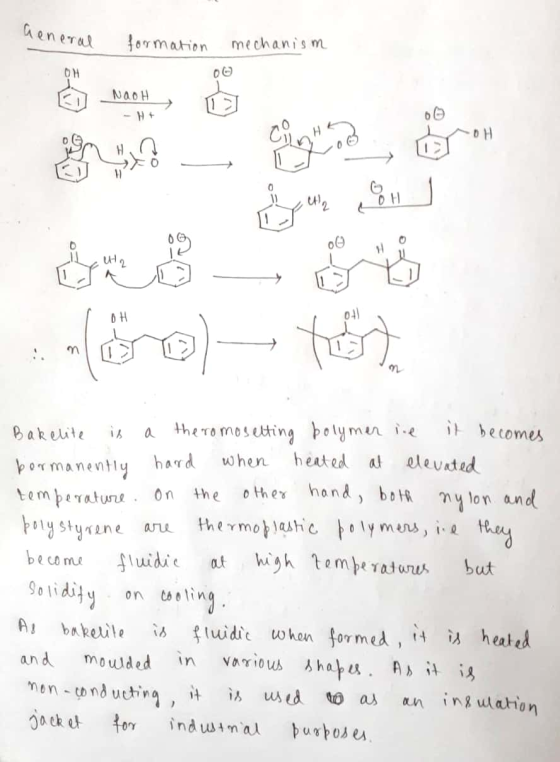
Provide a general mechanism (with arrows) for the formation of Bakelite from phenol and formaldehyde (CH2O)...
Provide a general mechanism (with arrows) for the formation of Bakelite from phenol and formaldehyde (CH2O) in the presence of acid. In what way is this polymer different from nylon and polystyrene? How is it manifested in its physical properties?
Homework Answers
Add Answer to:
Provide a general mechanism (with arrows) for the formation of
Bakelite from phenol and formaldehyde (CH2O)...
Provide mechanisms (with arrows) for the formation of Nylon-6,10 and polystyrene from their constituted monomers. What...
Provide mechanisms (with arrows) for the formation of Nylon-6,10 and polystyrene from their constituted monomers. What is the role of the aqueous base in the nylon synthesis? What is the role of sulfuric acid in the polystyrene synthesis?
Provide mechanisms (with arrows) for the formation of Nylon-6,10 from hexamethlenediamine and sebacoyl chloride , and po...
Provide mechanisms (with arrows) for the formation of Nylon-6,10 from hexamethlenediamine and sebacoyl chloride , and polystyrene from 1,2-dichloroethane and sulfuric acid. What is the role of the aqueous base in the nylon synthesis? What is the role of sulfuric acid in the polystyrene synthesis?
sms (with arrows) for the formation of Nylon-6,10 and polystyrene from their constituent monomers. What is...
 sms (with arrows) for the formation of Nylon-6,10 and polystyrene from their constituent monomers. What is the role of the aqueous base nomers. What is the role of the aqueous base in the nylon synthesis? What is the role of the sulfuric acid in the polystyrene synthesis
Provide the elimination mechanism (with arrows) of the formation of cis-2'-bromostyrene from 2,3-dibromo-3-phenylpro...
Provide the elimination mechanism (with arrows) of the formation of cis-2'-bromostyrene from 2,3-dibromo-3-phenylpropanoic acid in the presence of K2CO3 and the solvent acetone. Also provide the mechanism of KMNO4 on a TLC (thin later chromatography) plate and why colour change occurs
x Your answer is incorrect. Try again. Provide a reasonable mechanism for its formation. Start from...
 x Your answer is incorrect. Try again. Provide a reasonable mechanism for its formation. Start from a mechanism for the addition of HCl to the double bond that is adjacent to the methoxy (OCH3) group. Draw the first step of the mechanism. First draw any lone pairs, then draw the curved arrows, and then draw the resulting ions (the carbocation and the halide). Don't forget to draw all formal charges and lone pairs. CH HCl Edit VC Hac
1. Provide the products of the reaction below and a detailed reaction mechanism using curved arrows...
 1. Provide the products of the reaction below and a detailed reaction mechanism using curved arrows to indicate the movement of electrons. (a) (b) КОН (c) Note that formation of 4- or 7-membered rings is disfavored. Hiyo KOH acidie workup 2. An interesting problem that involves a bit of review (imines and Grignard chemistry) and application of what you previously learned to a new reaction: The Carbon of an imine functional group (i.e. R.C-NR) is sufficiently electron deficient to be...
7) [28 pts.] L-Proline was recently found to catalytically promote the quantitative stereochemical isomerization of the aldehyde shown below. The proposed mechanism proceeds through the enamine deriv...
 7) [28 pts.] L-Proline was recently found to catalytically promote the quantitative stereochemical isomerization of the aldehyde shown below. The proposed mechanism proceeds through the enamine derivative of L-Proline, and involves intramolecular general acid and general base catalyzed steps. Provide the missing structures in boxes 1-4 and arrows where requested. Boxes 2 and 3 are to display different faces of a prochiral double bond, brought about by a conformational change. (Reference J. Org. Chen. 2007, 72, 10279) OR OR OR...
Organic Chemistry. Please answer all questions and show work 1. Provide a mechanism for the formation...
 Organic Chemistry. Please answer all
questions and show work
1. Provide a mechanism for the formation of the compound from
its biosynthetic precursors. (I believe it has to do with starting
units and extender units and built in a similar way that fatty
acids are made?)
2. How many signals would you expect to see in the
1HNMR and proton decoupled 13CNMR of the
polyketide (pictured above)?
11] A polyketide synthase leads to the formation of the following compound: OH
Organic Chemistry. Please answer all
questions and show work
1. Provide a mechanism for the formation of the compound from
its biosynthetic precursors. (I believe it has to do with starting
units and extender units and built in a similar way that fatty
acids are made?)
2. How many signals would you expect to see in the
1HNMR and proton decoupled 13CNMR of the
polyketide (pictured above)?
11] A polyketide synthase leads to the formation of the following compound: OH
for this experiment, what is the balanced chemical equation and mechanism? Experimental Procedure a) Reagent Prep...
 for this experiment, what is the balanced chemical equation and
mechanism?
Experimental Procedure a) Reagent Preparation (mix in hood): 1. In a 125mL Erlenmeyer dissolve 1 mL of the sebacyl chloride in 50 mL of hexane. Label the Solution as SC 2. In a 50mL Erlenmeyer dissolve 2.5 mL of 1,6-hexanediamine in 25 mL of 3% sodium hydroxid Label the solution as diamine. (The 3% NaOH solution will be provided) b) Nylon Synthesis 1. Using a 10mL graduate cylinder take...
for this experiment, what is the balanced chemical equation and
mechanism?
Experimental Procedure a) Reagent Preparation (mix in hood): 1. In a 125mL Erlenmeyer dissolve 1 mL of the sebacyl chloride in 50 mL of hexane. Label the Solution as SC 2. In a 50mL Erlenmeyer dissolve 2.5 mL of 1,6-hexanediamine in 25 mL of 3% sodium hydroxid Label the solution as diamine. (The 3% NaOH solution will be provided) b) Nylon Synthesis 1. Using a 10mL graduate cylinder take...
convert from alcohol to alkane by reduction process vis SN2 mechanism. (SHOW MECHANISM) 1-ethylcyclohexan-1-ol reacts with...
convert from alcohol to alkane by reduction process vis SN2 mechanism. (SHOW MECHANISM) 1-ethylcyclohexan-1-ol reacts with 1.TsOH, Pyridine/2.LiAlH4, H3O^+ I don't know how to describe the second one its a Phenol as the main ring with a carbon group attached to the side. It has a methyl, ethyl and alcohol attached to this carbon which is connected to the main ring. This phenol compound with the attached alcohol, ethyl and methyl groups reacts with TsCL, Pyridine/ LiAlH4, acetone. Obtain the...
 sms (with arrows) for the formation of Nylon-6,10 and polystyrene from their constituent monomers. What is the role of the aqueous base nomers. What is the role of the aqueous base in the nylon synthesis? What is the role of the sulfuric acid in the polystyrene synthesis
 x Your answer is incorrect. Try again. Provide a reasonable mechanism for its formation. Start from a mechanism for the addition of HCl to the double bond that is adjacent to the methoxy (OCH3) group. Draw the first step of the mechanism. First draw any lone pairs, then draw the curved arrows, and then draw the resulting ions (the carbocation and the halide). Don't forget to draw all formal charges and lone pairs. CH HCl Edit VC Hac
 1. Provide the products of the reaction below and a detailed reaction mechanism using curved arrows to indicate the movement of electrons. (a) (b) КОН (c) Note that formation of 4- or 7-membered rings is disfavored. Hiyo KOH acidie workup 2. An interesting problem that involves a bit of review (imines and Grignard chemistry) and application of what you previously learned to a new reaction: The Carbon of an imine functional group (i.e. R.C-NR) is sufficiently electron deficient to be...
 7) [28 pts.] L-Proline was recently found to catalytically promote the quantitative stereochemical isomerization of the aldehyde shown below. The proposed mechanism proceeds through the enamine derivative of L-Proline, and involves intramolecular general acid and general base catalyzed steps. Provide the missing structures in boxes 1-4 and arrows where requested. Boxes 2 and 3 are to display different faces of a prochiral double bond, brought about by a conformational change. (Reference J. Org. Chen. 2007, 72, 10279) OR OR OR...
 Organic Chemistry. Please answer all
questions and show work
1. Provide a mechanism for the formation of the compound from
its biosynthetic precursors. (I believe it has to do with starting
units and extender units and built in a similar way that fatty
acids are made?)
2. How many signals would you expect to see in the
1HNMR and proton decoupled 13CNMR of the
polyketide (pictured above)?
11] A polyketide synthase leads to the formation of the following compound: OH
Organic Chemistry. Please answer all
questions and show work
1. Provide a mechanism for the formation of the compound from
its biosynthetic precursors. (I believe it has to do with starting
units and extender units and built in a similar way that fatty
acids are made?)
2. How many signals would you expect to see in the
1HNMR and proton decoupled 13CNMR of the
polyketide (pictured above)?
11] A polyketide synthase leads to the formation of the following compound: OH
 for this experiment, what is the balanced chemical equation and
mechanism?
Experimental Procedure a) Reagent Preparation (mix in hood): 1. In a 125mL Erlenmeyer dissolve 1 mL of the sebacyl chloride in 50 mL of hexane. Label the Solution as SC 2. In a 50mL Erlenmeyer dissolve 2.5 mL of 1,6-hexanediamine in 25 mL of 3% sodium hydroxid Label the solution as diamine. (The 3% NaOH solution will be provided) b) Nylon Synthesis 1. Using a 10mL graduate cylinder take...
for this experiment, what is the balanced chemical equation and
mechanism?
Experimental Procedure a) Reagent Preparation (mix in hood): 1. In a 125mL Erlenmeyer dissolve 1 mL of the sebacyl chloride in 50 mL of hexane. Label the Solution as SC 2. In a 50mL Erlenmeyer dissolve 2.5 mL of 1,6-hexanediamine in 25 mL of 3% sodium hydroxid Label the solution as diamine. (The 3% NaOH solution will be provided) b) Nylon Synthesis 1. Using a 10mL graduate cylinder take...
Most questions answered within 3 hours.
-
Where is the error in this code sequence?
String s1 = "Hello";
String s2 = "ello";...
asked 10 months ago -
Financial data for Joel de Paris, Inc., for last year
follow:
Joel de Paris, Inc.
Balance...
asked 10 months ago -
Consider this reaction:
Al2(SO4)3 (aq)+ BaCl3
(aq) Al2Cl6 (aq)- +
3BaSO4(s) . What is the...
asked 10 months ago -
Suppose that Savneet is considering increasing her
recent random sample from 20 car rentals to 40...
asked 10 months ago -
Trucks arrive at an unloading terminal at an average rate of 120
per hour.
Trucks arrive...
asked 10 months ago -
Why are methanol and ethanol completely soluble in water while
octanol is not very little soluble....
asked 10 months ago -
A facilities manager at a university reads in a research report
that the mean amount of...
asked 10 months ago -
When the CuSO4 is rehydrated by adding water to the anhydrous
compound, is this an endothermic...
asked 10 months ago -
A ray of sunlight is passing from diamond into crown glass; the
angle of incidence is...
asked 10 months ago -
A block of mass 0.249 kg is placed on top of a light, vertical
spring of...
asked 10 months ago -
how do the kidneys compensate in the presences of acidosis
a) trigger hyperventilate
b) reserve acid...
asked 10 months ago -
Question 501 pts
The rental rate of capital to the firm increases. Which of the
following...
asked 10 months ago