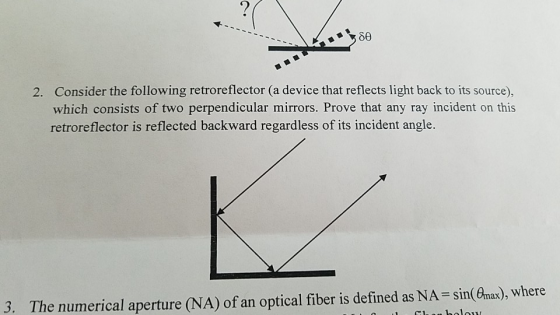
Consider the following retroreflector (a device that reflects light back to its source), which consists of two perpendicular mirrors. Prove that any ray incident on this retroreflector is reflected backward regardless of its incident angle
Homework Answers
 Mirror
AO is perpendicular to mirror OD
Mirror
AO is perpendicular to mirror OD
i.e
AOD= 90°
To prove any incident rays get reflected backward regardless of its angle of incidence , it is enough to prove incident rays and reflected rays become parallel to each other after reflection from retroreflector.
Proof:
Let PB is incident ray that falls at B making an angle
1 with the normal BM
BC is the reflected ray that makes angle
2 with normal BM
Now the reflected ray will act as incident ray for the mirror OD
making an angle
3 with normal CM
CQ is the reflected ray making angle
4 with normal
Now,
BM is normal to mirror OA and CM is normal to OD
BOC = 90°
Hence closed figure BOCM is a rectangle
and
BMC= 90°
Now coming to traingle BCM
Sum of angle of traingle is 180°
2
+
3+
BMC = 180
2+
3 = 180° - 90° = 90°
....... eqn1
Now multiply eqn 1 by 2
2*(2
+
3)
= 90* 2
(2 *
2 + 2*
3
)= 180°
(1+
2
)+ (
3+
4)=
180°
PMC
+
BCQ = 180°
{ Note: angle of incidence and angle of reflection are equal
hence ,angle PBM = angle CBM
and angle BCQ =angle QCM ( see diagram)}
Hence sum of interior angle on same side of transversal. ( supplementary angles )= 180°
This proves that Ray PB and CQ are parallel to each other
Conclusion :
As rays of incident and final reflected rays become parallel to each other in retroreflector, this implies whatever may be the angle of incidence is! final reflected rays will always be parallel to incidence rays regardless of its angle of incidence
Add Answer to:
Consider the following retroreflector (a device that
reflects light back to its source), which consists of...
1. A ray is incident on a mirror as shown in the following figure. If the...
 1. A ray is incident on a mirror as shown in the
following figure. If the mirror is tilted by , calculate the angle
change of the reflected ray
ClesS A ray is incident on a mirror as shown in the following figure. If the mirror is tilted by 8e, calculate the angle change of the reflected ray. 1. . Consider the following retroreflector (a device that reflects light back to its source), which consists of two perpendicular mirrors. Prove...
1. A ray is incident on a mirror as shown in the
following figure. If the mirror is tilted by , calculate the angle
change of the reflected ray
ClesS A ray is incident on a mirror as shown in the following figure. If the mirror is tilted by 8e, calculate the angle change of the reflected ray. 1. . Consider the following retroreflector (a device that reflects light back to its source), which consists of two perpendicular mirrors. Prove...
EXERCISE 1.3-2 Numerical Aperture of the Graded-Index Fiber. Consider a graded-index fiber with the index profile...
 EXERCISE 1.3-2 Numerical Aperture of the Graded-Index Fiber. Consider a graded-index fiber with the index profile in (1.3-12) and radius a. A tay is incident fro a nto te fibe a its center, making an angle with the fiber axis (see Fig. 1.3-8). Show, in the paraxial Figure 1.3-8 Acceptance angle of a graded-index optical fiber approximation, that the numerical aperture is Numerical Aperture (Graded-Index Fiber) where ea is the maximum angle for which the ray trajectory is confined within...
need Answers for c & d only. Everthing else is good. need answers for d &...
 need Answers for c & d only. Everthing else is good.
need answers for d & e only. Not c. Thank you
11:14 AM Wed Jun 19 71% Problem1: Fiber Optics different optical loss (attenuation) sources a) Provide six extrinsic sources) of an optical fiber system. b) Sketch and briefly explain the Total Internal Reflection (TIR) phenomenon. c) What is the difference between a step index fiber and a graded index fiber? (Hint: Consider the ray tracing of different modes...
need Answers for c & d only. Everthing else is good.
need answers for d & e only. Not c. Thank you
11:14 AM Wed Jun 19 71% Problem1: Fiber Optics different optical loss (attenuation) sources a) Provide six extrinsic sources) of an optical fiber system. b) Sketch and briefly explain the Total Internal Reflection (TIR) phenomenon. c) What is the difference between a step index fiber and a graded index fiber? (Hint: Consider the ray tracing of different modes...
An important experimental device that uses interference is the Michelson interferometer. Michelson interferometers are used to...
An important experimental device that uses interference is the Michelson interferometer. Michelson interferometers are used to make precise measurements of wavelengths and of very small distances. A Michelson interferometer takes monochromatic light from a single source and divides it into two waves that follow different paths. Interference occurs when the two light waves are recombined. The figure below shows the principal components of a Michelson interferometer. A ray of light from a monochromatic source A strikes the beam splitter C,...
Reflection from Plane & Convave Mirrors Snell's n sin 02 Law n2 sine, For the plane...
 Reflection from Plane & Convave Mirrors Snell's n sin 02 Law n2 sine, For the plane mirror, we assume the mirror is placed on this page so that it stands vertically along the blue line below, with its length parallel to the page. Take the light source and arrange it to emit a ray of light that lies in the plane of this page. Cast the light ray onto the mirror, so that the ray hits the mirror at an...
water interface (the surface of the lake), it is partly reflected back into the air and...
 water interface (the surface of the lake), it is partly
reflected back into the air and partly refracted
or transmitted into the water. This explains why on the surface of
a lake sometimes you see the reflection of the surrounding
landscape and other times the underwater vegetation.
These effects on light propagation occur because light travels at
different speeds depending on the medium. The index of refraction
of a material, denoted by n, gives an indication of the speed of...
water interface (the surface of the lake), it is partly
reflected back into the air and partly refracted
or transmitted into the water. This explains why on the surface of
a lake sometimes you see the reflection of the surrounding
landscape and other times the underwater vegetation.
These effects on light propagation occur because light travels at
different speeds depending on the medium. The index of refraction
of a material, denoted by n, gives an indication of the speed of...
3- Consider a bare fiber consisting of core of refractive index 1.48 and having air as...
 3- Consider a bare fiber consisting of core of refractive index 1.48 and having air as cladding What is its NA? What is the maximum incident angle up to which light can be guided by the fiber? 4- Consider a fiber from which cladding is removed over a short length as shown below. Assume that the core and cladding refractive indices are 1.5 and 1.4 respectively, What ill happen to the output power if the bare portion of the fiber...
Problem 1: Fibre optics (2 points) Figure 1: Sketches of the geometry of an optical fibre...
 Problem 1: Fibre optics (2 points) Figure 1: Sketches of the geometry of an optical fibre A long cylinder of dielectric material can guide light via total internal reflection. This idea dates back to the 1870s and forms the basis of the modern fibre optics communication technology. As long as the diameter of these fibres is large compared to the wavelength of the infalling light, its wave nature is negligible and we can use Geometric Optics to study the propagation...
Snell's Law and the Law of Reflection explain how light is redirected when it encounters a...
Snell's Law and the Law of Reflection explain how light is redirected when it encounters a surface between two media. In the extreme, light may only reflect at a boundary, and go back into the medium it was in. More often, some of it reflects and some goes through. If the boundary is plane and flat, then these laws are easy to interpret. When the boundary is curved, they describe happens at every point on the surface. One of the...
Partner: Date Name 11 Snell's Law Introduction When light passes from one material to another it ...
 Partner: Date Name 11 Snell's Law Introduction When light passes from one material to another it is always bent away from its original path. This process is known as refraction and the change in direction depends on the change in optical density (or refractive index) of the two materials. A larger change in refractive index results in a larger change in angle between incoming and outgoing light beams. A light beam bends closer to the normal in the material with...
 1. A ray is incident on a mirror as shown in the
following figure. If the mirror is tilted by , calculate the angle
change of the reflected ray
ClesS A ray is incident on a mirror as shown in the following figure. If the mirror is tilted by 8e, calculate the angle change of the reflected ray. 1. . Consider the following retroreflector (a device that reflects light back to its source), which consists of two perpendicular mirrors. Prove...
1. A ray is incident on a mirror as shown in the
following figure. If the mirror is tilted by , calculate the angle
change of the reflected ray
ClesS A ray is incident on a mirror as shown in the following figure. If the mirror is tilted by 8e, calculate the angle change of the reflected ray. 1. . Consider the following retroreflector (a device that reflects light back to its source), which consists of two perpendicular mirrors. Prove...
 EXERCISE 1.3-2 Numerical Aperture of the Graded-Index Fiber. Consider a graded-index fiber with the index profile in (1.3-12) and radius a. A tay is incident fro a nto te fibe a its center, making an angle with the fiber axis (see Fig. 1.3-8). Show, in the paraxial Figure 1.3-8 Acceptance angle of a graded-index optical fiber approximation, that the numerical aperture is Numerical Aperture (Graded-Index Fiber) where ea is the maximum angle for which the ray trajectory is confined within...
 need Answers for c & d only. Everthing else is good.
need answers for d & e only. Not c. Thank you
11:14 AM Wed Jun 19 71% Problem1: Fiber Optics different optical loss (attenuation) sources a) Provide six extrinsic sources) of an optical fiber system. b) Sketch and briefly explain the Total Internal Reflection (TIR) phenomenon. c) What is the difference between a step index fiber and a graded index fiber? (Hint: Consider the ray tracing of different modes...
need Answers for c & d only. Everthing else is good.
need answers for d & e only. Not c. Thank you
11:14 AM Wed Jun 19 71% Problem1: Fiber Optics different optical loss (attenuation) sources a) Provide six extrinsic sources) of an optical fiber system. b) Sketch and briefly explain the Total Internal Reflection (TIR) phenomenon. c) What is the difference between a step index fiber and a graded index fiber? (Hint: Consider the ray tracing of different modes...
 Reflection from Plane & Convave Mirrors Snell's n sin 02 Law n2 sine, For the plane mirror, we assume the mirror is placed on this page so that it stands vertically along the blue line below, with its length parallel to the page. Take the light source and arrange it to emit a ray of light that lies in the plane of this page. Cast the light ray onto the mirror, so that the ray hits the mirror at an...
 water interface (the surface of the lake), it is partly
reflected back into the air and partly refracted
or transmitted into the water. This explains why on the surface of
a lake sometimes you see the reflection of the surrounding
landscape and other times the underwater vegetation.
These effects on light propagation occur because light travels at
different speeds depending on the medium. The index of refraction
of a material, denoted by n, gives an indication of the speed of...
water interface (the surface of the lake), it is partly
reflected back into the air and partly refracted
or transmitted into the water. This explains why on the surface of
a lake sometimes you see the reflection of the surrounding
landscape and other times the underwater vegetation.
These effects on light propagation occur because light travels at
different speeds depending on the medium. The index of refraction
of a material, denoted by n, gives an indication of the speed of...
 3- Consider a bare fiber consisting of core of refractive index 1.48 and having air as cladding What is its NA? What is the maximum incident angle up to which light can be guided by the fiber? 4- Consider a fiber from which cladding is removed over a short length as shown below. Assume that the core and cladding refractive indices are 1.5 and 1.4 respectively, What ill happen to the output power if the bare portion of the fiber...
 Problem 1: Fibre optics (2 points) Figure 1: Sketches of the geometry of an optical fibre A long cylinder of dielectric material can guide light via total internal reflection. This idea dates back to the 1870s and forms the basis of the modern fibre optics communication technology. As long as the diameter of these fibres is large compared to the wavelength of the infalling light, its wave nature is negligible and we can use Geometric Optics to study the propagation...
 Partner: Date Name 11 Snell's Law Introduction When light passes from one material to another it is always bent away from its original path. This process is known as refraction and the change in direction depends on the change in optical density (or refractive index) of the two materials. A larger change in refractive index results in a larger change in angle between incoming and outgoing light beams. A light beam bends closer to the normal in the material with...
Most questions answered within 3 hours.
-
Where is the error in this code sequence?
String s1 = "Hello";
String s2 = "ello";...
asked 10 months ago -
Financial data for Joel de Paris, Inc., for last year
follow:
Joel de Paris, Inc.
Balance...
asked 10 months ago -
Consider this reaction:
Al2(SO4)3 (aq)+ BaCl3
(aq) Al2Cl6 (aq)- +
3BaSO4(s) . What is the...
asked 10 months ago -
Suppose that Savneet is considering increasing her
recent random sample from 20 car rentals to 40...
asked 10 months ago -
Trucks arrive at an unloading terminal at an average rate of 120
per hour.
Trucks arrive...
asked 10 months ago -
Why are methanol and ethanol completely soluble in water while
octanol is not very little soluble....
asked 10 months ago -
A facilities manager at a university reads in a research report
that the mean amount of...
asked 10 months ago -
When the CuSO4 is rehydrated by adding water to the anhydrous
compound, is this an endothermic...
asked 10 months ago -
A ray of sunlight is passing from diamond into crown glass; the
angle of incidence is...
asked 10 months ago -
A block of mass 0.249 kg is placed on top of a light, vertical
spring of...
asked 10 months ago -
how do the kidneys compensate in the presences of acidosis
a) trigger hyperventilate
b) reserve acid...
asked 10 months ago -
Question 501 pts
The rental rate of capital to the firm increases. Which of the
following...
asked 10 months ago