

Homework Answers
Add Answer to:
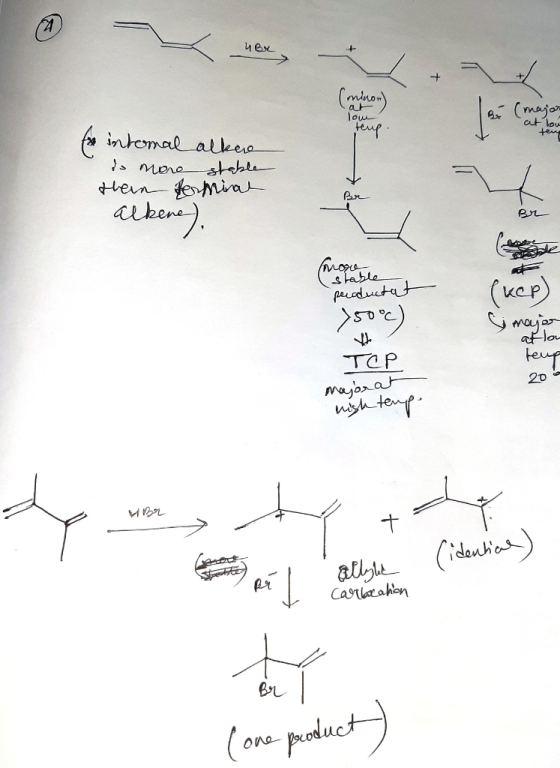
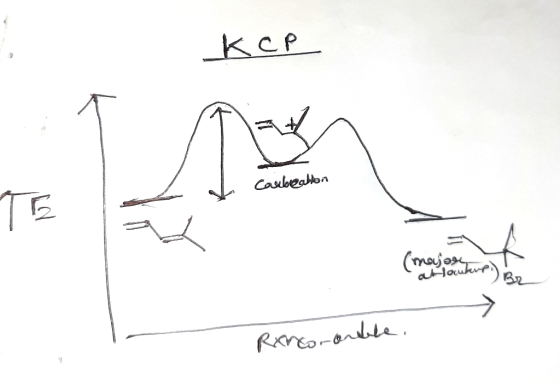
4. The following 2 isomers are reacted with HBr, first at low temperatures (<-20°C) and then...
(a) Answer TWO of (i), (ii) or (iii) [2 x 6 marks] (i) The two isomers...
 (a) Answer TWO of (i), (ii) or (iii) [2 x 6 marks] (i) The two isomers shown below undergo E2 elimination at very different rates when reacted with KO'Bu. Me • Me Me Br Br (A) Draw structural representations of both isomers. (B) Indicate which isomer will react faster. (C) Give the structure of the product and provide a reaction mechanism for its formation.
Answer the following questions to complete your Results and Discussion section for this experiment. HBr HBr...
 Answer the following questions to complete your Results and Discussion section for this experiment. HBr HBr A B Br Br 1 2 2. Does a more negative heat of formation (a larger negative number) mean that a compound formation? Draw an energy diagram that illustrates this. more stable or less stable than an isomer with a less negative heat of Drawing this on paper and uploading an image is recommended 3. There is a third bromobutene structure that could have...
3&4 a Week+15+Workshop Questions.pdf (page 2 of 4) Highlight Rotate Markup hindered base NaN(SiMes). 3. "Cirele...
 3&4
a Week+15+Workshop Questions.pdf (page 2 of 4) Highlight Rotate Markup hindered base NaN(SiMes). 3. "Cirele each compound that has a conjugated x system. 0 4. ."Draw the major product expected for each reaction, showing the mechanism for its formation. HBr 0°c HBr 40°C
3&4
a Week+15+Workshop Questions.pdf (page 2 of 4) Highlight Rotate Markup hindered base NaN(SiMes). 3. "Cirele each compound that has a conjugated x system. 0 4. ."Draw the major product expected for each reaction, showing the mechanism for its formation. HBr 0°c HBr 40°C
E2 Reaction 2. Draw all constitutional isomers formed in each E2 reaction and predict the major...
 E2 Reaction 2. Draw all constitutional isomers formed in each E2 reaction and predict the major product using the Zaitsev rule. Be OH El Reaction 3. What alkene is the major product formed from each alkyl halide in an El reaction? 4. Label the mechanism as SN2, SN1, E2 or El. You do not have to draw the product(s). CHO CH3-C-CH2-CH CH
Provide the major organic product of the reaction shown below. HBr (2 eq.) -C =C -H....
 Provide the major organic product of the reaction shown below. HBr (2 eq.) -C =C -H. Draw the molecule on the canvas by choosing buttons from the Tools (for bonds), Atoms, and Advanced Template toolbars. The single bond is active by default. 3 Co. . ®. H: 200 m O + 1'? Marvin JS ChemAxon
Problem #2. Alkene Spectroscopy a) Draw in two of the major fragmentation products of the radical...
 Problem #2. Alkene Spectroscopy a) Draw in two of the major fragmentation products of the radical cation of this alkene in the boxes provided. Clearly indicate if each compound is a radical, a cation, or a radical cation. -4 m/z 125 m/z = 97 b) Briefly describe the diagnostic peaks for the alkene from part a) in the IR spectrum. Explain where you would look (which cm) and what you would see. Since we are focusing on diagnostic peaks here,...
Please help me with the following questions: A) Draw all isomers of C4H9Br, name then and...
Please help me with the following questions: A) Draw all isomers of C4H9Br, name then and arrange them in order of decreasing reactivity in Sn1 reaction. B) Give the products (if any) of the E2 reaction of the following substrates: 1) CH3CH2I 2) CH3I 3) (CH3)3CCl 4) (CH3)3CCH2I C) Write all the products for the E1 reaction of 3-bromo-2,3-dimethylpentane with a base and heat. Indicate which product is the major one and why. Explain!
4. Draw the major organic product(s) for each of the following reactions. HBr, ROOR a. 1....
 4. Draw the major organic product(s) for each of the following reactions. HBr, ROOR a. 1. 03 b. 2. H202 1. Os04 c. 2. H2S
4. Predict the products of the following reactions & indicate whether they are most likely to...
 4. Predict the products of the following reactions & indicate whether they are most likely to go through an SN2, SN1, E1, or E2 mechanism. NaCN DMSO NaOH CH3OH heat Only one product is formed in the following E2 elimination reaction. Draw an arrow-pushing mechanism for the reaction and provide the correct product structure. Include a 3-D drawing (chair conformation) displaying proper stereochemistry of the transition state to explain formation of only the major product. CH3 •Br NaOCH3 ~"'CHS
2) a- Provide the reagents (A, B and C) and the product D in the following...
 2) a- Provide the reagents (A, B and C) and the product D in the following multistep synthesis b- Write the name of product I. DII C) a-Draw the product for each step of the reaction. b-Name each reaction in the scheme. 3) 1) 3 eq. NaNH2 2) NH4CI Br NaH HBr, H202
 (a) Answer TWO of (i), (ii) or (iii) [2 x 6 marks] (i) The two isomers shown below undergo E2 elimination at very different rates when reacted with KO'Bu. Me • Me Me Br Br (A) Draw structural representations of both isomers. (B) Indicate which isomer will react faster. (C) Give the structure of the product and provide a reaction mechanism for its formation.
 Answer the following questions to complete your Results and Discussion section for this experiment. HBr HBr A B Br Br 1 2 2. Does a more negative heat of formation (a larger negative number) mean that a compound formation? Draw an energy diagram that illustrates this. more stable or less stable than an isomer with a less negative heat of Drawing this on paper and uploading an image is recommended 3. There is a third bromobutene structure that could have...
 3&4
a Week+15+Workshop Questions.pdf (page 2 of 4) Highlight Rotate Markup hindered base NaN(SiMes). 3. "Cirele each compound that has a conjugated x system. 0 4. ."Draw the major product expected for each reaction, showing the mechanism for its formation. HBr 0°c HBr 40°C
3&4
a Week+15+Workshop Questions.pdf (page 2 of 4) Highlight Rotate Markup hindered base NaN(SiMes). 3. "Cirele each compound that has a conjugated x system. 0 4. ."Draw the major product expected for each reaction, showing the mechanism for its formation. HBr 0°c HBr 40°C
 E2 Reaction 2. Draw all constitutional isomers formed in each E2 reaction and predict the major product using the Zaitsev rule. Be OH El Reaction 3. What alkene is the major product formed from each alkyl halide in an El reaction? 4. Label the mechanism as SN2, SN1, E2 or El. You do not have to draw the product(s). CHO CH3-C-CH2-CH CH
 Provide the major organic product of the reaction shown below. HBr (2 eq.) -C =C -H. Draw the molecule on the canvas by choosing buttons from the Tools (for bonds), Atoms, and Advanced Template toolbars. The single bond is active by default. 3 Co. . ®. H: 200 m O + 1'? Marvin JS ChemAxon
 Problem #2. Alkene Spectroscopy a) Draw in two of the major fragmentation products of the radical cation of this alkene in the boxes provided. Clearly indicate if each compound is a radical, a cation, or a radical cation. -4 m/z 125 m/z = 97 b) Briefly describe the diagnostic peaks for the alkene from part a) in the IR spectrum. Explain where you would look (which cm) and what you would see. Since we are focusing on diagnostic peaks here,...
 4. Draw the major organic product(s) for each of the following reactions. HBr, ROOR a. 1. 03 b. 2. H202 1. Os04 c. 2. H2S
 4. Predict the products of the following reactions & indicate whether they are most likely to go through an SN2, SN1, E1, or E2 mechanism. NaCN DMSO NaOH CH3OH heat Only one product is formed in the following E2 elimination reaction. Draw an arrow-pushing mechanism for the reaction and provide the correct product structure. Include a 3-D drawing (chair conformation) displaying proper stereochemistry of the transition state to explain formation of only the major product. CH3 •Br NaOCH3 ~"'CHS
 2) a- Provide the reagents (A, B and C) and the product D in the following multistep synthesis b- Write the name of product I. DII C) a-Draw the product for each step of the reaction. b-Name each reaction in the scheme. 3) 1) 3 eq. NaNH2 2) NH4CI Br NaH HBr, H202
Most questions answered within 3 hours.
-
Where is the error in this code sequence?
String s1 = "Hello";
String s2 = "ello";...
asked 11 months ago -
Financial data for Joel de Paris, Inc., for last year
follow:
Joel de Paris, Inc.
Balance...
asked 11 months ago -
Consider this reaction:
Al2(SO4)3 (aq)+ BaCl3
(aq) Al2Cl6 (aq)- +
3BaSO4(s) . What is the...
asked 11 months ago -
Suppose that Savneet is considering increasing her
recent random sample from 20 car rentals to 40...
asked 11 months ago -
Trucks arrive at an unloading terminal at an average rate of 120
per hour.
Trucks arrive...
asked 11 months ago -
Why are methanol and ethanol completely soluble in water while
octanol is not very little soluble....
asked 11 months ago -
A facilities manager at a university reads in a research report
that the mean amount of...
asked 11 months ago -
When the CuSO4 is rehydrated by adding water to the anhydrous
compound, is this an endothermic...
asked 11 months ago -
A ray of sunlight is passing from diamond into crown glass; the
angle of incidence is...
asked 11 months ago -
A block of mass 0.249 kg is placed on top of a light, vertical
spring of...
asked 11 months ago -
how do the kidneys compensate in the presences of acidosis
a) trigger hyperventilate
b) reserve acid...
asked 11 months ago -
Question 501 pts
The rental rate of capital to the firm increases. Which of the
following...
asked 11 months ago