
Homework Answers
Do rate if you understand
Add Answer to:
2. Enormous numbers of microwave photons are needed to warm macroscopic samples of matter. A 252...
Enormous numbers of microwave photons are needed to warm macroscopic samples of matter. A portion of...
Enormous numbers of microwave photons are needed to warm macroscopic samples of matter. A portion of soup containing 360.406 g of water is heated in a microwave oven from 15.9°C to 85°C, with radiation of wavelength 1.81×10⁻²m. How many moles of photons are absorbed by the water in the soup?
Enormous numbers of microwave photons are needed to warm macroscopic samples of matter. A portion of...
Enormous numbers of microwave photons are needed to warm macroscopic samples of matter. A portion of soup containing 204.373 g of water is heated in a microwave oven from 19.4°C to 88.7°C, with radiation of wavelength 1.32×10⁻²m. How many moles of photons are absorbed by the water in the soup?
Be sure to answer all parts. Enormous numbers of microwave photons are needed to warm macroscopic...
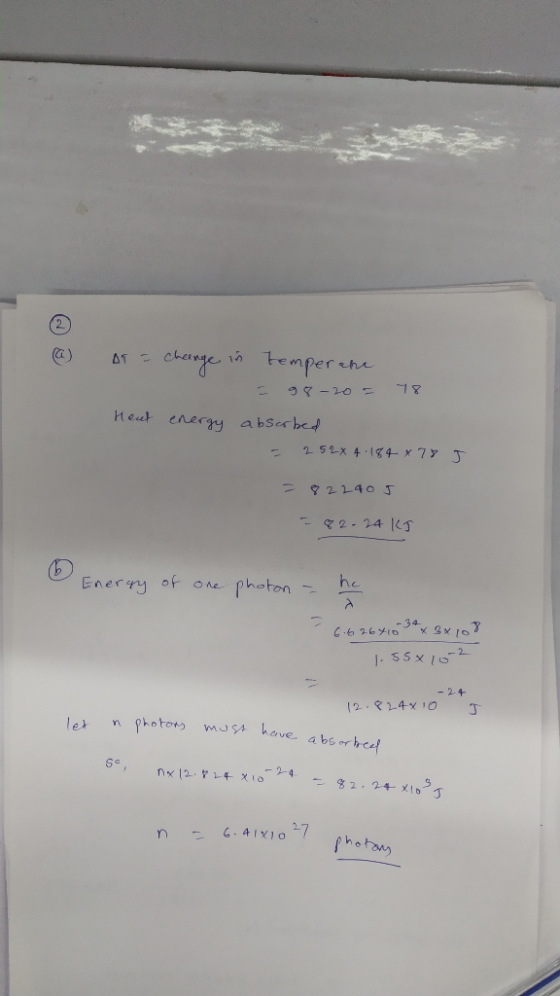
 Be sure to answer all parts. Enormous numbers of microwave photons are needed to warm macroscopic samples of matter. A portion of soup containing 149 g of water is heated in a microwave oven from 20.0°C to 98.0°C, with radiation of wavelength 1.55 x 10⁻² m. How many photons are absorbed by the water in the soup? x 10l (select) photons (Enter your answer in scientific notation.)
3 attempts left Check my work 36 Be sure to answer all parts. nts Enormous numbers...
 3 attempts left Check my work 36 Be sure to answer all parts. nts Enormous numbers of microwave photons are needed to warm macroscopic samples of matter. A portion of soup containing 269 g of water is heated in a microwave oven from 20.0°C to 98.0°C, with radiation of wavelength 1.55 10 m. How many photons are absorbed by the water in the soup? * 10 (select photons (Enter your answer in scientific notation.) eBook
Chapter 7 (Quantum Theory and Atomic Structure) 34 3 attempts left Check my work Enter your...
 Chapter 7 (Quantum Theory and Atomic Structure) 34 3 attempts left Check my work Enter your answer in the provided box. Rep points A ground-state H atom absorbs a photon of wavelength 92.31 nm. What higher energy level did the electron reach? eBook Guide 3 attempts left Check my work Be sure to answer all parts. points Enormous numbers of microwave photons are needed to warm macroscopic samples of matter. A portion of soup containing 269 g of water is...
A 553 g portion of soup is heated in a microwave oven from 25°C to 90°C,...
A 553 g portion of soup is heated in a microwave oven from 25°C to 90°C, using radiation with a wavelength of 1.55 × 10⁻² m. Assuming the heat capacity of the soup is the same as water (4.18 J/°C・g), how many photons are absorbed by the soup?
Amicrowave oven heats food by radiating it with microwave radiation. This radiation is absorbed by the...
 Amicrowave oven heats food by radiating it with microwave radiation. This radiation is absorbed by the food and converted to heat 1st attempt See Hint Jad See Periodic Table Suppose an oven's radiation wavelength is 0.125 m. A container with 250.00 g of water was placed in the oven, and the temperature of the water rose from 20.0°C to 80.0C. How many photons of this microwave radiation were required to heat the water? (Assume that all the energy from the...
Microwave ovens use microwave radiation to heat food. The microwaves are absorbed by the water molecules...
Microwave ovens use microwave radiation to heat food. The microwaves are absorbed by the water molecules in the food, which is transferred to other components of the food. As the water becomes hotter, so does the food. Suppose that the microwave radiation has a wavelength of 12.4 cm . How many photons are required to heat 235 mL of coffee from 25.0 ∘C to 62.0 ∘C? Assume that the coffee has the same density, 0.997 g/mL, and specific heat capacity,...
Microwave ovens use microwave radiation to heat food. The microwaves are absorbed by the water molecules...
 Microwave ovens use microwave radiation to heat food. The microwaves are absorbed by the water molecules in the food, which is transferred to other components of the food. As the water becomes hotter, so does the food. Part A Suppose that the microwave radiation has a wavelength of 12.4 cm. How many photons are required to heat 285 mL of coffee from 25.0°C to 62.0 °C? Assume that the coffee has the same density, 0.997 g/mL, and specific heat capacity...
Using Microwave Radiation to Heat Coffee (expanded) Microwave ovens use microwave radiation to heat food. The...
Using Microwave Radiation to Heat Coffee (expanded) Microwave ovens use microwave radiation to heat food. The microwaves are absorbed by the water molecules in the food, which is transferred to other components of the food. As the water becomes hotter, so does the food. Part A Suppose that the microwave radiation has a wavelength of 12.4 cm . How many photons are required to heat 215 mL of coffee from 25.0 ∘C to 64.6 ∘C? The coffee has a density...
 Be sure to answer all parts. Enormous numbers of microwave photons are needed to warm macroscopic samples of matter. A portion of soup containing 149 g of water is heated in a microwave oven from 20.0°C to 98.0°C, with radiation of wavelength 1.55 x 10⁻² m. How many photons are absorbed by the water in the soup? x 10l (select) photons (Enter your answer in scientific notation.)
 3 attempts left Check my work 36 Be sure to answer all parts. nts Enormous numbers of microwave photons are needed to warm macroscopic samples of matter. A portion of soup containing 269 g of water is heated in a microwave oven from 20.0°C to 98.0°C, with radiation of wavelength 1.55 10 m. How many photons are absorbed by the water in the soup? * 10 (select photons (Enter your answer in scientific notation.) eBook
 Chapter 7 (Quantum Theory and Atomic Structure) 34 3 attempts left Check my work Enter your answer in the provided box. Rep points A ground-state H atom absorbs a photon of wavelength 92.31 nm. What higher energy level did the electron reach? eBook Guide 3 attempts left Check my work Be sure to answer all parts. points Enormous numbers of microwave photons are needed to warm macroscopic samples of matter. A portion of soup containing 269 g of water is...
 Amicrowave oven heats food by radiating it with microwave radiation. This radiation is absorbed by the food and converted to heat 1st attempt See Hint Jad See Periodic Table Suppose an oven's radiation wavelength is 0.125 m. A container with 250.00 g of water was placed in the oven, and the temperature of the water rose from 20.0°C to 80.0C. How many photons of this microwave radiation were required to heat the water? (Assume that all the energy from the...
 Microwave ovens use microwave radiation to heat food. The microwaves are absorbed by the water molecules in the food, which is transferred to other components of the food. As the water becomes hotter, so does the food. Part A Suppose that the microwave radiation has a wavelength of 12.4 cm. How many photons are required to heat 285 mL of coffee from 25.0°C to 62.0 °C? Assume that the coffee has the same density, 0.997 g/mL, and specific heat capacity...
Most questions answered within 3 hours.
-
Where is the error in this code sequence?
String s1 = "Hello";
String s2 = "ello";...
asked 11 months ago -
Financial data for Joel de Paris, Inc., for last year
follow:
Joel de Paris, Inc.
Balance...
asked 11 months ago -
Consider this reaction:
Al2(SO4)3 (aq)+ BaCl3
(aq) Al2Cl6 (aq)- +
3BaSO4(s) . What is the...
asked 11 months ago -
Suppose that Savneet is considering increasing her
recent random sample from 20 car rentals to 40...
asked 11 months ago -
Trucks arrive at an unloading terminal at an average rate of 120
per hour.
Trucks arrive...
asked 11 months ago -
Why are methanol and ethanol completely soluble in water while
octanol is not very little soluble....
asked 11 months ago -
A facilities manager at a university reads in a research report
that the mean amount of...
asked 11 months ago -
When the CuSO4 is rehydrated by adding water to the anhydrous
compound, is this an endothermic...
asked 11 months ago -
A ray of sunlight is passing from diamond into crown glass; the
angle of incidence is...
asked 11 months ago -
A block of mass 0.249 kg is placed on top of a light, vertical
spring of...
asked 11 months ago -
how do the kidneys compensate in the presences of acidosis
a) trigger hyperventilate
b) reserve acid...
asked 11 months ago -
Question 501 pts
The rental rate of capital to the firm increases. Which of the
following...
asked 11 months ago