
Homework Answers
here this is is binomial distribution for which parameter n=10 and p=0.05
we are assuming that sample is random ; and probability of one product being defective is independent of other product.
P(full inspection)=P(2 or more defective)=P(X>=2)=1-P(X<=1)=1-(P(X=0)+P(X=1))
=1-10C0(0.05)0(0.95)10-10C1(0.05)1(0.95)9 =0.0861
Add Answer to:
A sample of 10 is taken from a day's output of a machine that produces parts...
A machine produces an average of 10% defective bolts. A batch is accepted if a sample...
A machine produces an average of 10% defective bolts. A batch is accepted if a sample of five bolts taken from the batch that contains no defective and rejected if the sample contains 3 or more defectives. In other cases, a second sample is taken. 1- ehatvis rhe probability that the second sample will be required 2- what Is the probability that the sample is rejected 3- if 15 bolts are taken from a batch, how many bolts are defective
a production process produces 4% defective parts. a sample of six parts from the production process...
a production process produces 4% defective parts. a sample of six parts from the production process is selected. what is the probability that the sample contains more than one defective parts
A machine that manufactures automobile parts produces defective parts 13% of the time. If 10 parts produced...
A machine that manufactures automobile parts produces defective parts 13% of the time. If 10 parts produced by this machine are randomly selected, what is the probability that at least 2 of the parts are defective? Carry your intermediate computations to at least four decimal places, and round your answer to at least two decimal places.
6) If 10% of the parts produced by a machine are defective, find the probability of...
 6) If 10% of the parts produced by a machine are defective, find the probability of at least one defective part in a random sample of five. Use probability notation to solve this problem.
6) If 10% of the parts produced by a machine are defective, find the probability of...
 6) If 10% of the parts produced by a machine are defective, find the probability of at least one defective part in a random sample of five. Use probability notation to solve this problem.
:Among 20 metal parts produced in a machine shop, 5 are defective. If a random sample...
:Among 20 metal parts produced in a machine shop, 5 are defective. If a random sample of three of these metal parts is selected, find: 1. The probability that this sample will contain at least two defectives? 2. The probability that this sample will contain at most one defective? Note: Use hypergeometric probability formula
A sample of 200 machined parts is selected from the 1-week production of a machine shop...
A sample of 200 machined parts is selected from the 1-week production of a machine shop that employs three machinists. The parts are inspected to determine whether they are defective, and they are categorized according to which machine did the work. The observed counts are given in Table. We want to determine the independence of defective/nondefective classification and machinist classification at the 1% significance level. Observed (Expected) Cell Counts for Machinist A Machinist B Machinist C Defective 10 8 14...
In a factory, only two machines, A and B, manufacture washers. Neither machine is perfect: machine...
In a factory, only two machines, A and B, manufacture washers. Neither machine is perfect: machine A produces defective washers 14% of the time, while machine B produces defectives 10% of the time. Machine B is more efficient than machine A and accounts for 80% of the total output of washers. For purposes of quality control, a sample of washers is taken and examined for defectives. Compute the probability that a randomly chosen washer found to be defective was manufactured...
5. A certain production process produces 20 defective parts out of 200. An engineer designs a change in the process whi...
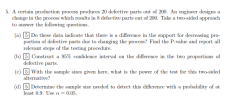 5. A certain production process produces 20 defective parts out of 200. An engineer designs a change in the process which results in 8 defective parts out of 200. Take a two-sided approach to answer the following questions. (a) 5 Do these data indicate that there is a difference in the support for decreasing pro- portion of defective parts due to changing the process? Find the P-value and report all relevant steps of the testing procedure. (b) Construct a 95%...
There are 5% defective parts manufactured by your production line, and you would like to find...
There are 5% defective parts manufactured by your production line, and you would like to find these before they are shipped. A quick and inexpensive inspection method has been devised that identifies 8% of parts as defective. Of parts identified as defective, 50% are truly defective. a. Complete a probability tree for this situation. b. Find the probability that a defective part will be identified (ie, the conditional probability of being identified given that the part was defective). c. Find...
 6) If 10% of the parts produced by a machine are defective, find the probability of at least one defective part in a random sample of five. Use probability notation to solve this problem.
 6) If 10% of the parts produced by a machine are defective, find the probability of at least one defective part in a random sample of five. Use probability notation to solve this problem.
 5. A certain production process produces 20 defective parts out of 200. An engineer designs a change in the process which results in 8 defective parts out of 200. Take a two-sided approach to answer the following questions. (a) 5 Do these data indicate that there is a difference in the support for decreasing pro- portion of defective parts due to changing the process? Find the P-value and report all relevant steps of the testing procedure. (b) Construct a 95%...
Most questions answered within 3 hours.
-
Where is the error in this code sequence?
String s1 = "Hello";
String s2 = "ello";...
asked 11 months ago -
Financial data for Joel de Paris, Inc., for last year
follow:
Joel de Paris, Inc.
Balance...
asked 11 months ago -
Consider this reaction:
Al2(SO4)3 (aq)+ BaCl3
(aq) Al2Cl6 (aq)- +
3BaSO4(s) . What is the...
asked 11 months ago -
Suppose that Savneet is considering increasing her
recent random sample from 20 car rentals to 40...
asked 11 months ago -
Trucks arrive at an unloading terminal at an average rate of 120
per hour.
Trucks arrive...
asked 11 months ago -
Why are methanol and ethanol completely soluble in water while
octanol is not very little soluble....
asked 11 months ago -
A facilities manager at a university reads in a research report
that the mean amount of...
asked 11 months ago -
When the CuSO4 is rehydrated by adding water to the anhydrous
compound, is this an endothermic...
asked 11 months ago -
A ray of sunlight is passing from diamond into crown glass; the
angle of incidence is...
asked 11 months ago -
A block of mass 0.249 kg is placed on top of a light, vertical
spring of...
asked 11 months ago -
how do the kidneys compensate in the presences of acidosis
a) trigger hyperventilate
b) reserve acid...
asked 11 months ago -
Question 501 pts
The rental rate of capital to the firm increases. Which of the
following...
asked 11 months ago