For each of the following utility functions, draw an indifference map with 3 indifference curves. Be...
For each of the following utility functions, draw an indifference map with 3 indifference curves. Be sure to label your axes, and label your curves as IC1, IC2, and IC3, where U1 < U2 < U3. (5 points each) a. ?(?, ?) = 3? + 5? b. ?(?, ?) = ? 2 + ? 2 c. ?(?, ?) = −? 2 + ln(?) d. ?(?, ?) = min(3?, 5?)
Homework Answers
a)
The utility function is given as
This is an equation of a straight line. The goods are a perfect substitute, and hence the ICs are a straight line. The higher the utility, the further away the ICs are from the origin. The three ICs with their respective utilities are:
The indifference map represents the above utility functions for different utilities described above:

===================================================================================
b)
The utility function is given as
This is an equation of a circle. In the positive quadrant, it is concave to the origin. The goods are bad to the consumer, and hence the ICs are concave to the origin. The higher the utility, the further away the ICs are from the origin. The three ICs with their respective utilities are:
The indifference map represents the above utility functions for different utilities described above:

==============================================================================
c)
The utility function is given as
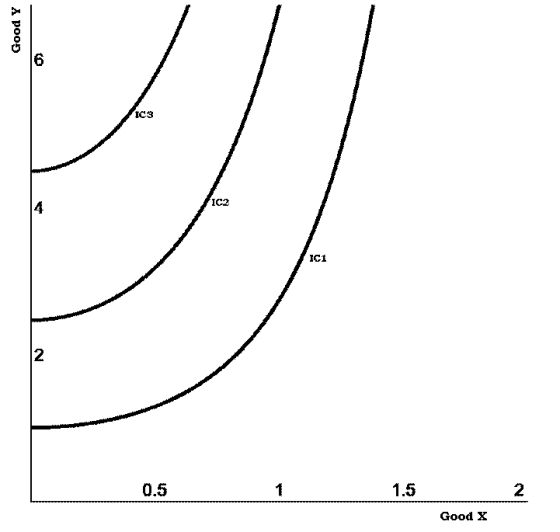
This is an equation of a parabola. In the positive quadrant, it is positively sloped and concave. This implies one of the goods is bad to the consumer, and hence the ICs are concave to the origin. The higher the utility, the further away the ICs are from the origin. The three ICs with their respective utilities are:
The indifference map represents the above utility functions for different utilities described above:
====================================================================================
d)
The utility function is given as
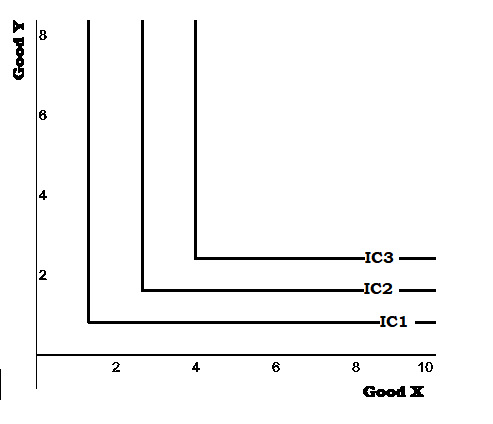
This is an equation of a right-angled curve. This implies one of the goods are perfect complement and used in a fixed proportion, and hence the ICs have a kink. The higher the utility, the further away the ICs are from the origin. The three ICs with their respective utilities are:
The indifference map represents the above utility functions for different utilities described above:
Add Answer to:
For each of the following utility functions, draw an
indifference map with 3 indifference curves. Be...
For each of the following utility functions, draw an indifference map with 3 in curves. Be...
 For each of the following utility functions, draw an indifference map with 3 in curves. Be sure to label your axes, and label your curves as IC1, IC2, and ICs, where difference 1 U2 U (X,Y)=3X+5Y U3. (5 points each) a. U(X, Y) U(X, Y) -X2 + ln(Y) min(3X,5Y) c. d.
Consider the following 3 utility functions with good x and good y: ? ?(?, ?) =...
Consider the following 3 utility functions with good x and good y: ? ?(?, ?) = (?^2)*sqrt(?), ? ?(?, ?) = 2? − (1/2)?, ? ? (?, ?) = 4 ln ? + ln ? a. Find Marginal Utility (MUx and MUy) for each these utility functions. b. Is assumption that more is better satisfied for both goods in all of these utility functions? If not, specify for which function(s) and for which good(s) it is not satisfied. c. Does...
carefully 1. Carefully sketch the indifference curves corresponding to the utility functions and the utility levels...
 carefully
1. Carefully sketch the indifference curves corresponding to the utility functions and the utility levels given below (a) u1 2 and ug 8. (b) ulxi,x) x u8 and ug 512. (c) 2 ules,)InIns u1 0.6931 and ug 2.0794. 4 1. Carefully sketch the indifference curves corresponding to the utility functions and the utility levels given below. (a) u(x1,x2) xx u1 2 and u2 = 8. (b) u(x1,x2) x1x; u1 8 and u2 =512. (c) 2 u(x1,x2)=Inx1 +Inx2; u1 0.6931...
carefully
1. Carefully sketch the indifference curves corresponding to the utility functions and the utility levels given below (a) u1 2 and ug 8. (b) ulxi,x) x u8 and ug 512. (c) 2 ules,)InIns u1 0.6931 and ug 2.0794. 4 1. Carefully sketch the indifference curves corresponding to the utility functions and the utility levels given below. (a) u(x1,x2) xx u1 2 and u2 = 8. (b) u(x1,x2) x1x; u1 8 and u2 =512. (c) 2 u(x1,x2)=Inx1 +Inx2; u1 0.6931...
For the following sets of goods, draw two indifference curves (IC1 and IC2 where IC2 yields...
For the following sets of goods, draw two indifference curves (IC1 and IC2 where IC2 yields a higher level of utility than IC1). Draw each graph so that the quantity of the first good is on the horizonal axis and identify utility functions for part a),b) and c (show all work) a) Sugar and Nutrasweet. The consumer likes them equally well (indifferent between 1 spoon of sugar and 1 spoon of Nutrasweet) b) Peanut butter and Jelly, The consumer always...
The following graph shows a variety of possible indifference curves (labeled IC1, IC2, and IC3, respectively)...
 The following graph shows a variety of possible indifference curves (labeled IC1, IC2, and IC3, respectively) for Latasha. Each indifference curve represents a different level of happiness. RASPBERRIES (Pints per month 10 Budget Constraint Best Bundle IC3 C1 0 2 3 456 7 8 9 10 STRAWBERRIES (Pints per month) HelpClear ALl The shape of the indifference curves indicates that the goods strawberries and raspberries must be Suppose the price of strawberries is $3 per pint, the price of raspberries...
4. [25 POINTS]Use separate graphs to draw indifference curves for each of the following utility functions: (a) 6 POINTS...
 4. [25 POINTS]Use separate graphs to draw indifference curves for each of the following utility functions: (a) 6 POINTS] U (x, y) = min{2x + y, 2y + x}. (b) [6 PoINts] U (x,y) = max{2.x + y, 2y + x}. (c) 6 POINTS] U (x,y) = x + min {x, y}. (d) 7 POINTS] In which of these cases are preferences convex?
4. [25 POINTS]Use separate graphs to draw indifference curves for each of the following utility functions: (a)...
4. [25 POINTS]Use separate graphs to draw indifference curves for each of the following utility functions: (a) 6 POINTS] U (x, y) = min{2x + y, 2y + x}. (b) [6 PoINts] U (x,y) = max{2.x + y, 2y + x}. (c) 6 POINTS] U (x,y) = x + min {x, y}. (d) 7 POINTS] In which of these cases are preferences convex?
4. [25 POINTS]Use separate graphs to draw indifference curves for each of the following utility functions: (a)...
For each of the following functions, i) pick three utility levels and draw the precise indifference...
 For each of the following functions, i) pick three utility levels and draw the precise indifference curves that are associated with the levels of your choice, ii) label the utility level of the lines--you cannot just draw random lines and assign arbitrary utility levels, and iii) give the name of preferences they represent (hint: see figures in textbook chapter 3) 2. u(x,2) -min(xi,x2) 5. u(xi, x2) -xjx2
please answer all questions 2. Draw the graph of an indifference curve map for the utility...
 please answer all questions
2. Draw the graph of an indifference curve map for the utility function U(X,Y)= XY. Put good X on X-axis and good Y on Y-axis. Draw at least 3 indifference curves and label the utility level for each indifference curve. Explain why or why not do the indifference curves cross each other on the map.
please answer all questions
2. Draw the graph of an indifference curve map for the utility function U(X,Y)= XY. Put good X on X-axis and good Y on Y-axis. Draw at least 3 indifference curves and label the utility level for each indifference curve. Explain why or why not do the indifference curves cross each other on the map.
For each of the following functions, i) pick three utility levels and draw the precise indifference...
 For each of the following functions, i) pick three utility levels and draw the precise indifference curves that are associated with the levels of your choice, ii) label the utility level of the lines -- you cannot just draw random lines and assign arbitrary utility levels, and iii) give the name of preferences they represent (hint: see figures in textbook chapter 3). 1. u(x1, 12) = I1 + 2.12 2. u(21, 22) = min(21, 22) 3. u(x1,22) = 21 4....
Draw indifference curves to represent the following consumer preferences. For each set of preferences draw two...
 Draw indifference curves to represent the following consumer
preferences. For each set of preferences draw two indifference
curves U1 and U2 such like, U1 > U2
e) I like peanut butter and jelly, and have a diminishing marginal rate of substitution. f) I like to consume exactly 5 ounces of peanut butter and 5 ounces of jelly. The further away I get from this point, in any direction, the less happy I am.
Draw indifference curves to represent the following consumer
preferences. For each set of preferences draw two indifference
curves U1 and U2 such like, U1 > U2
e) I like peanut butter and jelly, and have a diminishing marginal rate of substitution. f) I like to consume exactly 5 ounces of peanut butter and 5 ounces of jelly. The further away I get from this point, in any direction, the less happy I am.
 For each of the following utility functions, draw an indifference map with 3 in curves. Be sure to label your axes, and label your curves as IC1, IC2, and ICs, where difference 1 U2 U (X,Y)=3X+5Y U3. (5 points each) a. U(X, Y) U(X, Y) -X2 + ln(Y) min(3X,5Y) c. d.
 carefully
1. Carefully sketch the indifference curves corresponding to the utility functions and the utility levels given below (a) u1 2 and ug 8. (b) ulxi,x) x u8 and ug 512. (c) 2 ules,)InIns u1 0.6931 and ug 2.0794. 4 1. Carefully sketch the indifference curves corresponding to the utility functions and the utility levels given below. (a) u(x1,x2) xx u1 2 and u2 = 8. (b) u(x1,x2) x1x; u1 8 and u2 =512. (c) 2 u(x1,x2)=Inx1 +Inx2; u1 0.6931...
carefully
1. Carefully sketch the indifference curves corresponding to the utility functions and the utility levels given below (a) u1 2 and ug 8. (b) ulxi,x) x u8 and ug 512. (c) 2 ules,)InIns u1 0.6931 and ug 2.0794. 4 1. Carefully sketch the indifference curves corresponding to the utility functions and the utility levels given below. (a) u(x1,x2) xx u1 2 and u2 = 8. (b) u(x1,x2) x1x; u1 8 and u2 =512. (c) 2 u(x1,x2)=Inx1 +Inx2; u1 0.6931...
 The following graph shows a variety of possible indifference curves (labeled IC1, IC2, and IC3, respectively) for Latasha. Each indifference curve represents a different level of happiness. RASPBERRIES (Pints per month 10 Budget Constraint Best Bundle IC3 C1 0 2 3 456 7 8 9 10 STRAWBERRIES (Pints per month) HelpClear ALl The shape of the indifference curves indicates that the goods strawberries and raspberries must be Suppose the price of strawberries is $3 per pint, the price of raspberries...
 4. [25 POINTS]Use separate graphs to draw indifference curves for each of the following utility functions: (a) 6 POINTS] U (x, y) = min{2x + y, 2y + x}. (b) [6 PoINts] U (x,y) = max{2.x + y, 2y + x}. (c) 6 POINTS] U (x,y) = x + min {x, y}. (d) 7 POINTS] In which of these cases are preferences convex?
4. [25 POINTS]Use separate graphs to draw indifference curves for each of the following utility functions: (a)...
4. [25 POINTS]Use separate graphs to draw indifference curves for each of the following utility functions: (a) 6 POINTS] U (x, y) = min{2x + y, 2y + x}. (b) [6 PoINts] U (x,y) = max{2.x + y, 2y + x}. (c) 6 POINTS] U (x,y) = x + min {x, y}. (d) 7 POINTS] In which of these cases are preferences convex?
4. [25 POINTS]Use separate graphs to draw indifference curves for each of the following utility functions: (a)...
 For each of the following functions, i) pick three utility levels and draw the precise indifference curves that are associated with the levels of your choice, ii) label the utility level of the lines--you cannot just draw random lines and assign arbitrary utility levels, and iii) give the name of preferences they represent (hint: see figures in textbook chapter 3) 2. u(x,2) -min(xi,x2) 5. u(xi, x2) -xjx2
 please answer all questions
2. Draw the graph of an indifference curve map for the utility function U(X,Y)= XY. Put good X on X-axis and good Y on Y-axis. Draw at least 3 indifference curves and label the utility level for each indifference curve. Explain why or why not do the indifference curves cross each other on the map.
please answer all questions
2. Draw the graph of an indifference curve map for the utility function U(X,Y)= XY. Put good X on X-axis and good Y on Y-axis. Draw at least 3 indifference curves and label the utility level for each indifference curve. Explain why or why not do the indifference curves cross each other on the map.
 For each of the following functions, i) pick three utility levels and draw the precise indifference curves that are associated with the levels of your choice, ii) label the utility level of the lines -- you cannot just draw random lines and assign arbitrary utility levels, and iii) give the name of preferences they represent (hint: see figures in textbook chapter 3). 1. u(x1, 12) = I1 + 2.12 2. u(21, 22) = min(21, 22) 3. u(x1,22) = 21 4....
 Draw indifference curves to represent the following consumer
preferences. For each set of preferences draw two indifference
curves U1 and U2 such like, U1 > U2
e) I like peanut butter and jelly, and have a diminishing marginal rate of substitution. f) I like to consume exactly 5 ounces of peanut butter and 5 ounces of jelly. The further away I get from this point, in any direction, the less happy I am.
Draw indifference curves to represent the following consumer
preferences. For each set of preferences draw two indifference
curves U1 and U2 such like, U1 > U2
e) I like peanut butter and jelly, and have a diminishing marginal rate of substitution. f) I like to consume exactly 5 ounces of peanut butter and 5 ounces of jelly. The further away I get from this point, in any direction, the less happy I am.
Most questions answered within 3 hours.
-
Where is the error in this code sequence?
String s1 = "Hello";
String s2 = "ello";...
asked 11 months ago -
Financial data for Joel de Paris, Inc., for last year
follow:
Joel de Paris, Inc.
Balance...
asked 11 months ago -
Consider this reaction:
Al2(SO4)3 (aq)+ BaCl3
(aq) Al2Cl6 (aq)- +
3BaSO4(s) . What is the...
asked 11 months ago -
Suppose that Savneet is considering increasing her
recent random sample from 20 car rentals to 40...
asked 11 months ago -
Trucks arrive at an unloading terminal at an average rate of 120
per hour.
Trucks arrive...
asked 11 months ago -
Why are methanol and ethanol completely soluble in water while
octanol is not very little soluble....
asked 11 months ago -
A facilities manager at a university reads in a research report
that the mean amount of...
asked 11 months ago -
When the CuSO4 is rehydrated by adding water to the anhydrous
compound, is this an endothermic...
asked 11 months ago -
A ray of sunlight is passing from diamond into crown glass; the
angle of incidence is...
asked 11 months ago -
A block of mass 0.249 kg is placed on top of a light, vertical
spring of...
asked 11 months ago -
how do the kidneys compensate in the presences of acidosis
a) trigger hyperventilate
b) reserve acid...
asked 11 months ago -
Question 501 pts
The rental rate of capital to the firm increases. Which of the
following...
asked 11 months ago