
Homework Answers
Answer) i) Auricle- Description (D)- Visible part of the ear, also known as pinnacle.
ii) External auditory canal- Connection (C)- Outside one-third portion of the canal is made up of cartilage and rest is made up of bones.
iii) Tympanic Membrane- D- This is a membrane at the end of external auditory canal which transmit sound signals from outside to auditory ossicles.
C- It consists of three layer: outside skin layer, middle layer made up of radial and circular fibre, and outside mucous layer. This membrane has blood vessels and sensory nerves attached to it which makes it sensitive to pain.
iv) Auditory ossicles- D- Tympanic membrane leads to the tympanic cavity where the auditory ossicles is present. It is made up of three bones, named as, malleus (outside), incus (middle), and stapes (inside).
Add Answer to:
Making Connections: The Structure of the Ear Connections to Things I Have Already Learned Description (Structure...
Please type answer Explain functions of these structures: a. Outer Ear: pinna, external auditory meatus (ear...
Please type answer Explain functions of these structures: a. Outer Ear: pinna, external auditory meatus (ear canal), tympanic membrane b. Middle ear: oval window, round window, eustachian tube, malleus, incus, stapes c. Inner ear: perilymph, endolymph, cochlea, vestibule, semicircular canals, ampulla d. Organ of Corti: hair cells, basilar membrane, tectorial membrane, helicotrema e. Vestibular apparatus: f.Otolith organs (utricle and saccule): Maculae, otoliths, hair cells g. Semicircular canals: crista ampullaris, Cupula (gelatinous cap), hair cells
Special Senses: Hearing and Equilibrium Anatomy of the Ear 1. Identify all indicated structures and ear...
 Special Senses: Hearing and Equilibrium Anatomy of the Ear 1. Identify all indicated structures and ear regions in the following photograph. 338 Review Sheet 19 2. Identify the structures of the middle and internal ear indicated in the following photograph OH 2920922 muildily 3. Select the terms from column B that match the column A descriptions Column B Column A 1. collectively called the auditory ossicles a. ampulla b. ampullary cupula c. basilar membrane 2. sacs found within the vestibule:...
14. The amount of light entering the eye is regulated by the: a) lens b) iris c) cornea d) conjun...
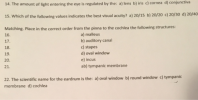 14. The amount of light entering the eye is regulated by the: a) lens b) iris c) cornea d) conjunctiva 15. Which of the following values indicates the best visual acuity? a) 20/15 b) 20/20 c) 20/30 d) 20/40 Matching. Place in the correct order from the pinna to the cochlea the following structures 16. 17 18. 19. 20. 21. a) malleus b) auditory canal c) stapes d) oval window e) incus ab) tympanic membrane 22. The scientific name for...
QUESTION 2 Match the terms with their correct meanings A perilymph B labyrinth C pinna D....
 QUESTION 2 Match the terms with their correct meanings A perilymph B labyrinth C pinna D. eustachian tube E cerumen F. cholesteatoma G myringotomy H otosclerosis I semicircular canals Incision of the eardrum 回Passages in the inner ear that are associated with maintaining equilibrium Surgical repair of the eardrum Waxy substance secreted by the external ear sensation of noises (nnging, buzzng, whistling) in the ears Hardening of bony tissue in the inner ear ankylosis of the stapes may occur Fungal...
QUESTION 1 The sense organ of the eye is a. retina O b. lens O c....
 QUESTION 1 The sense organ of the eye is a. retina O b. lens O c. optic nerve Od.cornea QUESTION 2 The sensory receptors involved in vision are O a. optic nerve O b.rods and cones O c. organ of Corti O d. retina QUESTION 3 The lacrimal d produces a. saliva O b. mucus Oc. oil O d. tears QUESTION 4 The layer of the eye that is highly vascularized is the O a. choroid O b. sclera O...
When light passes between media of different densities, it is bent or refracted. True False Flag...
When light passes between media of different densities, it is bent or refracted. True False Flag this Question Question 2 3 pts Meniere’s disease is caused by an increase in the intraocular pressure. volume of endolymph. none of the above volume of blood. Flag this Question Question 3 3 pts An area of the retina that contains only cones, and is the site of sharpest vision, is the outer segment. inner segment. fovea. optic disc. Flag this Question Question 4...
Hi, please help me with my homework and please do not answer if you intend to...
 Hi, please help me with my homework and please do not answer
if you intend to answers all the questions. Thank you
The Central Nervous System, endocrine system B. Figure 1 Use the diagram above to answer the following question 1) Which letter indicates the primary visual cortex, which receives information from neurons in the retina of the eye? A) A B) B C) C D) D E) E Figure 2 Use the diagram above to answer the following questions....
Hi, please help me with my homework and please do not answer
if you intend to answers all the questions. Thank you
The Central Nervous System, endocrine system B. Figure 1 Use the diagram above to answer the following question 1) Which letter indicates the primary visual cortex, which receives information from neurons in the retina of the eye? A) A B) B C) C D) D E) E Figure 2 Use the diagram above to answer the following questions....
 Special Senses: Hearing and Equilibrium Anatomy of the Ear 1. Identify all indicated structures and ear regions in the following photograph. 338 Review Sheet 19 2. Identify the structures of the middle and internal ear indicated in the following photograph OH 2920922 muildily 3. Select the terms from column B that match the column A descriptions Column B Column A 1. collectively called the auditory ossicles a. ampulla b. ampullary cupula c. basilar membrane 2. sacs found within the vestibule:...
 14. The amount of light entering the eye is regulated by the: a) lens b) iris c) cornea d) conjunctiva 15. Which of the following values indicates the best visual acuity? a) 20/15 b) 20/20 c) 20/30 d) 20/40 Matching. Place in the correct order from the pinna to the cochlea the following structures 16. 17 18. 19. 20. 21. a) malleus b) auditory canal c) stapes d) oval window e) incus ab) tympanic membrane 22. The scientific name for...
 QUESTION 2 Match the terms with their correct meanings A perilymph B labyrinth C pinna D. eustachian tube E cerumen F. cholesteatoma G myringotomy H otosclerosis I semicircular canals Incision of the eardrum 回Passages in the inner ear that are associated with maintaining equilibrium Surgical repair of the eardrum Waxy substance secreted by the external ear sensation of noises (nnging, buzzng, whistling) in the ears Hardening of bony tissue in the inner ear ankylosis of the stapes may occur Fungal...
 QUESTION 1 The sense organ of the eye is a. retina O b. lens O c. optic nerve Od.cornea QUESTION 2 The sensory receptors involved in vision are O a. optic nerve O b.rods and cones O c. organ of Corti O d. retina QUESTION 3 The lacrimal d produces a. saliva O b. mucus Oc. oil O d. tears QUESTION 4 The layer of the eye that is highly vascularized is the O a. choroid O b. sclera O...
 Hi, please help me with my homework and please do not answer
if you intend to answers all the questions. Thank you
The Central Nervous System, endocrine system B. Figure 1 Use the diagram above to answer the following question 1) Which letter indicates the primary visual cortex, which receives information from neurons in the retina of the eye? A) A B) B C) C D) D E) E Figure 2 Use the diagram above to answer the following questions....
Hi, please help me with my homework and please do not answer
if you intend to answers all the questions. Thank you
The Central Nervous System, endocrine system B. Figure 1 Use the diagram above to answer the following question 1) Which letter indicates the primary visual cortex, which receives information from neurons in the retina of the eye? A) A B) B C) C D) D E) E Figure 2 Use the diagram above to answer the following questions....
Most questions answered within 3 hours.
-
Where is the error in this code sequence?
String s1 = "Hello";
String s2 = "ello";...
asked 10 months ago -
Financial data for Joel de Paris, Inc., for last year
follow:
Joel de Paris, Inc.
Balance...
asked 10 months ago -
Consider this reaction:
Al2(SO4)3 (aq)+ BaCl3
(aq) Al2Cl6 (aq)- +
3BaSO4(s) . What is the...
asked 10 months ago -
Suppose that Savneet is considering increasing her
recent random sample from 20 car rentals to 40...
asked 10 months ago -
Trucks arrive at an unloading terminal at an average rate of 120
per hour.
Trucks arrive...
asked 10 months ago -
Why are methanol and ethanol completely soluble in water while
octanol is not very little soluble....
asked 10 months ago -
A facilities manager at a university reads in a research report
that the mean amount of...
asked 10 months ago -
When the CuSO4 is rehydrated by adding water to the anhydrous
compound, is this an endothermic...
asked 10 months ago -
A ray of sunlight is passing from diamond into crown glass; the
angle of incidence is...
asked 10 months ago -
A block of mass 0.249 kg is placed on top of a light, vertical
spring of...
asked 10 months ago -
how do the kidneys compensate in the presences of acidosis
a) trigger hyperventilate
b) reserve acid...
asked 10 months ago -
Question 501 pts
The rental rate of capital to the firm increases. Which of the
following...
asked 10 months ago