
Homework Answers
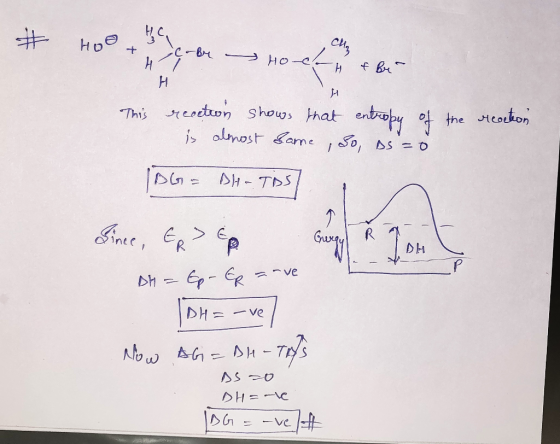
∆G for this process is negative.
The mechanism, rate equation and energy diagram all shows that this is a SN² reaction which is a spontaneous reaction and ∆G value for all spontaneous process is negative.
Add Answer to:
Integrated Problem 06.42d Consider the following reaction: HC H-Ö: + H S B : — H-...
Problem of the Day 18 1. (10 pts) Consider the following reaction: TO + HBr a....
 Problem of the Day 18 1. (10 pts) Consider the following reaction: TO + HBr a. Estimate AH for this reaction (use table 6.1 in your textbook) b. Is AS for this reaction positive or negative? Explain. C. Determine if AG is positive or negative. d. Is the sign of AG (positive or negative) dependent on temperature? Why? TABLE 6.1 BOND DISSOCIATION ENERGIES (AH) OF COMMON BONDS KJ/MOL KCAL/MOL KI/MOL KCAUMO Bonds to H H2C=CH-CH3 HCC-CH3 KJ/MOL KCAL/MOL 385 92...
Baking soda with vinegar to produce CO, as follows: NaHCO, (aq) + HC,H,O, (ag) CO (9)...
 Baking soda with vinegar to produce CO, as follows: NaHCO, (aq) + HC,H,O, (ag) CO (9) + H20 (1) + NaC,H,O2 (aq) AH - 7.3 kJ/mol Write the equation representing the rate of the reaction with respect to baking soda (NaHCO,) and then calculate the rate if a 0.5M solution of baking soda reacts completely in 45 seconds. Rates M/sec Select which of the following you expect the reaction coordinate (energy diagram to look like). - A
6.27 Consider the following four energy diagrams: Potential energy Potential energy Reaction coordinate Reaction coordinate Potential...
 6.27 Consider the following four energy diagrams: Potential energy Potential energy Reaction coordinate Reaction coordinate Potential energy =th -th Potential energy Reaction coordinate Reaction coordinate (a) Which diagrams correspond with a two-step mechanism? (b) which diagrams correspond with a one-step mechanism? (C) Compare energy diagrams A and C. Which has a relatively larger E,? (d) Compare diagrams A and C. Which has a negative AG? (e) Compare diagrams A and D. Which has a positive AG? (1) Compare all four...
Problem of the Day 18 1. (10 pts) Consider the following reaction: Br HBO a. Estimate AH for this reaction (use ta...
 Problem of the Day 18 1. (10 pts) Consider the following reaction: Br HBO a. Estimate AH for this reaction (use table 6.1 in your textbook) b. Is AS for this reaction positive or negative? Explain. C. Determine if AG is positive or negative. d. Is the sign of AG (positive or negative) dependent on temperature? Why? TABLE 6.1 BOND DISSOCIATION ENERGIES (AH) OF COMMON BONDS KJ/MOL KCAL/MOL KI/MOL KCAUMO Bonds to H H2C=CH-CH3 HC=C-CH3 KJ/MOL KCAL/MOL 385 92 489...
6.26 Consider the folloving four energy diagrams: Potential energy Potential energy Reaction coordinate Reaction coordinate Potential...
 6.26 Consider the folloving four energy diagrams: Potential energy Potential energy Reaction coordinate Reaction coordinate Potential energy Potential energy n Reaction coordinate Reaction coordinate (a) Which diagrams correspond with a two-step mechanism? (b) Which diagrams correspond with a one-step mechanism? (c) Compare energy diagrams A and C. Which has a relatively larger E.? (d) Compare diagrams A and C. Which has a negative AG? (e) Compare diagrams A and D. Which has a positive AG? (f) Compare all four energy...
4. The following reaction has a small, positive AG and takes place slowly at room temper H3C-Cl + H-OH - H3C-OH + H...
 4. The following reaction has a small, positive AG and takes place slowly at room temper H3C-Cl + H-OH - H3C-OH + H-CI (a) The mechanism for the reaction is shown below. Which bond is being broken in the sky step? Which bond is being made? slow Step 1 H3C-Cl + H-OH- - H3C-CH3 + CI endothermic fast Step 2 H3C-OH3 + 1 - H2C-Cl + H-CI exothermic (b) Based on this multi-step mechanism, draw a free energy reaction coordinate...
201 15 Review Constants 1 Pariodic Table Consider the following reaction: HC,H,O, (aq) + H2O(l) -...
 201 15 Review Constants 1 Pariodic Table Consider the following reaction: HC,H,O, (aq) + H2O(l) - H30* (aq) + C,H,O, (ag) K = 1.8 x 10⁻⁵ at 25°C Part A If a solution initially contains 0.240 M HC,H,O,, what is the equilibrium concentration of H, 25°C? Express your answer using two significant figures. 0 AED + RO ? (H20*)= Submit Request Answer Provide Feedback
Consider the following reaction: 6.20 Br +HBr (a) Use Table 6.1 to estimate ΔΗ for this reaction. (b) AS of this reaction is positive. Explain. (c) Determine the sign of AG. (d) Is the sig...
 Consider the following reaction: 6.20 Br +HBr (a) Use Table 6.1 to estimate ΔΗ for this reaction. (b) AS of this reaction is positive. Explain. (c) Determine the sign of AG. (d) Is the sign of AG dependent on temperature? (e) Is the magnitude of AG dependent on temperature? Go Tools Window Help :) 72%-) Tue Apr 30 10:38 A. 1 5492r25660150abebaf41ebet.pdf (page 248 of 1,319) TABLE 6.1 BOND DISSOOAmON ENERGIES (M.ฯ OF COMMON BONDS K/MOL KCAL/MO 92 117 НС-о-сн,...
2). Consider the following intramolecular S2 reaction. no ♡ + HI A) (5 pts) Use the...
 2). Consider the following intramolecular S2 reaction. no ♡ + HI A) (5 pts) Use the table of Bond Dissociation Enthalpies (at the back of the exam) to calculate the approximate ΔΗπη. B) (3 pts) Is the reaction endothermic or exothermic? Why? C) (6 pts) Draw the Reaction Energy Coordinate Diagram. Label the axes, reactant(s), product(s), transition state(s), intermediate(s), activation energy, and reaction enthalpy. D) (3 pts) In regards to entropy, would you expect the reaction to be favorable, or...
4.81,4.82 Chapter Review 177 481 Are the following compounds structural isomers, cis-trans isomers, or enantiomers? 4.82...
 4.81,4.82
Chapter Review 177 481 Are the following compounds structural isomers, cis-trans isomers, or enantiomers? 4.82 Draw the enantiomer of each of the following com- pounds. If the compound is not chiral, state that fact. a. H Η and b. HO Find Br" CH, MF HC Br b. Br но Br. OH w and b. H H-C-H HH H-C-C-C- H C H,CH(CH), c. Che Problems 4.83 Cartat omega-3 fatty acids can be found only in animal sources, such as fatty...
4.81,4.82
Chapter Review 177 481 Are the following compounds structural isomers, cis-trans isomers, or enantiomers? 4.82 Draw the enantiomer of each of the following com- pounds. If the compound is not chiral, state that fact. a. H Η and b. HO Find Br" CH, MF HC Br b. Br но Br. OH w and b. H H-C-H HH H-C-C-C- H C H,CH(CH), c. Che Problems 4.83 Cartat omega-3 fatty acids can be found only in animal sources, such as fatty...
 Problem of the Day 18 1. (10 pts) Consider the following reaction: TO + HBr a. Estimate AH for this reaction (use table 6.1 in your textbook) b. Is AS for this reaction positive or negative? Explain. C. Determine if AG is positive or negative. d. Is the sign of AG (positive or negative) dependent on temperature? Why? TABLE 6.1 BOND DISSOCIATION ENERGIES (AH) OF COMMON BONDS KJ/MOL KCAL/MOL KI/MOL KCAUMO Bonds to H H2C=CH-CH3 HCC-CH3 KJ/MOL KCAL/MOL 385 92...
 Baking soda with vinegar to produce CO, as follows: NaHCO, (aq) + HC,H,O, (ag) CO (9) + H20 (1) + NaC,H,O2 (aq) AH - 7.3 kJ/mol Write the equation representing the rate of the reaction with respect to baking soda (NaHCO,) and then calculate the rate if a 0.5M solution of baking soda reacts completely in 45 seconds. Rates M/sec Select which of the following you expect the reaction coordinate (energy diagram to look like). - A
 6.27 Consider the following four energy diagrams: Potential energy Potential energy Reaction coordinate Reaction coordinate Potential energy =th -th Potential energy Reaction coordinate Reaction coordinate (a) Which diagrams correspond with a two-step mechanism? (b) which diagrams correspond with a one-step mechanism? (C) Compare energy diagrams A and C. Which has a relatively larger E,? (d) Compare diagrams A and C. Which has a negative AG? (e) Compare diagrams A and D. Which has a positive AG? (1) Compare all four...
 Problem of the Day 18 1. (10 pts) Consider the following reaction: Br HBO a. Estimate AH for this reaction (use table 6.1 in your textbook) b. Is AS for this reaction positive or negative? Explain. C. Determine if AG is positive or negative. d. Is the sign of AG (positive or negative) dependent on temperature? Why? TABLE 6.1 BOND DISSOCIATION ENERGIES (AH) OF COMMON BONDS KJ/MOL KCAL/MOL KI/MOL KCAUMO Bonds to H H2C=CH-CH3 HC=C-CH3 KJ/MOL KCAL/MOL 385 92 489...
 6.26 Consider the folloving four energy diagrams: Potential energy Potential energy Reaction coordinate Reaction coordinate Potential energy Potential energy n Reaction coordinate Reaction coordinate (a) Which diagrams correspond with a two-step mechanism? (b) Which diagrams correspond with a one-step mechanism? (c) Compare energy diagrams A and C. Which has a relatively larger E.? (d) Compare diagrams A and C. Which has a negative AG? (e) Compare diagrams A and D. Which has a positive AG? (f) Compare all four energy...
 4. The following reaction has a small, positive AG and takes place slowly at room temper H3C-Cl + H-OH - H3C-OH + H-CI (a) The mechanism for the reaction is shown below. Which bond is being broken in the sky step? Which bond is being made? slow Step 1 H3C-Cl + H-OH- - H3C-CH3 + CI endothermic fast Step 2 H3C-OH3 + 1 - H2C-Cl + H-CI exothermic (b) Based on this multi-step mechanism, draw a free energy reaction coordinate...
 201 15 Review Constants 1 Pariodic Table Consider the following reaction: HC,H,O, (aq) + H2O(l) - H30* (aq) + C,H,O, (ag) K = 1.8 x 10⁻⁵ at 25°C Part A If a solution initially contains 0.240 M HC,H,O,, what is the equilibrium concentration of H, 25°C? Express your answer using two significant figures. 0 AED + RO ? (H20*)= Submit Request Answer Provide Feedback
 Consider the following reaction: 6.20 Br +HBr (a) Use Table 6.1 to estimate ΔΗ for this reaction. (b) AS of this reaction is positive. Explain. (c) Determine the sign of AG. (d) Is the sign of AG dependent on temperature? (e) Is the magnitude of AG dependent on temperature? Go Tools Window Help :) 72%-) Tue Apr 30 10:38 A. 1 5492r25660150abebaf41ebet.pdf (page 248 of 1,319) TABLE 6.1 BOND DISSOOAmON ENERGIES (M.ฯ OF COMMON BONDS K/MOL KCAL/MO 92 117 НС-о-сн,...
 2). Consider the following intramolecular S2 reaction. no ♡ + HI A) (5 pts) Use the table of Bond Dissociation Enthalpies (at the back of the exam) to calculate the approximate ΔΗπη. B) (3 pts) Is the reaction endothermic or exothermic? Why? C) (6 pts) Draw the Reaction Energy Coordinate Diagram. Label the axes, reactant(s), product(s), transition state(s), intermediate(s), activation energy, and reaction enthalpy. D) (3 pts) In regards to entropy, would you expect the reaction to be favorable, or...
 4.81,4.82
Chapter Review 177 481 Are the following compounds structural isomers, cis-trans isomers, or enantiomers? 4.82 Draw the enantiomer of each of the following com- pounds. If the compound is not chiral, state that fact. a. H Η and b. HO Find Br" CH, MF HC Br b. Br но Br. OH w and b. H H-C-H HH H-C-C-C- H C H,CH(CH), c. Che Problems 4.83 Cartat omega-3 fatty acids can be found only in animal sources, such as fatty...
4.81,4.82
Chapter Review 177 481 Are the following compounds structural isomers, cis-trans isomers, or enantiomers? 4.82 Draw the enantiomer of each of the following com- pounds. If the compound is not chiral, state that fact. a. H Η and b. HO Find Br" CH, MF HC Br b. Br но Br. OH w and b. H H-C-H HH H-C-C-C- H C H,CH(CH), c. Che Problems 4.83 Cartat omega-3 fatty acids can be found only in animal sources, such as fatty...
Most questions answered within 3 hours.
-
Where is the error in this code sequence?
String s1 = "Hello";
String s2 = "ello";...
asked 10 months ago -
Financial data for Joel de Paris, Inc., for last year
follow:
Joel de Paris, Inc.
Balance...
asked 10 months ago -
Consider this reaction:
Al2(SO4)3 (aq)+ BaCl3
(aq) Al2Cl6 (aq)- +
3BaSO4(s) . What is the...
asked 10 months ago -
Suppose that Savneet is considering increasing her
recent random sample from 20 car rentals to 40...
asked 10 months ago -
Trucks arrive at an unloading terminal at an average rate of 120
per hour.
Trucks arrive...
asked 10 months ago -
Why are methanol and ethanol completely soluble in water while
octanol is not very little soluble....
asked 10 months ago -
A facilities manager at a university reads in a research report
that the mean amount of...
asked 10 months ago -
When the CuSO4 is rehydrated by adding water to the anhydrous
compound, is this an endothermic...
asked 10 months ago -
A ray of sunlight is passing from diamond into crown glass; the
angle of incidence is...
asked 10 months ago -
A block of mass 0.249 kg is placed on top of a light, vertical
spring of...
asked 10 months ago -
how do the kidneys compensate in the presences of acidosis
a) trigger hyperventilate
b) reserve acid...
asked 10 months ago -
Question 501 pts
The rental rate of capital to the firm increases. Which of the
following...
asked 10 months ago