![3. A point (X, Y) is uniformly distributed on the unit square (0, 1]2. Let 0 be the angle between the r-axis and the line segment that connects (0,0) to the point (X, Y). Find the expected value El9] (Hint: recall that conin 0 and an](http://img.homeworklib.com/questions/4c90f3f0-7326-11ea-8ace-7d155e70d287.png?x-oss-process=image/resize,w_560)
Homework Answers
Add Answer to:
3. A point (X, Y) is uniformly distributed on the unit square (0, 1]2. Let 0...
Let X be a continuous random variable uniformly distributed on the unit interval (0, 1), .e...
 Let X be a continuous random variable uniformly distributed on the unit interval (0, 1), .e X has a density f(x) = { 1, 0<r<1 f (x)- 0, elsewhere μ+ơX, where-oo < μ < 00, σ > 0 (a) Find the density of Y (b) Find E(Y) and V(Y)
Let X be uniformly distributed in the unit interval [0,2]. Consider the random variable Y=g(x), where...
Let X be uniformly distributed in the unit interval [0,2]. Consider the random variable Y=g(x), where g(x)=2, if x ≤ 1/4 and g(x) = 3, if X > 1/4. a.) find the expected value of Y (by first deriving its PDF)
5. Let X be uniformly distributed in [0, 1]. Given X = x, the r.v. Y is uniformly distributed in ...
 5. Let X be uniformly distributed in [0, 1]. Given X = x, the r.v. Y is uniformly distributed in 0, x for 0
4. A random point (X, Y ) is chosen uniformly from within the unit disk in R2, {(x, y)|x2+y2< 1} (a) Let (R, O) deno...
 4. A random point (X, Y ) is chosen uniformly from within the unit disk in R2, {(x, y)|x2+y2< 1} (a) Let (R, O) denote the polar coordinates of the point (X,Y). Find the joint p.d.f. of R and . Compute the covariance between R and 0. Are R and e are independent? (b) Find E(XI{Y > 0}) and E(Y|{Y > 0}) (c) Compute the covariance between X and Y, Cov(X,Y). Are X and Y are independent?
4. A random...
4. A random point (X, Y ) is chosen uniformly from within the unit disk in R2, {(x, y)|x2+y2< 1} (a) Let (R, O) denote the polar coordinates of the point (X,Y). Find the joint p.d.f. of R and . Compute the covariance between R and 0. Are R and e are independent? (b) Find E(XI{Y > 0}) and E(Y|{Y > 0}) (c) Compute the covariance between X and Y, Cov(X,Y). Are X and Y are independent?
4. A random...
9 0/1 point (graded) Let X be distributed uniformly over 1,1, andlet y- Xw.p. 3/4, l-X...
 9 0/1 point (graded) Let X be distributed uniformly over 1,1, andlet y- Xw.p. 3/4, l-X w.p. 1/4, where w.p. means "with probability". Find Cov (X,Y) 2 Submit You have used 1 of 4 attempts
Let X,Y be uniformly distributed in the rectangle defined by −3 < x−y < 3, 1...
 Let X,Y be uniformly distributed in the rectangle defined by −3
< x−y < 3, 1 < x + y < 5. Find the marginal density
fX(x) and E(Y|X).In the same situation find Cov(X,Y ).
(3) Let X, Y be uniformly distributed in the rectangle defined by -3 < x-y<3, Find the marginal density fx(x) and E(Y|X). In the same situation find Cov(X, Y). 1<x+y<5.
Let X,Y be uniformly distributed in the rectangle defined by −3
< x−y < 3, 1 < x + y < 5. Find the marginal density
fX(x) and E(Y|X).In the same situation find Cov(X,Y ).
(3) Let X, Y be uniformly distributed in the rectangle defined by -3 < x-y<3, Find the marginal density fx(x) and E(Y|X). In the same situation find Cov(X, Y). 1<x+y<5.
0/1 point (graded) Let X be distributed uniformly over {-1 { Xw.p. 3/4, where w.p. means...
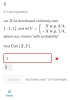 0/1 point (graded) Let X be distributed uniformly over {-1 { Xw.p. 3/4, where w.p. means "with probability". Find Cov (X, Y) , 1f, and let Y- X w.p. 1/4., 2 Submit You have used 1 of 4 attempts Reset
Exercise 6.34. Let (X,Y) be a uniformly distributed random point on the quadri- lateral D with...
 Exercise 6.34. Let (X,Y) be a uniformly distributed random point on the quadri- lateral D with vertices (0,0), (2,0), (1,1) and (0,1). (a) Find the joint density function of (X,Y) and the marginal density functions of X and Y. (b) Find E[X] and E[Y]. (c) Are X and Y independent?
Exercise 10.33. Let (X,Y) be uniformly distributed on the triangleD with vertices (1,0), (2,0) and (0,1), as in Example...
 Exercise 10.33. Let (X,Y) be uniformly distributed on the
triangleD with vertices (1,0), (2,0) and (0,1), as in Example
10.19. (a) Find the conditional probability P(X ≤ 1 2|Y =y). You
might first deduce the answer from Figure 10.2 and then check your
intuition with calculation. (b) Verify the averaging identity for
P(X ≤ 1 2). That is, check that P(X ≤ 1 2)=:∞ −∞ P(X ≤ 1 2|Y
=y)fY(y)dy.
Example 10.19. Let (X, Y) be uniformly distributed on the...
Exercise 10.33. Let (X,Y) be uniformly distributed on the
triangleD with vertices (1,0), (2,0) and (0,1), as in Example
10.19. (a) Find the conditional probability P(X ≤ 1 2|Y =y). You
might first deduce the answer from Figure 10.2 and then check your
intuition with calculation. (b) Verify the averaging identity for
P(X ≤ 1 2). That is, check that P(X ≤ 1 2)=:∞ −∞ P(X ≤ 1 2|Y
=y)fY(y)dy.
Example 10.19. Let (X, Y) be uniformly distributed on the...
5. Let (X, Y) be a uniformly distributed random point on the quadrilateral D with vertices...
 5. Let (X, Y) be a uniformly distributed random point on the quadrilateral D with vertices (0,0), (2,0),(1,1), (0,1) Uniformly distributed means that the joint probability density function of X and Y is a constant on D (equal to 1/area(D)). (a) Do you think Cov(X, Y) is positive, negative, or zero? Can you answer this without doing any calculations? (b) Compute Cov(X, Y) and pxyCorr(X, Y)
 Let X be a continuous random variable uniformly distributed on the unit interval (0, 1), .e X has a density f(x) = { 1, 0<r<1 f (x)- 0, elsewhere μ+ơX, where-oo < μ < 00, σ > 0 (a) Find the density of Y (b) Find E(Y) and V(Y)
 5. Let X be uniformly distributed in [0, 1]. Given X = x, the r.v. Y is uniformly distributed in 0, x for 0
 4. A random point (X, Y ) is chosen uniformly from within the unit disk in R2, {(x, y)|x2+y2< 1} (a) Let (R, O) denote the polar coordinates of the point (X,Y). Find the joint p.d.f. of R and . Compute the covariance between R and 0. Are R and e are independent? (b) Find E(XI{Y > 0}) and E(Y|{Y > 0}) (c) Compute the covariance between X and Y, Cov(X,Y). Are X and Y are independent?
4. A random...
4. A random point (X, Y ) is chosen uniformly from within the unit disk in R2, {(x, y)|x2+y2< 1} (a) Let (R, O) denote the polar coordinates of the point (X,Y). Find the joint p.d.f. of R and . Compute the covariance between R and 0. Are R and e are independent? (b) Find E(XI{Y > 0}) and E(Y|{Y > 0}) (c) Compute the covariance between X and Y, Cov(X,Y). Are X and Y are independent?
4. A random...
 9 0/1 point (graded) Let X be distributed uniformly over 1,1, andlet y- Xw.p. 3/4, l-X w.p. 1/4, where w.p. means "with probability". Find Cov (X,Y) 2 Submit You have used 1 of 4 attempts
 Let X,Y be uniformly distributed in the rectangle defined by −3
< x−y < 3, 1 < x + y < 5. Find the marginal density
fX(x) and E(Y|X).In the same situation find Cov(X,Y ).
(3) Let X, Y be uniformly distributed in the rectangle defined by -3 < x-y<3, Find the marginal density fx(x) and E(Y|X). In the same situation find Cov(X, Y). 1<x+y<5.
Let X,Y be uniformly distributed in the rectangle defined by −3
< x−y < 3, 1 < x + y < 5. Find the marginal density
fX(x) and E(Y|X).In the same situation find Cov(X,Y ).
(3) Let X, Y be uniformly distributed in the rectangle defined by -3 < x-y<3, Find the marginal density fx(x) and E(Y|X). In the same situation find Cov(X, Y). 1<x+y<5.
 0/1 point (graded) Let X be distributed uniformly over {-1 { Xw.p. 3/4, where w.p. means "with probability". Find Cov (X, Y) , 1f, and let Y- X w.p. 1/4., 2 Submit You have used 1 of 4 attempts Reset
 Exercise 6.34. Let (X,Y) be a uniformly distributed random point on the quadri- lateral D with vertices (0,0), (2,0), (1,1) and (0,1). (a) Find the joint density function of (X,Y) and the marginal density functions of X and Y. (b) Find E[X] and E[Y]. (c) Are X and Y independent?
 Exercise 10.33. Let (X,Y) be uniformly distributed on the
triangleD with vertices (1,0), (2,0) and (0,1), as in Example
10.19. (a) Find the conditional probability P(X ≤ 1 2|Y =y). You
might first deduce the answer from Figure 10.2 and then check your
intuition with calculation. (b) Verify the averaging identity for
P(X ≤ 1 2). That is, check that P(X ≤ 1 2)=:∞ −∞ P(X ≤ 1 2|Y
=y)fY(y)dy.
Example 10.19. Let (X, Y) be uniformly distributed on the...
Exercise 10.33. Let (X,Y) be uniformly distributed on the
triangleD with vertices (1,0), (2,0) and (0,1), as in Example
10.19. (a) Find the conditional probability P(X ≤ 1 2|Y =y). You
might first deduce the answer from Figure 10.2 and then check your
intuition with calculation. (b) Verify the averaging identity for
P(X ≤ 1 2). That is, check that P(X ≤ 1 2)=:∞ −∞ P(X ≤ 1 2|Y
=y)fY(y)dy.
Example 10.19. Let (X, Y) be uniformly distributed on the...
 5. Let (X, Y) be a uniformly distributed random point on the quadrilateral D with vertices (0,0), (2,0),(1,1), (0,1) Uniformly distributed means that the joint probability density function of X and Y is a constant on D (equal to 1/area(D)). (a) Do you think Cov(X, Y) is positive, negative, or zero? Can you answer this without doing any calculations? (b) Compute Cov(X, Y) and pxyCorr(X, Y)
Most questions answered within 3 hours.
-
Where is the error in this code sequence?
String s1 = "Hello";
String s2 = "ello";...
asked 10 months ago -
Financial data for Joel de Paris, Inc., for last year
follow:
Joel de Paris, Inc.
Balance...
asked 10 months ago -
Consider this reaction:
Al2(SO4)3 (aq)+ BaCl3
(aq) Al2Cl6 (aq)- +
3BaSO4(s) . What is the...
asked 10 months ago -
Suppose that Savneet is considering increasing her
recent random sample from 20 car rentals to 40...
asked 10 months ago -
Trucks arrive at an unloading terminal at an average rate of 120
per hour.
Trucks arrive...
asked 10 months ago -
Why are methanol and ethanol completely soluble in water while
octanol is not very little soluble....
asked 10 months ago -
A facilities manager at a university reads in a research report
that the mean amount of...
asked 10 months ago -
When the CuSO4 is rehydrated by adding water to the anhydrous
compound, is this an endothermic...
asked 10 months ago -
A ray of sunlight is passing from diamond into crown glass; the
angle of incidence is...
asked 10 months ago -
A block of mass 0.249 kg is placed on top of a light, vertical
spring of...
asked 10 months ago -
how do the kidneys compensate in the presences of acidosis
a) trigger hyperventilate
b) reserve acid...
asked 10 months ago -
Question 501 pts
The rental rate of capital to the firm increases. Which of the
following...
asked 10 months ago