
Homework Answers
Answer
By transitivity property, suppose x,y and z three bundles. So if x> y, and y> z, then x> z. This is law of transitivity. Similarly if x= y and y= z then, x= z by transitivity.

Add Answer to:
The following problem shows an example of preferences that satisfy transitivity for but not for~. Johrn...
Anna consumes two goods, x and y. She prefers the bundle (x, y) to the bundle...
Anna consumes two goods, x and y. She prefers the bundle (x, y) to the bundle (x ' , y' ) if and only if (xy − x 'y' > 1). Otherwise she is indifferent between the two bundles. a. Show that the relation of indifference (∼) is not transitive for Anna. b. Show that the preferred relation () is transitive for Anna.
Natasha's preferences over novels and short stories books are well behaved. The graph shows a few...
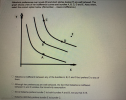 Natasha's preferences over novels and short stories books are well behaved. The graph shows a few of her indifference curves and bundles A, B, C, D and E. About them, select the correct option below. (Remember, - means indifference.) Y C E D B A X Natasha is indifferent between any of the bundles A, B, C and D but prefers E to any of them. Although her preferences are well behaved, the fact that Natasha is indifferent between C...
3. There are two goods x and y. Milton preferences for bundles of x and y...
3. There are two goods x and y. Milton preferences for bundles of x and y can be described as follows: Between any two bundles, Milton prefers the bundle that has more x. If two bundles have the same amount of x, he prefers the bundle that has more y. (Obviously, bundles with the same amount of x and y are the same bundle). a. Prove that Milton’s preferences satisfy the completeness assumption. (6) b. Describe what the indifference curves...
Mr. MacGregor's preferences are such that he is indifferent between the following bundles of (x,y): (1,4),...
 Mr. MacGregor's preferences are such that he is indifferent between the following bundles of (x,y): (1,4), (2,2), (4,1). Is it possible that the utility function U In(ry) will represent his preferences? Explain why or why not. Ignoring the utity function, do you think it is likely that he would be indifferent between the previous three bundles and the bundle (2,3)? Why or why not? ::/摄
the origin 1. (3 Points) Intuitively explain why indifference curves are weakly) convex to the (that...
 the origin 1. (3 Points) Intuitively explain why indifference curves are weakly) convex to the (that is, bow inwards) 5. (6 Points) Suppose Matt is comparing oranges (X) and bananas (Y). Bundle A consists of 5 oranges and 1 banana, bundle B consists of 1 orange and 5 bananas, and bundle C consists of 3 oranges and 4 bananas. Matt is indifferent between bundles A and B. If Matt were given a choice between bundles A and C, which would...
3. Indifference curves and preferences Alex likes both soda and milk. Assume that the "more is...
 3. Indifference curves and preferences Alex likes both soda and milk. Assume that the "more is better" principle applies to Alex; that is, he would always prefer to consume more of either good, holding the consumption of the other good constant. The points on Figure 1 represent combinations of milk and soda that Alex might choose to consume. Figure 2 shows the same points as Figure 1, but it also shows some of Alex's indifference curves: 11, 12, and 13...
3. Indifference curves and preferences Edison likes both chocolate and ice cream. Assume that the more...
 3. Indifference curves and preferences Edison likes both chocolate and ice cream. Assume that the more is better" principle applies to Edison; that is, he would always prefer to consume more of either good, holding the consumption of the other good constant. The points on Figure 1 represent combinations of ice cream and chocolate that Edison might choose to consume. Figure 2 shows the same points as Figure 1, but it also shows some of Edison's indifference curves: 11, 12,...
Question 2. Consider the following 8 bundles of goods x and y: A = (8,4) B...
Question 2. Consider the following 8 bundles of goods x and y: A = (8,4) B = (5,6) C = (5,9) D = (10,3) E =(1,4) F =(6,5) G=(2,8) H =(7,8) (a) Come up with an example of a utility function that will produce the following order of preference for the bundles, where H is most preferred, A and G are equally preferred, and E is least preferred. H , C , B , F , A = G ,...
Problem Show that each of the follwing utility functions has a diminishing MRS but that they...
 Problem Show that each of the follwing utility functions has a diminishing MRS but that they exhibit constant, increasing, and decreasing marginal utility, respectively. a) UE,y) = ry b) U(I,y) = rºy c) U(x,y) = ln I + Iny W Pyoblem A consumer is willing to trade 3 units of for 1 unit of y when she has 6 units of rand 5 units y. She is also willing to trade in 6 units of for 2 units of y...
3. Craig likes both apples and bananas. He consumes nothing else. The consumption bundle where Craig...
 3. Craig likes both apples and bananas. He consumes nothing else. The consumption bundle where Craig consumes x, bushels of apples per year and Xg bushels of bananas per year is written as (X4, Xg). Last year, Craig consumed 20 bushels of apples and 5 bushels of bananas. It happens that the set of consumption bundles (XA, Xg) such that Craig is indifferent between (XA, Xg) and 0,5) is the set of all bundles such that Xg = 100/XA. The...
 Natasha's preferences over novels and short stories books are well behaved. The graph shows a few of her indifference curves and bundles A, B, C, D and E. About them, select the correct option below. (Remember, - means indifference.) Y C E D B A X Natasha is indifferent between any of the bundles A, B, C and D but prefers E to any of them. Although her preferences are well behaved, the fact that Natasha is indifferent between C...
 Mr. MacGregor's preferences are such that he is indifferent between the following bundles of (x,y): (1,4), (2,2), (4,1). Is it possible that the utility function U In(ry) will represent his preferences? Explain why or why not. Ignoring the utity function, do you think it is likely that he would be indifferent between the previous three bundles and the bundle (2,3)? Why or why not? ::/摄
 the origin 1. (3 Points) Intuitively explain why indifference curves are weakly) convex to the (that is, bow inwards) 5. (6 Points) Suppose Matt is comparing oranges (X) and bananas (Y). Bundle A consists of 5 oranges and 1 banana, bundle B consists of 1 orange and 5 bananas, and bundle C consists of 3 oranges and 4 bananas. Matt is indifferent between bundles A and B. If Matt were given a choice between bundles A and C, which would...
 3. Indifference curves and preferences Alex likes both soda and milk. Assume that the "more is better" principle applies to Alex; that is, he would always prefer to consume more of either good, holding the consumption of the other good constant. The points on Figure 1 represent combinations of milk and soda that Alex might choose to consume. Figure 2 shows the same points as Figure 1, but it also shows some of Alex's indifference curves: 11, 12, and 13...
 3. Indifference curves and preferences Edison likes both chocolate and ice cream. Assume that the more is better" principle applies to Edison; that is, he would always prefer to consume more of either good, holding the consumption of the other good constant. The points on Figure 1 represent combinations of ice cream and chocolate that Edison might choose to consume. Figure 2 shows the same points as Figure 1, but it also shows some of Edison's indifference curves: 11, 12,...
 Problem Show that each of the follwing utility functions has a diminishing MRS but that they exhibit constant, increasing, and decreasing marginal utility, respectively. a) UE,y) = ry b) U(I,y) = rºy c) U(x,y) = ln I + Iny W Pyoblem A consumer is willing to trade 3 units of for 1 unit of y when she has 6 units of rand 5 units y. She is also willing to trade in 6 units of for 2 units of y...
 3. Craig likes both apples and bananas. He consumes nothing else. The consumption bundle where Craig consumes x, bushels of apples per year and Xg bushels of bananas per year is written as (X4, Xg). Last year, Craig consumed 20 bushels of apples and 5 bushels of bananas. It happens that the set of consumption bundles (XA, Xg) such that Craig is indifferent between (XA, Xg) and 0,5) is the set of all bundles such that Xg = 100/XA. The...
Most questions answered within 3 hours.
-
Where is the error in this code sequence?
String s1 = "Hello";
String s2 = "ello";...
asked 10 months ago -
Financial data for Joel de Paris, Inc., for last year
follow:
Joel de Paris, Inc.
Balance...
asked 10 months ago -
Consider this reaction:
Al2(SO4)3 (aq)+ BaCl3
(aq) Al2Cl6 (aq)- +
3BaSO4(s) . What is the...
asked 10 months ago -
Suppose that Savneet is considering increasing her
recent random sample from 20 car rentals to 40...
asked 10 months ago -
Trucks arrive at an unloading terminal at an average rate of 120
per hour.
Trucks arrive...
asked 10 months ago -
Why are methanol and ethanol completely soluble in water while
octanol is not very little soluble....
asked 10 months ago -
A facilities manager at a university reads in a research report
that the mean amount of...
asked 10 months ago -
When the CuSO4 is rehydrated by adding water to the anhydrous
compound, is this an endothermic...
asked 10 months ago -
A ray of sunlight is passing from diamond into crown glass; the
angle of incidence is...
asked 10 months ago -
A block of mass 0.249 kg is placed on top of a light, vertical
spring of...
asked 10 months ago -
how do the kidneys compensate in the presences of acidosis
a) trigger hyperventilate
b) reserve acid...
asked 10 months ago -
Question 501 pts
The rental rate of capital to the firm increases. Which of the
following...
asked 10 months ago