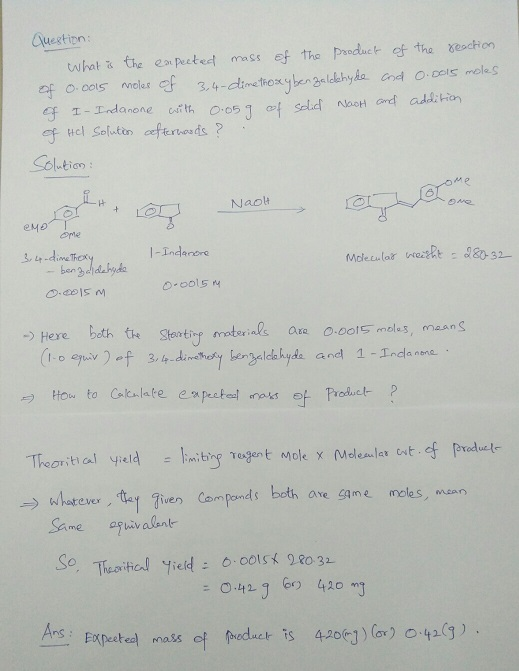
What is the expected mass of the product of the reaction of 0.0015 moles of 3,4-dimethoxybenzaldehyde...
What is the expected mass of the product of the reaction of 0.0015 moles of 3,4-dimethoxybenzaldehyde and 0.0015 moles of 1-indanone with 0.05g of solid NaOH and addition of HCl solution afterwards? This is an aldol condensation (green chemistry) problem.
Homework Answers
Add Answer to:
What is the expected mass of the product of the reaction of
0.0015 moles of 3,4-dimethoxybenzaldehyde...
Aldol Condensation (multi-part question) 1. a. Why does mixing of solid 3,4-dimethoxybenzaldehyde and solid 1-indanone result...
Aldol Condensation (multi-part question) 1. a. Why does mixing of solid 3,4-dimethoxybenzaldehyde and solid 1-indanone result a liquid solution? b. Why is the condensation (dehydrated) product rather than the aldol addition (hydrated) product obtained in this experiment? (What makes the condensation product exceptionally stable?) c. Why does the enolate ion of an aromatic ketone react faster with an aldehyde group (producing a crossed-aldol reaction) than with the carbonyl group of another molecule of ketone?
Provide a stepwise mechanism for the formation of 2-[(3,4-dimethoxyphenyl)methylene]-2,3-dihydro-1H-inden-1-one from 3,4-dimethoxybenzaldehyde and 1-indanone. Please show all...
 Provide a stepwise mechanism for the formation of
2-[(3,4-dimethoxyphenyl)methylene]-2,3-dihydro-1H-inden-1-one from
3,4-dimethoxybenzaldehyde and 1-indanone. Please show all steps!
This is a crossed aldol condensation. Thanks!
Crossed aldol condensation of 3,4-dimethoxybenzaldehyde and l-indanone CHO CH,0 NaOH spolu co m ments CH,O CH,09 enolate formation OH -H,0 T dehydration CHO OH O CH,0 CHOA carbonyl addition CH,0 initial aldol product
Provide a stepwise mechanism for the formation of
2-[(3,4-dimethoxyphenyl)methylene]-2,3-dihydro-1H-inden-1-one from
3,4-dimethoxybenzaldehyde and 1-indanone. Please show all steps!
This is a crossed aldol condensation. Thanks!
Crossed aldol condensation of 3,4-dimethoxybenzaldehyde and l-indanone CHO CH,0 NaOH spolu co m ments CH,O CH,09 enolate formation OH -H,0 T dehydration CHO OH O CH,0 CHOA carbonyl addition CH,0 initial aldol product
Draw a mechanism for a green aldol synthesis without solvent. using 3,4-dimethoxybenzaldehyde, 1-indanone, NaOH, HCl, ethanol...
Draw a mechanism for a green aldol synthesis without solvent. using 3,4-dimethoxybenzaldehyde, 1-indanone, NaOH, HCl, ethanol and water
the top half of the image depicts the synthesis of 2-[(3,4-dimethoxyphenyl)methylene]-2,3-dihydro-1H-inden-1-one from 1-indanone and 3,4-dimethoxybenzaldehyde. The...
 the top half of the image depicts the synthesis of
2-[(3,4-dimethoxyphenyl)methylene]-2,3-dihydro-1H-inden-1-one from
1-indanone and 3,4-dimethoxybenzaldehyde. The bottom half of the
image attached shows the table of chemicals used in the reaction.
How would I calculate theoretical yield and furthermore, the
percent yield? This experiment had a lot of chemicals used and I
don't know where to start.
Crossed aldol condensation of 3.4-dimethoxybenzaldehyde and l-indanone your co m ments cholateOH -4.0 dehydration formation OH O CHOY carbonyl addition initial aldol product...
the top half of the image depicts the synthesis of
2-[(3,4-dimethoxyphenyl)methylene]-2,3-dihydro-1H-inden-1-one from
1-indanone and 3,4-dimethoxybenzaldehyde. The bottom half of the
image attached shows the table of chemicals used in the reaction.
How would I calculate theoretical yield and furthermore, the
percent yield? This experiment had a lot of chemicals used and I
don't know where to start.
Crossed aldol condensation of 3.4-dimethoxybenzaldehyde and l-indanone your co m ments cholateOH -4.0 dehydration formation OH O CHOY carbonyl addition initial aldol product...
Product was formed successfully based on the exp. below (about 85% yield), please interpret/discuss HNMR/IR in...
 Product was formed successfully based on the exp. below (about
85% yield), please interpret/discuss HNMR/IR in as much detail as
possible and assign peaks on HNMR (which peak represents which
protons of which group, etc). Note: I already know how you
determine the formation of the product so you can skip that part of
part b).
Based on this exp:
Discuss the IR spectrum and what is the peak in IR that you can see for a specific functional group...
Product was formed successfully based on the exp. below (about
85% yield), please interpret/discuss HNMR/IR in as much detail as
possible and assign peaks on HNMR (which peak represents which
protons of which group, etc). Note: I already know how you
determine the formation of the product so you can skip that part of
part b).
Based on this exp:
Discuss the IR spectrum and what is the peak in IR that you can see for a specific functional group...
Lab : Aldol Condensation Purpose. In this lab you will conduct the Aldol condensation reaction under solid-state...
Lab : Aldol Condensation Purpose. In this lab you will conduct the Aldol condensation reaction under solid-state reaction conditions that will involve grinding reactants in the solid phase. You must read ahead and learn about this reaction and the chemical mechanism for the Aldol condensation. There are two possible products which are the initial Aldol or subsequent elimination product. You will need to isolate and purify your reaction product. You will use your melting point, IR, 1H and 13C NMR spectra to...
Aldol Condensation: 1) What is the purpose of using NaOH solution in this Aldol condensation? 2)...
 Aldol Condensation: 1) What is the purpose of using NaOH solution in this Aldol condensation? 2) Why acetic acid is used to wash the solid on the fiter? 3) Draw the structure of the product from the reaction: NaOH H +Acetone in ethanol
What is the expected major product from the reaction of (3R,4S)-2,2,3-trimethyl-3,4-epoxypentane with sodium methoxide and methanol?...
What is the expected major product from the reaction of (3R,4S)-2,2,3-trimethyl-3,4-epoxypentane with sodium methoxide and methanol? What is the expected major product arising from the reaction of (1R,2S)-2-chloro-3,4-dibromo-5-methylene-3-cyclopenten-1-ol with sodium dichromate and sulfuric acid?
1. The reaction web includes most of the reactions of enolates we have studied. The products...
 1. The reaction web includes most of the reactions of enolates we have studied. The products of these reactions can be treated with other reagents to generate new functionality - think synthesis! Make up your own examples - e.g. What if you treated compound D with CH,MgBr? In the table, summarize the types of products produced from these reactions. CH3 MgBr acid quench acid quench NaOH, H2O EIO OEt acid quench acid quench acid quench D LIAIHA acid quench acid...
please answer all of the 4 questions What cyclic product is formed in the intramolecular Aldol...
 please answer all of the 4 questions
What cyclic product is formed in the intramolecular Aldol condensation when the following compound is treated with aqueous NaOH? OT 11 0 0 IV What is the Aldol addition product formed from reaction of the following compound with itself? ++,C#o Cาถวาย 0 0 0 What is the cyclic product formed in the intramolecular Aldol condensation when the following compound is treated with aqueous NaOH? 08 pod od IV OT O II III O...
please answer all of the 4 questions
What cyclic product is formed in the intramolecular Aldol condensation when the following compound is treated with aqueous NaOH? OT 11 0 0 IV What is the Aldol addition product formed from reaction of the following compound with itself? ++,C#o Cาถวาย 0 0 0 What is the cyclic product formed in the intramolecular Aldol condensation when the following compound is treated with aqueous NaOH? 08 pod od IV OT O II III O...
 Provide a stepwise mechanism for the formation of
2-[(3,4-dimethoxyphenyl)methylene]-2,3-dihydro-1H-inden-1-one from
3,4-dimethoxybenzaldehyde and 1-indanone. Please show all steps!
This is a crossed aldol condensation. Thanks!
Crossed aldol condensation of 3,4-dimethoxybenzaldehyde and l-indanone CHO CH,0 NaOH spolu co m ments CH,O CH,09 enolate formation OH -H,0 T dehydration CHO OH O CH,0 CHOA carbonyl addition CH,0 initial aldol product
Provide a stepwise mechanism for the formation of
2-[(3,4-dimethoxyphenyl)methylene]-2,3-dihydro-1H-inden-1-one from
3,4-dimethoxybenzaldehyde and 1-indanone. Please show all steps!
This is a crossed aldol condensation. Thanks!
Crossed aldol condensation of 3,4-dimethoxybenzaldehyde and l-indanone CHO CH,0 NaOH spolu co m ments CH,O CH,09 enolate formation OH -H,0 T dehydration CHO OH O CH,0 CHOA carbonyl addition CH,0 initial aldol product
 the top half of the image depicts the synthesis of
2-[(3,4-dimethoxyphenyl)methylene]-2,3-dihydro-1H-inden-1-one from
1-indanone and 3,4-dimethoxybenzaldehyde. The bottom half of the
image attached shows the table of chemicals used in the reaction.
How would I calculate theoretical yield and furthermore, the
percent yield? This experiment had a lot of chemicals used and I
don't know where to start.
Crossed aldol condensation of 3.4-dimethoxybenzaldehyde and l-indanone your co m ments cholateOH -4.0 dehydration formation OH O CHOY carbonyl addition initial aldol product...
the top half of the image depicts the synthesis of
2-[(3,4-dimethoxyphenyl)methylene]-2,3-dihydro-1H-inden-1-one from
1-indanone and 3,4-dimethoxybenzaldehyde. The bottom half of the
image attached shows the table of chemicals used in the reaction.
How would I calculate theoretical yield and furthermore, the
percent yield? This experiment had a lot of chemicals used and I
don't know where to start.
Crossed aldol condensation of 3.4-dimethoxybenzaldehyde and l-indanone your co m ments cholateOH -4.0 dehydration formation OH O CHOY carbonyl addition initial aldol product...
 Product was formed successfully based on the exp. below (about
85% yield), please interpret/discuss HNMR/IR in as much detail as
possible and assign peaks on HNMR (which peak represents which
protons of which group, etc). Note: I already know how you
determine the formation of the product so you can skip that part of
part b).
Based on this exp:
Discuss the IR spectrum and what is the peak in IR that you can see for a specific functional group...
Product was formed successfully based on the exp. below (about
85% yield), please interpret/discuss HNMR/IR in as much detail as
possible and assign peaks on HNMR (which peak represents which
protons of which group, etc). Note: I already know how you
determine the formation of the product so you can skip that part of
part b).
Based on this exp:
Discuss the IR spectrum and what is the peak in IR that you can see for a specific functional group...
 Aldol Condensation: 1) What is the purpose of using NaOH solution in this Aldol condensation? 2) Why acetic acid is used to wash the solid on the fiter? 3) Draw the structure of the product from the reaction: NaOH H +Acetone in ethanol
 1. The reaction web includes most of the reactions of enolates we have studied. The products of these reactions can be treated with other reagents to generate new functionality - think synthesis! Make up your own examples - e.g. What if you treated compound D with CH,MgBr? In the table, summarize the types of products produced from these reactions. CH3 MgBr acid quench acid quench NaOH, H2O EIO OEt acid quench acid quench acid quench D LIAIHA acid quench acid...
 please answer all of the 4 questions
What cyclic product is formed in the intramolecular Aldol condensation when the following compound is treated with aqueous NaOH? OT 11 0 0 IV What is the Aldol addition product formed from reaction of the following compound with itself? ++,C#o Cาถวาย 0 0 0 What is the cyclic product formed in the intramolecular Aldol condensation when the following compound is treated with aqueous NaOH? 08 pod od IV OT O II III O...
please answer all of the 4 questions
What cyclic product is formed in the intramolecular Aldol condensation when the following compound is treated with aqueous NaOH? OT 11 0 0 IV What is the Aldol addition product formed from reaction of the following compound with itself? ++,C#o Cาถวาย 0 0 0 What is the cyclic product formed in the intramolecular Aldol condensation when the following compound is treated with aqueous NaOH? 08 pod od IV OT O II III O...
Most questions answered within 3 hours.
-
Where is the error in this code sequence?
String s1 = "Hello";
String s2 = "ello";...
asked 11 months ago -
Financial data for Joel de Paris, Inc., for last year
follow:
Joel de Paris, Inc.
Balance...
asked 11 months ago -
Consider this reaction:
Al2(SO4)3 (aq)+ BaCl3
(aq) Al2Cl6 (aq)- +
3BaSO4(s) . What is the...
asked 11 months ago -
Suppose that Savneet is considering increasing her
recent random sample from 20 car rentals to 40...
asked 11 months ago -
Trucks arrive at an unloading terminal at an average rate of 120
per hour.
Trucks arrive...
asked 11 months ago -
Why are methanol and ethanol completely soluble in water while
octanol is not very little soluble....
asked 11 months ago -
A facilities manager at a university reads in a research report
that the mean amount of...
asked 11 months ago -
When the CuSO4 is rehydrated by adding water to the anhydrous
compound, is this an endothermic...
asked 11 months ago -
A ray of sunlight is passing from diamond into crown glass; the
angle of incidence is...
asked 11 months ago -
A block of mass 0.249 kg is placed on top of a light, vertical
spring of...
asked 11 months ago -
how do the kidneys compensate in the presences of acidosis
a) trigger hyperventilate
b) reserve acid...
asked 11 months ago -
Question 501 pts
The rental rate of capital to the firm increases. Which of the
following...
asked 11 months ago