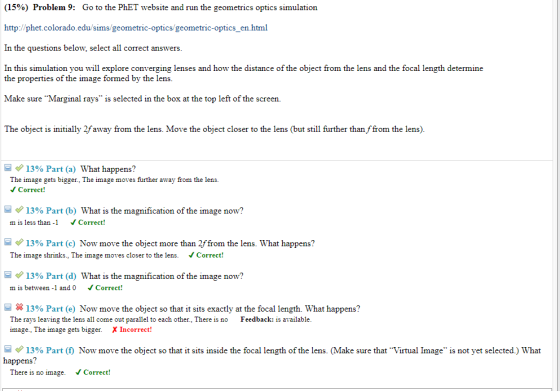
Problem 9: Go to the PhET website and run the geometrics optics simulation
http://phet.colorado.edu/sims/geometric-optics/geometric-optics_en.html
In the questions below, select all correct answers.
In this simulation you will explore converging lenses and how the distance of the object from the lens and the focal length determine the properties of the image formed by the lens.
Make sure "Marginal rays" is selected in the box at the top left of the screen.
The object is initially 2 f away from the lens. Move the object closer to the lens (but still further than f from the lens).
Homework Answers
part (e) Ans.
when you put the object exactly at the focus. Rays will travel parallel to the principal axis and image will be formed at the Infinity, the image will be highly enlarged and will be real. (this is the assumption in physics that these parallel looking rays might converge at the infinity, forming an image out there.!)
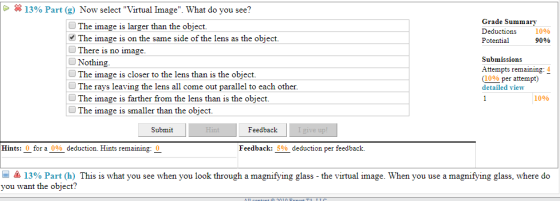
Part (g) Ans.
- Image is larger than the object.
- Image is on the same side of the lens as the object.
- Image is farther from the lens than the object.
Add Answer to:
Problem 9: Go to the PhET website and run the geometrics optics simulation
Image Saeen Convex Light Source and Objact Figure 7.1- A sketch of the apparatus run the PhET s...
 7.2?7.3?7.4?
Image Saeen Convex Light Source and Objact Figure 7.1- A sketch of the apparatus run the PhET simulation "Geometric 7.1] Action-Item: Download and Optics". You should see a sketch of an object, a thin, convex lens, and an image, with two light rays passing from one particular point on the object through the lens, to one particular point on the image, and beyond. The horizontal line stretching across the screen is called the "principle axis". The small "x" marks...
7.2?7.3?7.4?
Image Saeen Convex Light Source and Objact Figure 7.1- A sketch of the apparatus run the PhET simulation "Geometric 7.1] Action-Item: Download and Optics". You should see a sketch of an object, a thin, convex lens, and an image, with two light rays passing from one particular point on the object through the lens, to one particular point on the image, and beyond. The horizontal line stretching across the screen is called the "principle axis". The small "x" marks...
Optics Procedure Needed HOL lab kit equipment:magnifier, ruler Student supplied equipment index card,Styrofoam cups or modeling...
Optics Procedure Needed HOL lab kit equipment:magnifier, ruler Student supplied equipment index card,Styrofoam cups or modeling clay,paper clips,tape,colored pens or pencils,digital camera.Finding the Focal Length of a Lens 1.This part of the lab requires a dimly-lit room with an outside-facing window producing an unobstructed view of a distant object. Best results are obtained on a sunny day. 2.You need something to hold both your magnifier and a screen to project an image on.One possibility is to insert your magnifier into...
Chapter 10 Lenses Learning Objectives During this lab, you will, use the Law of Sagitta to determ...
 Chapter 10 Lenses Learning Objectives During this lab, you will, use the Law of Sagitta to determine the radius of curvature of a lens use the lens equation to determine focal length, . use the lensmaker's formula to determine the index of refraction of a trans- parent material. 10.1 Pre-lab This pre-lab will introduce you to a concept in geometrical optics known as ray tracing. Given an object that emits or reflects light, you can place a lens in the...
So we are using the PhET Geometric Optics simulation to complete these problems. I'm lost on...
 So we are using the PhET Geometric Optics simulation to complete
these problems. I'm lost on how to find the focal distance that we
use for table 1, and I don't know what formulas to use for the
table either.
Set the len's refractive index (n) to 1.8 and the radius
curvature (R) to .7 m. find the focal distance (f).
Using the focal distance you just found, complete the table.
Repeat the previous exercise, but with a very different...
So we are using the PhET Geometric Optics simulation to complete
these problems. I'm lost on how to find the focal distance that we
use for table 1, and I don't know what formulas to use for the
table either.
Set the len's refractive index (n) to 1.8 and the radius
curvature (R) to .7 m. find the focal distance (f).
Using the focal distance you just found, complete the table.
Repeat the previous exercise, but with a very different...
Which is true of a compound microscope? Question 1 options: Uses two converging lenses The optics...
Which is true of a compound microscope? Question 1 options: Uses two converging lenses The optics are reversed from those of a refracting telescope The object to be viewed to be enlarged is placed just outside the focal point of the lens All of the above An optical surface is converging if . . . Question 2 options: Parallel incident rays are bent so they intersect after interacting with the surface Parallel incident rays are bent so they intersect before...
3. Optics problem set: a) [6 pts) An incident light ray in air strikes a glass...
 3. Optics problem set: a) [6 pts) An incident light ray in air strikes a glass prism as shown. Sketch the ray diagram with the light rays refracted through each glass boundary. There is no total internal reflection in this problem. This ray diagram should include (1) normal lines, and (2) the qualitatively correct directions of refracted rays. b) [6 pts) Two converging lenses (#1 and #2) are given with an object as an arrow below. A pair of focal...
For this lab we will be using "The Skate Park" simulation from PhET. You can run...
For this lab we will be using "The Skate Park" simulation from PhET. You can run this simulation by clicking on the following image. This will open in a new window. You need JAVA to run this. If you have trouble, after installing JAVA, try copying and pasting the following link into a new window: http://phet.colorado.edu/sims/energy-skate-park/energy-skate-park_en.jar --------------------------------- Based upon the equation for potential energy, how do you expect the potential energy to change when the gravity is lower than it...
PHYS 2010 Geometric Optics Page 75 Prelab Question 1: A candle is located 30 cm from...
 PHYS 2010 Geometric Optics Page 75 Prelab Question 1: A candle is located 30 cm from a converging lens with a focal length 25 cm. a. Calculate the image distance. b. Will the image form on the same or opposite side of the lens as the object? c. What is the magnification of the image? d. Is the image upright or inverted? e. Is the image real or virtual? f. Can the image be viewed on a screen?
For this lab we will be using "The Skate Park" simulation from PhET. You can run...
For this lab we will be using "The Skate Park" simulation from PhET. You can run this simulation by clicking on the following image. This will open in a new window. You need JAVA to run this. If you have trouble, after installing JAVA, try copying and pasting the following link into a new window: http://phet.colorado.edu/sims/energy-skate-park/energy-skate-park_en.jar ------------------------------------------------ How high must a 20 kg skater start at to have a kinetic energy of 360 joules at a height of 0 meters?...
Remove the rays from the simulation by clicking on them and then pressing Delete. Place a...
 Remove the rays from the simulation by clicking on them and then pressing Delete. Place a Point Source at (60,180) by clicking Point Source under Tools, then clicking the simulation at (60,180). Note that the location at which the rays converge is the same as it was using the principal ray method. This is, in fact, why we use the principal ray method: it generates the convergence point using comparatively few lines. As we know from Huygens's principal, every point...
 7.2?7.3?7.4?
Image Saeen Convex Light Source and Objact Figure 7.1- A sketch of the apparatus run the PhET simulation "Geometric 7.1] Action-Item: Download and Optics". You should see a sketch of an object, a thin, convex lens, and an image, with two light rays passing from one particular point on the object through the lens, to one particular point on the image, and beyond. The horizontal line stretching across the screen is called the "principle axis". The small "x" marks...
7.2?7.3?7.4?
Image Saeen Convex Light Source and Objact Figure 7.1- A sketch of the apparatus run the PhET simulation "Geometric 7.1] Action-Item: Download and Optics". You should see a sketch of an object, a thin, convex lens, and an image, with two light rays passing from one particular point on the object through the lens, to one particular point on the image, and beyond. The horizontal line stretching across the screen is called the "principle axis". The small "x" marks...
 Chapter 10 Lenses Learning Objectives During this lab, you will, use the Law of Sagitta to determine the radius of curvature of a lens use the lens equation to determine focal length, . use the lensmaker's formula to determine the index of refraction of a trans- parent material. 10.1 Pre-lab This pre-lab will introduce you to a concept in geometrical optics known as ray tracing. Given an object that emits or reflects light, you can place a lens in the...
 So we are using the PhET Geometric Optics simulation to complete
these problems. I'm lost on how to find the focal distance that we
use for table 1, and I don't know what formulas to use for the
table either.
Set the len's refractive index (n) to 1.8 and the radius
curvature (R) to .7 m. find the focal distance (f).
Using the focal distance you just found, complete the table.
Repeat the previous exercise, but with a very different...
So we are using the PhET Geometric Optics simulation to complete
these problems. I'm lost on how to find the focal distance that we
use for table 1, and I don't know what formulas to use for the
table either.
Set the len's refractive index (n) to 1.8 and the radius
curvature (R) to .7 m. find the focal distance (f).
Using the focal distance you just found, complete the table.
Repeat the previous exercise, but with a very different...
 3. Optics problem set: a) [6 pts) An incident light ray in air strikes a glass prism as shown. Sketch the ray diagram with the light rays refracted through each glass boundary. There is no total internal reflection in this problem. This ray diagram should include (1) normal lines, and (2) the qualitatively correct directions of refracted rays. b) [6 pts) Two converging lenses (#1 and #2) are given with an object as an arrow below. A pair of focal...
 PHYS 2010 Geometric Optics Page 75 Prelab Question 1: A candle is located 30 cm from a converging lens with a focal length 25 cm. a. Calculate the image distance. b. Will the image form on the same or opposite side of the lens as the object? c. What is the magnification of the image? d. Is the image upright or inverted? e. Is the image real or virtual? f. Can the image be viewed on a screen?
 Remove the rays from the simulation by clicking on them and then pressing Delete. Place a Point Source at (60,180) by clicking Point Source under Tools, then clicking the simulation at (60,180). Note that the location at which the rays converge is the same as it was using the principal ray method. This is, in fact, why we use the principal ray method: it generates the convergence point using comparatively few lines. As we know from Huygens's principal, every point...
Most questions answered within 3 hours.
-
Where is the error in this code sequence?
String s1 = "Hello";
String s2 = "ello";...
asked 10 months ago -
Financial data for Joel de Paris, Inc., for last year
follow:
Joel de Paris, Inc.
Balance...
asked 10 months ago -
Consider this reaction:
Al2(SO4)3 (aq)+ BaCl3
(aq) Al2Cl6 (aq)- +
3BaSO4(s) . What is the...
asked 10 months ago -
Suppose that Savneet is considering increasing her
recent random sample from 20 car rentals to 40...
asked 10 months ago -
Trucks arrive at an unloading terminal at an average rate of 120
per hour.
Trucks arrive...
asked 10 months ago -
Why are methanol and ethanol completely soluble in water while
octanol is not very little soluble....
asked 10 months ago -
A facilities manager at a university reads in a research report
that the mean amount of...
asked 10 months ago -
When the CuSO4 is rehydrated by adding water to the anhydrous
compound, is this an endothermic...
asked 10 months ago -
A ray of sunlight is passing from diamond into crown glass; the
angle of incidence is...
asked 10 months ago -
A block of mass 0.249 kg is placed on top of a light, vertical
spring of...
asked 10 months ago -
how do the kidneys compensate in the presences of acidosis
a) trigger hyperventilate
b) reserve acid...
asked 10 months ago -
Question 501 pts
The rental rate of capital to the firm increases. Which of the
following...
asked 10 months ago