
Homework Answers

Add Answer to:
A particle with a charge of q = 13.0 PC travels from the origin to the...
A small object with a charge of q = 10.0 pC travels from the origin to...
 A small object with a charge of q = 10.0 pC travels from the origin to the point (x, y) = (20.0 cm, 50.0 cm) in the presence of a uniform electric field E = 240İ V/m. Determine the following (a) the change in the electric potential energy (in J) of the object-field system (b) the electric potential difference (in V) through which the object moves
1. -12 points SerPSE10 24.1.OP001 My Notes Ask Your Teacher A particle with a charge of...
 1. -12 points SerPSE10 24.1.OP001 My Notes Ask Your Teacher A particle with a charge of q= 15.0yC travels from the origin to the point (x, y) (20.0 cm, 50.0 cm) in the presence of a uniform electric field E220 V/m. Determine the following. (a) the change in the electric potential energy (in J) of the particle-field system (b) the electric potential difference (in V) through which the particle moves Need Help? L Readin
+ -12 points SerPSE10 24.1.OP001 A small object with a charge of q = 10.0 μС...
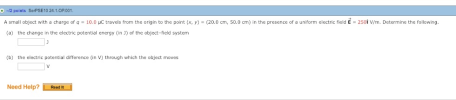 + -12 points SerPSE10 24.1.OP001 A small object with a charge of q = 10.0 μС travels from the origin to the point x, y = 20.0 cm, 50.0 cm in the presence of a uniform electric field E = 250 V/m. Determine the following. (a) the change in the electric potential energy (in J) of the object-field system (b) the electric potential difference (in V) through which the object moves Need Help? Readt
please help with 1-6!!! Potential 1. Find the potential 3 cm from a 1 uC charge....
 please help with 1-6!!!
Potential 1. Find the potential 3 cm from a 1 uC charge. How much energy is required to bring a 1 pC charge there from very far away? Four 5 uC charges are located at the corners of a square with side 12 cm. Find the potential: a) at the middle. b) at the center of one edge. 2. A 50 HF capacitor is held at a potential difference of 12 V. Find the charge on...
please help with 1-6!!!
Potential 1. Find the potential 3 cm from a 1 uC charge. How much energy is required to bring a 1 pC charge there from very far away? Four 5 uC charges are located at the corners of a square with side 12 cm. Find the potential: a) at the middle. b) at the center of one edge. 2. A 50 HF capacitor is held at a potential difference of 12 V. Find the charge on...
A particle has a charge of q-2e, where e is the charge on an electron. (a)...
 A particle has a charge of q-2e, where e is the charge on an electron. (a) Determine the electric potential (in V) due to the charge at a distance r = 0.130 cm from the charge. b) Determine the electric potential difference (in V) between a point that is 2r away and this point, that is (2r)-V(r) (c) Determine the electric potential difference (in V) between a point that isaway and this point, that isVCr) 2 (d) How would the...
A particle has a charge of q 3e, where e is the charge on an electron....
 A particle has a charge of q 3e, where e is the charge on an electron. (a) Determine the electric potential (in V) due to the charge at a distance r 0.260 cm from the charge. (b) Determine the electric potential difference (in V) between a point that is 3r away and this point, that is V(3r) - r) (c) Determine the electric potential difference (in V) between a point that is-away and this point, that is V(-)-V(r) (d) How...
A point particle that has a charge of 13.5 pC is located atx-0, y-0 and a...
 A point particle that has a charge of 13.5 pC is located atx-0, y-0 and a point particle that has a charge q is located at x = 10.8 cm, y-0 The electric force on a point particle that has a charge of 5.4 μC at x-21.6 cm, y-0 is-(19.7) N İ, Determine the charge q. UC eBook Submit Answer Save Progress Practice Another Version
A particle has a charge of q = +5.5 pC and is located at the origin....
 A particle has a charge of q = +5.5 pC and is located at the origin. As the drawing shows, an electric field of Ex-+214 N/C exists along the +χ axis. A magnetic field also exists, and its χ and y components are B*-+1.3 T and By +1.9 T. Calculate the force (magnitude and direction) exerted on the particle by each of the three fields when it is (a) stationary, (b) moving along the +χ axis at a speed of...
The work done by an external force to move a particle of charge -2.20 uC at...
 The work done by an external force to move a particle of charge -2.20 uC at constant speed from point A to point B is 6.40x10⁻³J. (a) What is the difference between the electric potential energy of the charge at the two points? (b) What is the difference in the kinetic energy of the charge at the two points? (c) Determine the potential difference between the two points. (d) State which point is at the higher potential.
m u= 0 + 9 Given a particle having charge q = +1.90 PC and mass m, = 100 mg is connected to a string that is L = 1.10 m...
 m u= 0 + 9 Given a particle having charge q = +1.90 PC and mass m, = 100 mg is connected to a string that is L = 1.10 m long and tied to the pivot point P in the figure below. The particle, string, and pivot point all lie on a horizontal table. The particle is released from rest when the string makes an angle = 75.0° with a uniform electric field of magnitude E = 700 v/m....
 A small object with a charge of q = 10.0 pC travels from the origin to the point (x, y) = (20.0 cm, 50.0 cm) in the presence of a uniform electric field E = 240İ V/m. Determine the following (a) the change in the electric potential energy (in J) of the object-field system (b) the electric potential difference (in V) through which the object moves
 1. -12 points SerPSE10 24.1.OP001 My Notes Ask Your Teacher A particle with a charge of q= 15.0yC travels from the origin to the point (x, y) (20.0 cm, 50.0 cm) in the presence of a uniform electric field E220 V/m. Determine the following. (a) the change in the electric potential energy (in J) of the particle-field system (b) the electric potential difference (in V) through which the particle moves Need Help? L Readin
 + -12 points SerPSE10 24.1.OP001 A small object with a charge of q = 10.0 μС travels from the origin to the point x, y = 20.0 cm, 50.0 cm in the presence of a uniform electric field E = 250 V/m. Determine the following. (a) the change in the electric potential energy (in J) of the object-field system (b) the electric potential difference (in V) through which the object moves Need Help? Readt
 please help with 1-6!!!
Potential 1. Find the potential 3 cm from a 1 uC charge. How much energy is required to bring a 1 pC charge there from very far away? Four 5 uC charges are located at the corners of a square with side 12 cm. Find the potential: a) at the middle. b) at the center of one edge. 2. A 50 HF capacitor is held at a potential difference of 12 V. Find the charge on...
please help with 1-6!!!
Potential 1. Find the potential 3 cm from a 1 uC charge. How much energy is required to bring a 1 pC charge there from very far away? Four 5 uC charges are located at the corners of a square with side 12 cm. Find the potential: a) at the middle. b) at the center of one edge. 2. A 50 HF capacitor is held at a potential difference of 12 V. Find the charge on...
 A particle has a charge of q-2e, where e is the charge on an electron. (a) Determine the electric potential (in V) due to the charge at a distance r = 0.130 cm from the charge. b) Determine the electric potential difference (in V) between a point that is 2r away and this point, that is (2r)-V(r) (c) Determine the electric potential difference (in V) between a point that isaway and this point, that isVCr) 2 (d) How would the...
 A particle has a charge of q 3e, where e is the charge on an electron. (a) Determine the electric potential (in V) due to the charge at a distance r 0.260 cm from the charge. (b) Determine the electric potential difference (in V) between a point that is 3r away and this point, that is V(3r) - r) (c) Determine the electric potential difference (in V) between a point that is-away and this point, that is V(-)-V(r) (d) How...
 A point particle that has a charge of 13.5 pC is located atx-0, y-0 and a point particle that has a charge q is located at x = 10.8 cm, y-0 The electric force on a point particle that has a charge of 5.4 μC at x-21.6 cm, y-0 is-(19.7) N İ, Determine the charge q. UC eBook Submit Answer Save Progress Practice Another Version
 A particle has a charge of q = +5.5 pC and is located at the origin. As the drawing shows, an electric field of Ex-+214 N/C exists along the +χ axis. A magnetic field also exists, and its χ and y components are B*-+1.3 T and By +1.9 T. Calculate the force (magnitude and direction) exerted on the particle by each of the three fields when it is (a) stationary, (b) moving along the +χ axis at a speed of...
 The work done by an external force to move a particle of charge -2.20 uC at constant speed from point A to point B is 6.40x10⁻³J. (a) What is the difference between the electric potential energy of the charge at the two points? (b) What is the difference in the kinetic energy of the charge at the two points? (c) Determine the potential difference between the two points. (d) State which point is at the higher potential.
 m u= 0 + 9 Given a particle having charge q = +1.90 PC and mass m, = 100 mg is connected to a string that is L = 1.10 m long and tied to the pivot point P in the figure below. The particle, string, and pivot point all lie on a horizontal table. The particle is released from rest when the string makes an angle = 75.0° with a uniform electric field of magnitude E = 700 v/m....
Most questions answered within 3 hours.
-
Where is the error in this code sequence?
String s1 = "Hello";
String s2 = "ello";...
asked 11 months ago -
Financial data for Joel de Paris, Inc., for last year
follow:
Joel de Paris, Inc.
Balance...
asked 11 months ago -
Consider this reaction:
Al2(SO4)3 (aq)+ BaCl3
(aq) Al2Cl6 (aq)- +
3BaSO4(s) . What is the...
asked 11 months ago -
Suppose that Savneet is considering increasing her
recent random sample from 20 car rentals to 40...
asked 11 months ago -
Trucks arrive at an unloading terminal at an average rate of 120
per hour.
Trucks arrive...
asked 11 months ago -
Why are methanol and ethanol completely soluble in water while
octanol is not very little soluble....
asked 11 months ago -
A facilities manager at a university reads in a research report
that the mean amount of...
asked 11 months ago -
When the CuSO4 is rehydrated by adding water to the anhydrous
compound, is this an endothermic...
asked 11 months ago -
A ray of sunlight is passing from diamond into crown glass; the
angle of incidence is...
asked 11 months ago -
A block of mass 0.249 kg is placed on top of a light, vertical
spring of...
asked 11 months ago -
how do the kidneys compensate in the presences of acidosis
a) trigger hyperventilate
b) reserve acid...
asked 11 months ago -
Question 501 pts
The rental rate of capital to the firm increases. Which of the
following...
asked 11 months ago