A cost-volume-profit graph is frequently used in business meetings because it presents a picture of cost...
A cost-volume-profit graph is frequently used in business meetings because it presents a picture of cost relationships within a company. Briefly describe the type of information and data that you would need in order to prepare a CVP graph. After a CVP graph is prepared, what are the major points that could be made from the graph that would be of interest to management?
Homework Answers
The purpose of making a CVP graph is to help a company determine the impact that a change in sales volumes has on cost and profits.
It is necessary to make certain assumptions when preparing a CVP graph:
- Fixed costs remain constant regardless of the level of production.
- The company is able to sell each unit that it produces.
- The selling price of each unit is the same.
- Each additional unit of production results in the same increase in variable costs.
One of the key benefits that a CVP graph provides is that it tells a company about its breakeven point. This allows a firm to plan its production and sales activities.
The CVP graph also puts costs into focus. It highlights fixed costs as well as variable costs.
Example of CVP Graph
The following CVP graph represents Zephyr Corporation’s costs and production levels:
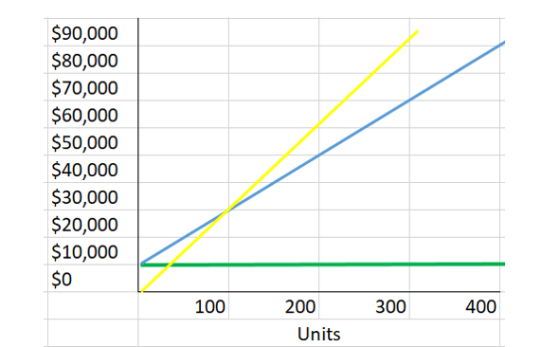
The vertical axis denotes dollar amounts and the horizontal axis represents units of production.
The thick green line at the $10,000 level represents fixed costs. This does not change with the level of production. It remains constant at $10,000 even if there is no production.
The blue line is the total cost line. When there is zero production, total costs are at $10,000. The total costs gradually rise with the increase in production.
The yellow line represents sales. At a 100 units of production, when total costs are at $30,000, breakeven is achieved. After this point, Zephyr starts making profits.
- Managers frequently use CVP to estimate the level of sales that will allow the company to make a particular profit, called targeted income. They add the targeted income to fixed costs associated with production, then divide the total by the contribution margin ratio. Alternatively, they divide the total by the contribution margin per unit, to learn how many units they must sell. Using CVP, managers can also estimate how changes in the costs of their products or volume of products affect the company's profits.
Add Answer to:
A cost-volume-profit graph is frequently used in business
meetings because it presents a picture of cost...
The cost volume profit analysis, commonly referred to as CVP, is a planning process that management...
The cost volume profit analysis, commonly referred to as CVP, is a planning process that management uses to predict the future volume of activity, costs incurred, sales made, and profits received. In other words, it’s a mathematical equation that computes how changes in costs and sales will affect income in future periods (Peavler, 2019). CVP analysis provides managers with the advantage of being able to answer specific questions needed in business analysis. Such as, what is the company's breakeven point?...
EXERCISE 5-2 Prepare a Cost-Volume-Profit (CVP) Graph L05-2 Karlik Enterprises distributes a single product whose selling...
 EXERCISE 5-2 Prepare a Cost-Volume-Profit (CVP) Graph L05-2 Karlik Enterprises distributes a single product whose selling price is $24 per unit and whose vari- able expense is $18 per unit. The company's monthly fixed expense is $24,000. Required: Prepare a cost-volume-profit graph for the company up to a sales level of 8,000 units. Estimate the company's break-even point in unit sales using your cost-volume-profit graph.
Cost-volume-profit analysis (CPV) can be used by management to better understand the relationships between the company’s...
Cost-volume-profit analysis (CPV) can be used by management to better understand the relationships between the company’s costs, sales volume, and profit. Cost-volume-profit analysis can be used to evaluate the effects on profit when companies make changes in selling prices, service fees, costs, income-tax rates, and the organization’s mix of products or services. CVP analysis provides management with a comprehensive overview of the effects on revenue and costs, allowing them to implement financial changes and track outcomes. Managers in nonprofit organizations,...
Subject: Please read the instructions carefully. You learned that cost volume profit analysis is used to...
Subject: Please read the instructions carefully. You learned that cost volume profit analysis is used to analyze decisions. Management uses CVP analysis to plan future projects and to help in determining a project’s feasibility. Find an article or press release about a manufacturing company that needed to increase production in anticipation of demand, or that needed to discontinue or restructure a product or product line that became obsolete or unprofitable. In 200 words or more, summarize the article with specificity...
Exercise 5-2 Prepare a Cost-Volume-Profit (CVP) Graph (LO5-2] Karlik Enterprises distributes a single product whose selling...
 Exercise 5-2 Prepare a Cost-Volume-Profit (CVP) Graph (LO5-2] Karlik Enterprises distributes a single product whose selling price is $17.10 and whose variable expense is $12.00 per unit. The company's monthly fixed expense is $17,340. Required: 2. Calculate the company's break-even point in unit sales. Unit sales to break even
Exercise 6-2 Prepare a Cost-Volume-Profit (CVP) Graph (LO6-2] Karlik Enterprises distributes a single product whose selling...
 Exercise 6-2 Prepare a Cost-Volume-Profit (CVP) Graph (LO6-2] Karlik Enterprises distributes a single product whose selling price is $28 per unit and whose variable expense is $18 per unit. The company's monthly fixed expense is $24,000. Required: 2 Calculate the company's break-even point in unit sales. Unit sales to break even + unts
Exercise 2-2 (Static) Prepare a Cost-Volume-Profit (CVP) Graph [LO2-2] [The following information applies to the questions...
Exercise 2-2 (Static) Prepare a Cost-Volume-Profit (CVP) Graph [LO2-2] [The following information applies to the questions displayed below.] Karlik Enterprises distributes a single product whose selling price is $24 per unit and whose variable expense is $18 per unit. The company’s monthly fixed expense is $24,000. Exercise 2-2 (Static) Part 1 Required: 1. Prepare a cost-volume-profit graph for the company up to a sales level of 8,000 units. (Use the line tool to draw three lines (Total Sales Revenue, Fixed...
cost volume profit analysis The Woodcraft Company produces thin limestone sheets that are used for the...
 cost volume profit analysis
The Woodcraft Company produces thin limestone sheets that are used for the facings on buildings. As can be seen in the contribution margin statement, last year the company had a net profit of S157 500, based on sales of 1800 tonnes. The manufacturing capacity of the firm's facilities is 3000 tonnes per year Woodcraft Company Contribution Margin Statement Year ded 31 December $900 000 Sales Variable costs Manufacturing Selling costs Total variable costs Contribution margin Fixed...
cost volume profit analysis
The Woodcraft Company produces thin limestone sheets that are used for the facings on buildings. As can be seen in the contribution margin statement, last year the company had a net profit of S157 500, based on sales of 1800 tonnes. The manufacturing capacity of the firm's facilities is 3000 tonnes per year Woodcraft Company Contribution Margin Statement Year ded 31 December $900 000 Sales Variable costs Manufacturing Selling costs Total variable costs Contribution margin Fixed...
Break-Even Sales and Cost-Volume-Profit Graph For the coming year, Bernardino Company anticipates a unit selling price...
Break-Even Sales and Cost-Volume-Profit Graph For the coming year, Bernardino Company anticipates a unit selling price of $144, a unit variable cost of $72, and fixed costs of $640,800. Instructions: 1. Compute the anticipated break-even sales in units. units 2. Compute the sales (units) required to realize operating income of $244,800. units 3. Construct a cost-volume-profit graph on paper, assuming maximum sales of 17,800 units within the relevant range. From your chart, indicate whether each of the following sales levels...
Break-Even Sales and Cost-Volume-Profit Graph For the coming year, Bernardino Company anticipates a unit selling price...
Break-Even Sales and Cost-Volume-Profit Graph For the coming year, Bernardino Company anticipates a unit selling price of $140, a unit variable cost of $70, and fixed costs of $735,000. Instructions: 1. Compute the anticipated break-even sales in units. _________________ units 2. Compute the sales (units) required to realize operating income of $322,000. _________________ units 3. Construct a cost-volume-profit graph on paper, assuming maximum sales of 21,000 units within the relevant range. From your chart, indicate whether each of the following...
 EXERCISE 5-2 Prepare a Cost-Volume-Profit (CVP) Graph L05-2 Karlik Enterprises distributes a single product whose selling price is $24 per unit and whose vari- able expense is $18 per unit. The company's monthly fixed expense is $24,000. Required: Prepare a cost-volume-profit graph for the company up to a sales level of 8,000 units. Estimate the company's break-even point in unit sales using your cost-volume-profit graph.
 Exercise 5-2 Prepare a Cost-Volume-Profit (CVP) Graph (LO5-2] Karlik Enterprises distributes a single product whose selling price is $17.10 and whose variable expense is $12.00 per unit. The company's monthly fixed expense is $17,340. Required: 2. Calculate the company's break-even point in unit sales. Unit sales to break even
 Exercise 6-2 Prepare a Cost-Volume-Profit (CVP) Graph (LO6-2] Karlik Enterprises distributes a single product whose selling price is $28 per unit and whose variable expense is $18 per unit. The company's monthly fixed expense is $24,000. Required: 2 Calculate the company's break-even point in unit sales. Unit sales to break even + unts
 cost volume profit analysis
The Woodcraft Company produces thin limestone sheets that are used for the facings on buildings. As can be seen in the contribution margin statement, last year the company had a net profit of S157 500, based on sales of 1800 tonnes. The manufacturing capacity of the firm's facilities is 3000 tonnes per year Woodcraft Company Contribution Margin Statement Year ded 31 December $900 000 Sales Variable costs Manufacturing Selling costs Total variable costs Contribution margin Fixed...
cost volume profit analysis
The Woodcraft Company produces thin limestone sheets that are used for the facings on buildings. As can be seen in the contribution margin statement, last year the company had a net profit of S157 500, based on sales of 1800 tonnes. The manufacturing capacity of the firm's facilities is 3000 tonnes per year Woodcraft Company Contribution Margin Statement Year ded 31 December $900 000 Sales Variable costs Manufacturing Selling costs Total variable costs Contribution margin Fixed...
Most questions answered within 3 hours.
-
Where is the error in this code sequence?
String s1 = "Hello";
String s2 = "ello";...
asked 11 months ago -
Financial data for Joel de Paris, Inc., for last year
follow:
Joel de Paris, Inc.
Balance...
asked 11 months ago -
Consider this reaction:
Al2(SO4)3 (aq)+ BaCl3
(aq) Al2Cl6 (aq)- +
3BaSO4(s) . What is the...
asked 11 months ago -
Suppose that Savneet is considering increasing her
recent random sample from 20 car rentals to 40...
asked 11 months ago -
Trucks arrive at an unloading terminal at an average rate of 120
per hour.
Trucks arrive...
asked 11 months ago -
Why are methanol and ethanol completely soluble in water while
octanol is not very little soluble....
asked 11 months ago -
A facilities manager at a university reads in a research report
that the mean amount of...
asked 11 months ago -
When the CuSO4 is rehydrated by adding water to the anhydrous
compound, is this an endothermic...
asked 11 months ago -
A ray of sunlight is passing from diamond into crown glass; the
angle of incidence is...
asked 11 months ago -
A block of mass 0.249 kg is placed on top of a light, vertical
spring of...
asked 11 months ago -
how do the kidneys compensate in the presences of acidosis
a) trigger hyperventilate
b) reserve acid...
asked 11 months ago -
Question 501 pts
The rental rate of capital to the firm increases. Which of the
following...
asked 11 months ago