
Homework Answers
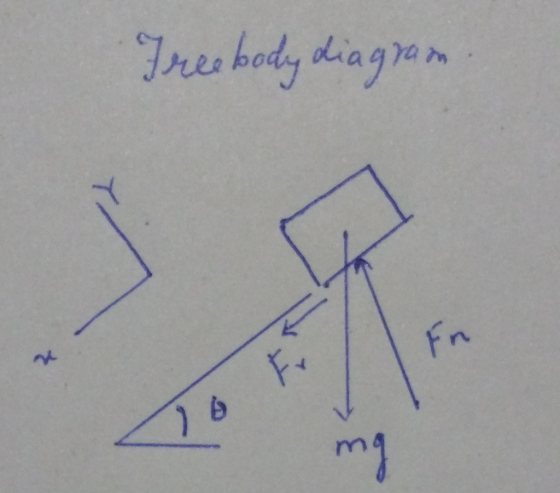
from the free body diagram we have
in y direction we have
Fy=may
Fn-mgcos=0
so Fn=mgcos...........1)
and Fr=Fn
so using eqn 1 we have
Fr=mgcos
........2)
we have the formula for kinetic energy
K.E=1/2mv2
and the work done by the friction force is
Fr*d=mgcos
*d
when the block reaches the top, the kinetic energy changes to potential energy
so P.E=mgh=mgsin*d
P.E=K.E-work done by friction
mgsin*d=1/2mv2-
mgcos
*d
gsin*d=1/2v2-
gcos
*d
1/2v2=d(gsin+
gcos
)
1/2*202=d(9.8*sin20o+0.2*9.8*cos20o)
200=d(5.1936)
d=200/5.1936=38.5m
so answer is 38.5m
Add Answer to:
5.) A 1000kg The coefficient of friction is .2 How far does the car travel uphill...
A mass m = 14 kg is pulled along a horizontal floor, with a coefficient of...
 A mass m = 14 kg is pulled along a horizontal floor, with a
coefficient of kinetic friction μk = 0.12, for a
distance d = 5.9 m. Then the mass is continued to be pulled up a
frictionless incline that makes an angle θ = 38° with the
horizontal. The entire time the massless rope used to pull the
block is pulled parallel to the incline at an angle of θ = 38°
(thus on the incline it is...
A mass m = 14 kg is pulled along a horizontal floor, with a
coefficient of kinetic friction μk = 0.12, for a
distance d = 5.9 m. Then the mass is continued to be pulled up a
frictionless incline that makes an angle θ = 38° with the
horizontal. The entire time the massless rope used to pull the
block is pulled parallel to the incline at an angle of θ = 38°
(thus on the incline it is...
A person is driving a car. The car&driver have combined mass of 1000kg. The car is...
A person is driving a car. The car&driver have combined mass of 1000kg. The car is travelling at 25m/s when it hits the car in front then it's brought to rest. How much energy was transferred from the car in bringing it to rest? - How does the energy flow diagram look like for this question? Is the arrow pointing from the car to the car in front? Could you draw them if you can?
A mass m = 17 kg is pulled along a horizontal floor with NO friction for...
 A mass m = 17 kg is pulled along a horizontal floor with NO
friction for a distance d =6 m. Then the mass is pulled up an
incline that makes an angle θ = 37° with the horizontal and has a
coefficient of kinetic friction μk = 0.4. The entire
time the massless rope used to pull the block is pulled parallel to
the incline at an angle of θ = 37° (thus on the incline it is
parallel...
A mass m = 17 kg is pulled along a horizontal floor with NO
friction for a distance d =6 m. Then the mass is pulled up an
incline that makes an angle θ = 37° with the horizontal and has a
coefficient of kinetic friction μk = 0.4. The entire
time the massless rope used to pull the block is pulled parallel to
the incline at an angle of θ = 37° (thus on the incline it is
parallel...
A block of mass m = 3.5 kg is on an inclined plane with a coefficient...
 A block of mass m = 3.5 kg is
on an inclined plane with a coefficient of friction
μ1 = 0.31, at an
initial height h = 0.53 m above
the ground. The plane is inclined at an angle θ =
54°. The block is then compressed against
a spring a distance Δx = 0.11 m
from its equilibrium point (the spring has a spring constant of
k1 = 39 N/m) and
released. At the bottom of the inclined plane...
A block of mass m = 3.5 kg is
on an inclined plane with a coefficient of friction
μ1 = 0.31, at an
initial height h = 0.53 m above
the ground. The plane is inclined at an angle θ =
54°. The block is then compressed against
a spring a distance Δx = 0.11 m
from its equilibrium point (the spring has a spring constant of
k1 = 39 N/m) and
released. At the bottom of the inclined plane...
A mass m = 12 kg is pulled along a horizontal floor with NO friction for...
 A mass m = 12 kg is pulled along a horizontal floor with NO
friction for a distance d =6.5 m. Then the mass is pulled up an
incline that makes an angle θ = 25° with the horizontal and has a
coefficient of kinetic friction μk = 0.44. The entire
time the massless rope used to pull the block is pulled parallel to
the incline at an angle of θ = 25° (thus on the incline it is
parallel...
A mass m = 12 kg is pulled along a horizontal floor with NO
friction for a distance d =6.5 m. Then the mass is pulled up an
incline that makes an angle θ = 25° with the horizontal and has a
coefficient of kinetic friction μk = 0.44. The entire
time the massless rope used to pull the block is pulled parallel to
the incline at an angle of θ = 25° (thus on the incline it is
parallel...
a truck ( mass == 1000kg) is travelling at a speed of 5 0 m/s when...
a truck ( mass == 1000kg) is travelling at a speed of 5 0 m/s when the driver suddenly stops. The coefficient for kinetic friction between rubber and the floor u_k = 0.90. find the stopping distance for the folllowing cases. a) travelling up a 20 degree slope b) down a 30 degree slope c) on a level road
A 5 kg block is on a 52◦ inclined plane, where the coefficient of kinetic friction...
 A 5 kg block is on a 52◦ inclined plane, where the coefficient
of kinetic friction is µk = 0.46. A force of 30 N is applied along
an axis parallel to the incline, as shown in the figure. The block
is initially moving up the incline at 3 m/s.
a) Draw a free-body diagram for the block.
b) What is the acceleration of the block?
c) How far does the block travel before it reaches its highest
point?
d)...
A 5 kg block is on a 52◦ inclined plane, where the coefficient
of kinetic friction is µk = 0.46. A force of 30 N is applied along
an axis parallel to the incline, as shown in the figure. The block
is initially moving up the incline at 3 m/s.
a) Draw a free-body diagram for the block.
b) What is the acceleration of the block?
c) How far does the block travel before it reaches its highest
point?
d)...
A mass m = 16 kg is pulled along a horizontal floor with NO friction for...
A mass m = 16 kg is pulled along a horizontal floor with NO friction for a distance d =7.5 m. Then the mass is pulled up an incline that makes an angle θ = 33° with the horizontal and has a coefficient of kinetic friction μk = 0.41. The entire time the massless rope used to pull the block is pulled parallel to the incline at an angle of θ = 33° (thus on the incline it is parallel...
A mass m = 17 kg is pulled along a horizontal floor with NO friction for...
 A mass m = 17 kg is pulled along a horizontal floor with NO friction for a distance d =5.8 m. Then the mass is pulled up an incline that makes an angle 0 = 35º with the horizontal and has a coefficient of kinetic friction uk = 0.38. The entire time the massless rope used to pull the block is pulled parallel to the incline at an angle of 0 = 35° (thus on the incline it is parallel...
A block of mass 3kg is sliding up a 10 degrees incline, a coefficient of friction...
A block of mass 3kg is sliding up a 10 degrees incline, a coefficient of friction of 0.4, vi=3 m/s to the right. How far does it slide up the incline before it stops?
 A mass m = 14 kg is pulled along a horizontal floor, with a
coefficient of kinetic friction μk = 0.12, for a
distance d = 5.9 m. Then the mass is continued to be pulled up a
frictionless incline that makes an angle θ = 38° with the
horizontal. The entire time the massless rope used to pull the
block is pulled parallel to the incline at an angle of θ = 38°
(thus on the incline it is...
A mass m = 14 kg is pulled along a horizontal floor, with a
coefficient of kinetic friction μk = 0.12, for a
distance d = 5.9 m. Then the mass is continued to be pulled up a
frictionless incline that makes an angle θ = 38° with the
horizontal. The entire time the massless rope used to pull the
block is pulled parallel to the incline at an angle of θ = 38°
(thus on the incline it is...
 A mass m = 17 kg is pulled along a horizontal floor with NO
friction for a distance d =6 m. Then the mass is pulled up an
incline that makes an angle θ = 37° with the horizontal and has a
coefficient of kinetic friction μk = 0.4. The entire
time the massless rope used to pull the block is pulled parallel to
the incline at an angle of θ = 37° (thus on the incline it is
parallel...
A mass m = 17 kg is pulled along a horizontal floor with NO
friction for a distance d =6 m. Then the mass is pulled up an
incline that makes an angle θ = 37° with the horizontal and has a
coefficient of kinetic friction μk = 0.4. The entire
time the massless rope used to pull the block is pulled parallel to
the incline at an angle of θ = 37° (thus on the incline it is
parallel...
 A block of mass m = 3.5 kg is
on an inclined plane with a coefficient of friction
μ1 = 0.31, at an
initial height h = 0.53 m above
the ground. The plane is inclined at an angle θ =
54°. The block is then compressed against
a spring a distance Δx = 0.11 m
from its equilibrium point (the spring has a spring constant of
k1 = 39 N/m) and
released. At the bottom of the inclined plane...
A block of mass m = 3.5 kg is
on an inclined plane with a coefficient of friction
μ1 = 0.31, at an
initial height h = 0.53 m above
the ground. The plane is inclined at an angle θ =
54°. The block is then compressed against
a spring a distance Δx = 0.11 m
from its equilibrium point (the spring has a spring constant of
k1 = 39 N/m) and
released. At the bottom of the inclined plane...
 A mass m = 12 kg is pulled along a horizontal floor with NO
friction for a distance d =6.5 m. Then the mass is pulled up an
incline that makes an angle θ = 25° with the horizontal and has a
coefficient of kinetic friction μk = 0.44. The entire
time the massless rope used to pull the block is pulled parallel to
the incline at an angle of θ = 25° (thus on the incline it is
parallel...
A mass m = 12 kg is pulled along a horizontal floor with NO
friction for a distance d =6.5 m. Then the mass is pulled up an
incline that makes an angle θ = 25° with the horizontal and has a
coefficient of kinetic friction μk = 0.44. The entire
time the massless rope used to pull the block is pulled parallel to
the incline at an angle of θ = 25° (thus on the incline it is
parallel...
 A 5 kg block is on a 52◦ inclined plane, where the coefficient
of kinetic friction is µk = 0.46. A force of 30 N is applied along
an axis parallel to the incline, as shown in the figure. The block
is initially moving up the incline at 3 m/s.
a) Draw a free-body diagram for the block.
b) What is the acceleration of the block?
c) How far does the block travel before it reaches its highest
point?
d)...
A 5 kg block is on a 52◦ inclined plane, where the coefficient
of kinetic friction is µk = 0.46. A force of 30 N is applied along
an axis parallel to the incline, as shown in the figure. The block
is initially moving up the incline at 3 m/s.
a) Draw a free-body diagram for the block.
b) What is the acceleration of the block?
c) How far does the block travel before it reaches its highest
point?
d)...
 A mass m = 17 kg is pulled along a horizontal floor with NO friction for a distance d =5.8 m. Then the mass is pulled up an incline that makes an angle 0 = 35º with the horizontal and has a coefficient of kinetic friction uk = 0.38. The entire time the massless rope used to pull the block is pulled parallel to the incline at an angle of 0 = 35° (thus on the incline it is parallel...
Most questions answered within 3 hours.
-
Where is the error in this code sequence?
String s1 = "Hello";
String s2 = "ello";...
asked 11 months ago -
Financial data for Joel de Paris, Inc., for last year
follow:
Joel de Paris, Inc.
Balance...
asked 11 months ago -
Consider this reaction:
Al2(SO4)3 (aq)+ BaCl3
(aq) Al2Cl6 (aq)- +
3BaSO4(s) . What is the...
asked 11 months ago -
Suppose that Savneet is considering increasing her
recent random sample from 20 car rentals to 40...
asked 11 months ago -
Trucks arrive at an unloading terminal at an average rate of 120
per hour.
Trucks arrive...
asked 11 months ago -
Why are methanol and ethanol completely soluble in water while
octanol is not very little soluble....
asked 11 months ago -
A facilities manager at a university reads in a research report
that the mean amount of...
asked 11 months ago -
When the CuSO4 is rehydrated by adding water to the anhydrous
compound, is this an endothermic...
asked 11 months ago -
A ray of sunlight is passing from diamond into crown glass; the
angle of incidence is...
asked 11 months ago -
A block of mass 0.249 kg is placed on top of a light, vertical
spring of...
asked 11 months ago -
how do the kidneys compensate in the presences of acidosis
a) trigger hyperventilate
b) reserve acid...
asked 11 months ago -
Question 501 pts
The rental rate of capital to the firm increases. Which of the
following...
asked 11 months ago