
Homework Answers


Add Answer to:
Independent random samples of n = 16 observations each are drawn from normal populations. The parameters...
Independent random samples of n = 100 observations each are drawn from normal populations. The parameters...
Independent random samples of n = 100 observations each are drawn from normal populations. The parameters of these populations are: • Population 1: μ1 = 300 and σ1 = 60; • Population 2: μ2 = 290 and σ2 = 80. (1) What is the probability that the mean of Population 1 is between 294 and 306? (2) How many samples should be included if we want the probability in Part (1) to be at least 95%? (3) What is the...
Independent random samples of 36 and 41 observations are drawn from two quantitative populations, 1 and...
 Independent random samples of 36 and 41 observations are drawn from two quantitative populations, 1 and 2, respectively. The sample data summary is shown here. Sample 1 36 Sample 2 Sample Size Sample Mean 1.32 0.05700.0520 Do the data present sufficlent evidence to indicate that the mean for population I is smaller than the mean for population 27 Use one of the two methods of testing presented in this section. (Round your answer to two decimal places.) z 2877
15. Multiple Choice Question Consider two independent normal populations. A random sample of size n =...
 15. Multiple Choice Question Consider two independent normal populations. A random sample of size n = 16 is selected from the first normal population with mean 75 and variance 288. A second random sample of size m - 9 is selected from the second normal population with mean 80 and variance 162. Assume that the random samples are independent. Let X, and X, be the respective sample means. Find the probability that X1 + X, is larger than 156.5. A....
The following observations are from two independent random samples, drawn from normally distribut...
 The following observations are from two independent random samples, drawn from normally distributed populations. Sample 1 9.74, 9.04, 8.06, 6.09, 7.51 Sample 2 |[25.96, 26,27, 26,34, 39.09, 33.88, 28.87, 33.46] We are interested in testing the null hypothesis that the two population variances are equal, against the one-sided alternative that the variance of Population 1 is larger than the variance of Population 2. Define Population 1 to be the population with the larger sample variance a) What are the appropriate...
Please help!!! Independent random samples from normal populations produced the results shown in the table to...
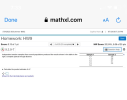 Please help!!!
Independent random samples from normal populations produced
the results shown in the table to the right. Complete parts a
through d below.
Done mathxl.com AA STA2023-20Summer B002 Sophia Hiatt & 07/29/20 7:33 PM Homework: HW9 Save Score: 0.13 of 1 pt 4 of 20 (10 complete) We 9.2.9-T Independent random samples from normal populations produced the results shown in the table to the right. Complete parts a through d below. HW Score: 20.24%, 5.06 of 25 pts Question...
Please help!!!
Independent random samples from normal populations produced
the results shown in the table to the right. Complete parts a
through d below.
Done mathxl.com AA STA2023-20Summer B002 Sophia Hiatt & 07/29/20 7:33 PM Homework: HW9 Save Score: 0.13 of 1 pt 4 of 20 (10 complete) We 9.2.9-T Independent random samples from normal populations produced the results shown in the table to the right. Complete parts a through d below. HW Score: 20.24%, 5.06 of 25 pts Question...
A random sample of n=49 observations is drawn from a population with a mean equal to...
A random sample of n=49 observations is drawn from a population with a mean equal to 20 and a standard deviation equal to14. a. Find the probability that x overbarx is less than 14. b. Find the probability that x overbarx is greater than 25. c. Find the probability that x overbarx falls between 14 and 22. LOADING... Click the icon to view the table of normal curve areas. a. The probability that x overbarx is less than 14 is...
3. Multiple Choice Question Consider two independent normal populations. A random sample of size ni =...
 3. Multiple Choice Question Consider two independent normal populations. A random sample of size ni = 16 is selected from the first normal population with mean 75 and variance 288. A second random sample of size 12 = 9 is selected from the second normal population with mean 80 and variance 162. Assume that the random samples are independent. Let X1 and X2 be the respective sample means. Find the probability that X1 + X2 is larger than 156.5. A....
Suppose independent random samples drawn from two normal populations, assumed to have equal variance, result in...
 Suppose independent random samples drawn from two normal populations, assumed to have equal variance, result in the following summary statistics: n1 =15.62. Calculate a pooled estimate of the common standard deviation of the two populations. 16, s1 17.1, n2 19, s2 3 pt(s)] Submit Answer Tries 0/3
You are given two independent random samples from two populations. For Sample #1, there are 60...
You are given two independent random samples from two populations. For Sample #1, there are 60 observations, the sample mean is 33.8 and you are given that the populationstandard deviation is 5.5 For Sample #2, there are 35 observations, the sample mean is 31.8 and you are given that the populationstandard deviation is 4.1 You are asked to test the null hypothesis that the two population have the same mean (the difference in population means is 0). What is the...
Question 2 (4 marks) Part a) A sample of n-25 observations is drawn from a normal...
 Question 2 (4 marks) Part a) A sample of n-25 observations is drawn from a normal population with μ-100 and o-20. Find the following. i) P(X<96) ii) P(96-X-105) Part b) The amount of time the university professors devote to their jobs per week is normally distributed with a mean of 52 hours and a standard deviation of 6 hours. i) What is the probability that a professor works for more than 60 hours per weeks? ii) Find the probability that...
 Independent random samples of 36 and 41 observations are drawn from two quantitative populations, 1 and 2, respectively. The sample data summary is shown here. Sample 1 36 Sample 2 Sample Size Sample Mean 1.32 0.05700.0520 Do the data present sufficlent evidence to indicate that the mean for population I is smaller than the mean for population 27 Use one of the two methods of testing presented in this section. (Round your answer to two decimal places.) z 2877
 15. Multiple Choice Question Consider two independent normal populations. A random sample of size n = 16 is selected from the first normal population with mean 75 and variance 288. A second random sample of size m - 9 is selected from the second normal population with mean 80 and variance 162. Assume that the random samples are independent. Let X, and X, be the respective sample means. Find the probability that X1 + X, is larger than 156.5. A....
 The following observations are from two independent random samples, drawn from normally distributed populations. Sample 1 9.74, 9.04, 8.06, 6.09, 7.51 Sample 2 |[25.96, 26,27, 26,34, 39.09, 33.88, 28.87, 33.46] We are interested in testing the null hypothesis that the two population variances are equal, against the one-sided alternative that the variance of Population 1 is larger than the variance of Population 2. Define Population 1 to be the population with the larger sample variance a) What are the appropriate...
 Please help!!!
Independent random samples from normal populations produced
the results shown in the table to the right. Complete parts a
through d below.
Done mathxl.com AA STA2023-20Summer B002 Sophia Hiatt & 07/29/20 7:33 PM Homework: HW9 Save Score: 0.13 of 1 pt 4 of 20 (10 complete) We 9.2.9-T Independent random samples from normal populations produced the results shown in the table to the right. Complete parts a through d below. HW Score: 20.24%, 5.06 of 25 pts Question...
Please help!!!
Independent random samples from normal populations produced
the results shown in the table to the right. Complete parts a
through d below.
Done mathxl.com AA STA2023-20Summer B002 Sophia Hiatt & 07/29/20 7:33 PM Homework: HW9 Save Score: 0.13 of 1 pt 4 of 20 (10 complete) We 9.2.9-T Independent random samples from normal populations produced the results shown in the table to the right. Complete parts a through d below. HW Score: 20.24%, 5.06 of 25 pts Question...
 3. Multiple Choice Question Consider two independent normal populations. A random sample of size ni = 16 is selected from the first normal population with mean 75 and variance 288. A second random sample of size 12 = 9 is selected from the second normal population with mean 80 and variance 162. Assume that the random samples are independent. Let X1 and X2 be the respective sample means. Find the probability that X1 + X2 is larger than 156.5. A....
 Suppose independent random samples drawn from two normal populations, assumed to have equal variance, result in the following summary statistics: n1 =15.62. Calculate a pooled estimate of the common standard deviation of the two populations. 16, s1 17.1, n2 19, s2 3 pt(s)] Submit Answer Tries 0/3
 Question 2 (4 marks) Part a) A sample of n-25 observations is drawn from a normal population with μ-100 and o-20. Find the following. i) P(X<96) ii) P(96-X-105) Part b) The amount of time the university professors devote to their jobs per week is normally distributed with a mean of 52 hours and a standard deviation of 6 hours. i) What is the probability that a professor works for more than 60 hours per weeks? ii) Find the probability that...
Most questions answered within 3 hours.
-
Where is the error in this code sequence?
String s1 = "Hello";
String s2 = "ello";...
asked 10 months ago -
Financial data for Joel de Paris, Inc., for last year
follow:
Joel de Paris, Inc.
Balance...
asked 10 months ago -
Consider this reaction:
Al2(SO4)3 (aq)+ BaCl3
(aq) Al2Cl6 (aq)- +
3BaSO4(s) . What is the...
asked 10 months ago -
Suppose that Savneet is considering increasing her
recent random sample from 20 car rentals to 40...
asked 10 months ago -
Trucks arrive at an unloading terminal at an average rate of 120
per hour.
Trucks arrive...
asked 10 months ago -
Why are methanol and ethanol completely soluble in water while
octanol is not very little soluble....
asked 10 months ago -
A facilities manager at a university reads in a research report
that the mean amount of...
asked 10 months ago -
When the CuSO4 is rehydrated by adding water to the anhydrous
compound, is this an endothermic...
asked 10 months ago -
A ray of sunlight is passing from diamond into crown glass; the
angle of incidence is...
asked 10 months ago -
A block of mass 0.249 kg is placed on top of a light, vertical
spring of...
asked 10 months ago -
how do the kidneys compensate in the presences of acidosis
a) trigger hyperventilate
b) reserve acid...
asked 10 months ago -
Question 501 pts
The rental rate of capital to the firm increases. Which of the
following...
asked 10 months ago