
Homework Answers


Add Answer to:
3. Divide the circle into N points, and consider a particle randomly moving between these points,...
3. Divide the circle into N points, and consider a particle randomly moving between these points,...
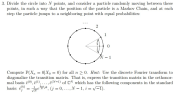 3. Divide the circle into N points, and consider a particle randomly moving between these points, in such a way that the position of the particle is a Markov Chain, and at each step the particle jumps to a neighboring point with equal probabilities: 2 2 0 N- 1 Compute P(X,-01X0-0) for all n > 0. Hint: Use the discrete Fourier transform to diagonalize the transition matrix. That is, express the transition matrix in the orthonor- mal basis (0), ê(1)...
2. (10 points) Consider a continuous-time Markov chain with the transition rate matrix -4 2 2 Q 3...
 2. (10 points) Consider a continuous-time Markov chain with the transition rate matrix -4 2 2 Q 34 1 5 0 -5 (a) What is the expected amount of time spent in each state? (b) What is the transition probability matrix of the embedded discrete-time Markov chain? (c) Is this continuous-time Markov chain irreducible? (d) Compute the stationary distribution for the continuous-time Markov chain and the em- bedded discrete-time Markov chain and compare the two
2. (10 points) Consider a...
2. (10 points) Consider a continuous-time Markov chain with the transition rate matrix -4 2 2 Q 34 1 5 0 -5 (a) What is the expected amount of time spent in each state? (b) What is the transition probability matrix of the embedded discrete-time Markov chain? (c) Is this continuous-time Markov chain irreducible? (d) Compute the stationary distribution for the continuous-time Markov chain and the em- bedded discrete-time Markov chain and compare the two
2. (10 points) Consider a...
(10 points) Consider a Markov chain (Xn)n-0,1,2 probability matrix with state space S ,2,3) and transition...
 (10 points) Consider a Markov chain (Xn)n-0,1,2 probability matrix with state space S ,2,3) and transition 1/5 3/5 1/5 P-0 1/2 1/2 3/10 7/10 0 The initial distribution is given by (1/2,1/6,1/3). Compute (a) P[X2-k for all k- 1,2,3 (b) E[X2] Does the distribution of X2 computed in (a) depend on the initial distribution a? Does the expected value of X2 computed in (b) depend on the nitial distribution a? Give a reason for both of your answers.
1) (35 points) The wave function for a particle moving along x axis between the limits 0 and L is: (x)-C sin (nx xL) where n are 1, 2, 3, A) Determine the normalization constant C B) Why can'...
 1) (35 points) The wave function for a particle moving along x axis between the limits 0 and L is: (x)-C sin (nx xL) where n are 1, 2, 3, A) Determine the normalization constant C B) Why can't n take the value of 0, briefly explain C) For n-3 determine the values of x (in terms of L) that correspond to a maximum or a minimum in the wave function D) For n-3 determine the values of x (in...
 3. Divide the circle into N points, and consider a particle randomly moving between these points, in such a way that the position of the particle is a Markov Chain, and at each step the particle jumps to a neighboring point with equal probabilities: 2 2 0 N- 1 Compute P(X,-01X0-0) for all n > 0. Hint: Use the discrete Fourier transform to diagonalize the transition matrix. That is, express the transition matrix in the orthonor- mal basis (0), ê(1)...
 2. (10 points) Consider a continuous-time Markov chain with the transition rate matrix -4 2 2 Q 34 1 5 0 -5 (a) What is the expected amount of time spent in each state? (b) What is the transition probability matrix of the embedded discrete-time Markov chain? (c) Is this continuous-time Markov chain irreducible? (d) Compute the stationary distribution for the continuous-time Markov chain and the em- bedded discrete-time Markov chain and compare the two
2. (10 points) Consider a...
2. (10 points) Consider a continuous-time Markov chain with the transition rate matrix -4 2 2 Q 34 1 5 0 -5 (a) What is the expected amount of time spent in each state? (b) What is the transition probability matrix of the embedded discrete-time Markov chain? (c) Is this continuous-time Markov chain irreducible? (d) Compute the stationary distribution for the continuous-time Markov chain and the em- bedded discrete-time Markov chain and compare the two
2. (10 points) Consider a...
 (10 points) Consider a Markov chain (Xn)n-0,1,2 probability matrix with state space S ,2,3) and transition 1/5 3/5 1/5 P-0 1/2 1/2 3/10 7/10 0 The initial distribution is given by (1/2,1/6,1/3). Compute (a) P[X2-k for all k- 1,2,3 (b) E[X2] Does the distribution of X2 computed in (a) depend on the initial distribution a? Does the expected value of X2 computed in (b) depend on the nitial distribution a? Give a reason for both of your answers.
 1) (35 points) The wave function for a particle moving along x axis between the limits 0 and L is: (x)-C sin (nx xL) where n are 1, 2, 3, A) Determine the normalization constant C B) Why can't n take the value of 0, briefly explain C) For n-3 determine the values of x (in terms of L) that correspond to a maximum or a minimum in the wave function D) For n-3 determine the values of x (in...
Most questions answered within 3 hours.
-
Where is the error in this code sequence?
String s1 = "Hello";
String s2 = "ello";...
asked 10 months ago -
Financial data for Joel de Paris, Inc., for last year
follow:
Joel de Paris, Inc.
Balance...
asked 10 months ago -
Consider this reaction:
Al2(SO4)3 (aq)+ BaCl3
(aq) Al2Cl6 (aq)- +
3BaSO4(s) . What is the...
asked 10 months ago -
Suppose that Savneet is considering increasing her
recent random sample from 20 car rentals to 40...
asked 10 months ago -
Trucks arrive at an unloading terminal at an average rate of 120
per hour.
Trucks arrive...
asked 10 months ago -
Why are methanol and ethanol completely soluble in water while
octanol is not very little soluble....
asked 10 months ago -
A facilities manager at a university reads in a research report
that the mean amount of...
asked 10 months ago -
When the CuSO4 is rehydrated by adding water to the anhydrous
compound, is this an endothermic...
asked 10 months ago -
A ray of sunlight is passing from diamond into crown glass; the
angle of incidence is...
asked 10 months ago -
A block of mass 0.249 kg is placed on top of a light, vertical
spring of...
asked 10 months ago -
how do the kidneys compensate in the presences of acidosis
a) trigger hyperventilate
b) reserve acid...
asked 10 months ago -
Question 501 pts
The rental rate of capital to the firm increases. Which of the
following...
asked 10 months ago