
Homework Answers
1 mole of C7H6O3 gives 1 mole of aspirin.
Number of moles = mass/molar mass
Molar mass of C7H6O3 = 138.12 g/mol
Moles of C7H6O3 = 79.8/138.12
= 0.58 moles
Moles of aspirin formed = 0.58 mol
Molar mass of aspirin = 180.16 g/mol
Mass of aspirin formed = 180.16 g/mol × 0.58 mol
= 104.50 g of aspirin.
Percent yield = (actual yield/theoretical yield) × 100
Percent yield = ( 79.8/104.50)×100
= 76.4%
Answer = 76.4 %
Add Answer to:
If 62.8 g of aspirin (C,H,Oa) is produced from 79.8 g of CyH6O3, what is the...
If 50.4 g of aspirin (C,H,O,) is produced from 79.8 g of C H2O3, what is...
 If 50.4 g of aspirin (C,H,O,) is produced from 79.8 g of C H2O3, what is the percent yield from the reaction below? CyH603 (s) + C4H603 (s) → C,H204 (s) + HC2H2O2 (aq).
Question 31 of 31 Submit If 50.9 g of aspirin (C9H8O4) is produced from 79.8 g...
 Question 31 of 31 Submit If 50.9 g of aspirin (C9H8O4) is produced from 79.8 g of CzH6O3, what is the percent yield from the reaction below? CzH603 (s) + C4H603 (s) → C9H8O4 (s) + HC2H3O2 (aq).
Submit If 50.9 g of aspirin (C3H&Os) is produced from 79.8 g of C7HeO3, what is...
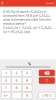 Submit If 50.9 g of aspirin (C3H&Os) is produced from 79.8 g of C7HeO3, what is the percent yield from the reaction below? (s) + HC2H3O2 (aq). 0 1 23 4 5 6 9 0 7 8 x 100
4. Aspirin (C,H,O,) is produced via reaction of salicylic acid (CyH603) with acetic anhydride (C H603),...
 4. Aspirin (C,H,O,) is produced via reaction of salicylic acid (CyH603) with acetic anhydride (C H603), according to the following chemical equation: CyH603() + C4H603(1)→ CH904() + HC2H302(aq) If you wanted to prepare 500.6 g of aspirin, how many grams of salicylic acid would you need to react?
What mass of aspirin (C₉H₈O₄) is produced from 60.2 g of C₇H₆O₃ assuming 95.0% yield from...
What mass of aspirin (C₉H₈O₄) is produced from 60.2 g of C₇H₆O₃ assuming 95.0% yield from the reaction below? C₇H₆O₃ (s) + C₄H₆O₃ (s) → C₉H₈O₄ (s) + HC₂H₃O₂ (aq).
11 If 50.0 g of H2 and 130.0 g of O2 react, how many moles of H2O can be produced in the reaction below? 2 H2(g) +...
 11 If 50.0 g of H2 and 130.0 g of O2 react, how many moles of H2O can be produced in the reaction below? 2 H2(g) + O2(g) → 2 H2O(g) Attempts remaining: 2 12 If 41.1 g of NO and 26.9 g of Oz react together, how many grams of NO2 can be formed via the reaction below? 2 NO (g) + O2(g) → 2 NO2 (g) Attempts remaining: 2 13 - You have 2.2 mol Xe and 1.9...
If 50.9 g of aspirin (CgHgO4) is prod ced from 9.8 g of CHgO3, what is...
 If 50.9 g of aspirin (CgHgO4) is prod ced from 9.8 g of CHgO3, what is the percent yield from the reaction below? C7H&O3 (s) + CaH6O3 (s) CoH,0& (s) + HC2H,02 (aq)
4.3 Percent Yield 5. Aspirin is produced by the reaction of salicylic acid (AM=138.1 g/mol) and...
 4.3 Percent Yield 5. Aspirin is produced by the reaction of salicylic acid (AM=138.1 g/mol) and acetic anhydride (M-102.1 g/mol). CH O(E) CoHO(s) +C2HO2(e) C H&O3(s) If 5.00 g of CsHO (M 180.2 g/mol) is produced from the reaction of 5.00 g CaHeO, and 6.00 g CaH&O, what is the percent yield? a) 11.6% 68.8% c) 59.9% b) 29.0% e) 76.68% 4.6 Chemical Equations and Chemical Analysis 6. A mixture of MnSOs and MnSO4 4H2O has a mass of 2.005...
10. Aspirin (CoH&O4) is produced by the reaction of salicylic acid (C7H6O3) and acetic anhydride (C4H6O3)...
 10. Aspirin (CoH&O4) is produced by the reaction of salicylic acid (C7H6O3) and acetic anhydride (C4H6O3) according to the following reaction CHO3(s)CaHoO3(1)C9H8O4(s)+ CHSCO2H(aq) If 100.0 g of each of the reactants are combined, what is the maximum mass of aspirin that can be obtained? 11. Bismuth selenide, Bi2Se3, is used in semiconductor research. It can be produced directly from its elements. If 15.2 g bismuth and 12.8 g selenium are used to produce 19.5 g of bismuth selenide, what is...
Hello, can somebody please help me answer these questions please. Thank you! 1) How many moles...
Hello, can somebody please help me answer these questions please. Thank you! 1) How many moles of Al are necessary to form 23.6 g of AlBr₃ from this reaction: 2 Al(s) + 3 Br₂(l) → 2 AlBr₃? 2) Nitrogen gas can be prepared by passing ammonia over copper(II) oxide, and the other products are copper metal and water vapor. If a sample containing 3.58 moles of NH₃ is reacted with excess copper(II) oxide, how many grams of N₂ will be...
 If 50.4 g of aspirin (C,H,O,) is produced from 79.8 g of C H2O3, what is the percent yield from the reaction below? CyH603 (s) + C4H603 (s) → C,H204 (s) + HC2H2O2 (aq).
 Question 31 of 31 Submit If 50.9 g of aspirin (C9H8O4) is produced from 79.8 g of CzH6O3, what is the percent yield from the reaction below? CzH603 (s) + C4H603 (s) → C9H8O4 (s) + HC2H3O2 (aq).
 Submit If 50.9 g of aspirin (C3H&Os) is produced from 79.8 g of C7HeO3, what is the percent yield from the reaction below? (s) + HC2H3O2 (aq). 0 1 23 4 5 6 9 0 7 8 x 100
 4. Aspirin (C,H,O,) is produced via reaction of salicylic acid (CyH603) with acetic anhydride (C H603), according to the following chemical equation: CyH603() + C4H603(1)→ CH904() + HC2H302(aq) If you wanted to prepare 500.6 g of aspirin, how many grams of salicylic acid would you need to react?
 11 If 50.0 g of H2 and 130.0 g of O2 react, how many moles of H2O can be produced in the reaction below? 2 H2(g) + O2(g) → 2 H2O(g) Attempts remaining: 2 12 If 41.1 g of NO and 26.9 g of Oz react together, how many grams of NO2 can be formed via the reaction below? 2 NO (g) + O2(g) → 2 NO2 (g) Attempts remaining: 2 13 - You have 2.2 mol Xe and 1.9...
 If 50.9 g of aspirin (CgHgO4) is prod ced from 9.8 g of CHgO3, what is the percent yield from the reaction below? C7H&O3 (s) + CaH6O3 (s) CoH,0& (s) + HC2H,02 (aq)
 4.3 Percent Yield 5. Aspirin is produced by the reaction of salicylic acid (AM=138.1 g/mol) and acetic anhydride (M-102.1 g/mol). CH O(E) CoHO(s) +C2HO2(e) C H&O3(s) If 5.00 g of CsHO (M 180.2 g/mol) is produced from the reaction of 5.00 g CaHeO, and 6.00 g CaH&O, what is the percent yield? a) 11.6% 68.8% c) 59.9% b) 29.0% e) 76.68% 4.6 Chemical Equations and Chemical Analysis 6. A mixture of MnSOs and MnSO4 4H2O has a mass of 2.005...
 10. Aspirin (CoH&O4) is produced by the reaction of salicylic acid (C7H6O3) and acetic anhydride (C4H6O3) according to the following reaction CHO3(s)CaHoO3(1)C9H8O4(s)+ CHSCO2H(aq) If 100.0 g of each of the reactants are combined, what is the maximum mass of aspirin that can be obtained? 11. Bismuth selenide, Bi2Se3, is used in semiconductor research. It can be produced directly from its elements. If 15.2 g bismuth and 12.8 g selenium are used to produce 19.5 g of bismuth selenide, what is...
Most questions answered within 3 hours.
-
Where is the error in this code sequence?
String s1 = "Hello";
String s2 = "ello";...
asked 11 months ago -
Financial data for Joel de Paris, Inc., for last year
follow:
Joel de Paris, Inc.
Balance...
asked 11 months ago -
Consider this reaction:
Al2(SO4)3 (aq)+ BaCl3
(aq) Al2Cl6 (aq)- +
3BaSO4(s) . What is the...
asked 11 months ago -
Suppose that Savneet is considering increasing her
recent random sample from 20 car rentals to 40...
asked 11 months ago -
Trucks arrive at an unloading terminal at an average rate of 120
per hour.
Trucks arrive...
asked 11 months ago -
Why are methanol and ethanol completely soluble in water while
octanol is not very little soluble....
asked 11 months ago -
A facilities manager at a university reads in a research report
that the mean amount of...
asked 11 months ago -
When the CuSO4 is rehydrated by adding water to the anhydrous
compound, is this an endothermic...
asked 11 months ago -
A ray of sunlight is passing from diamond into crown glass; the
angle of incidence is...
asked 11 months ago -
A block of mass 0.249 kg is placed on top of a light, vertical
spring of...
asked 11 months ago -
how do the kidneys compensate in the presences of acidosis
a) trigger hyperventilate
b) reserve acid...
asked 11 months ago -
Question 501 pts
The rental rate of capital to the firm increases. Which of the
following...
asked 11 months ago