
Homework Answers
The following is the R code (all statements starting with # are comments)
![#set the mean mu<-10 # 3et the 3tandard deviation sigma<-8 #set the random seed set.seed (123) #make an empty plot to add the curves later plot (1, type=n, x1ab=bquote (bar (X)^2), yłab= Density, x1im=c (0, 800) , ylim=c (0,0.02), main=bquote (The distribution of bar (X)^2)) #set the colors for the plot cols<-c(red, blue, green, magenta) #set the sample 31ze3 n<-c (3,6,10,50) #do this for each sample size n for (i in l:length (n)) f #set the number of samples to be taken r<-50000 #draw a sample of 31ze n, r times, that 13 n*r draw3 x<-rnorm (n[1] *r,mu, зіста) #make this into a matrix of n rows and r columns x<-matrix (x, nrow=n [1] , ncol=-) #get r 3ample means xbar<-apply (x, 2,mean) #get the square of means xbar2<-xbar 2 #draw the density of xbar2 lines (density (xbar2) , typ=l, col-cols [1] ) #add the vertical line abline (v=me an (xbar2 ) , co1=cols [1] , lty=2) from normal (10,8^2) #add a 3011d line for mu^2 abline ( v=mu 2 , lwd=2 ) #add the legend legend ( topright, paste (n=, n, sep=) , col=cols, lty=1)](http://img.homeworklib.com/questions/662dc880-733d-11ea-8dad-670f6538b092.png?x-oss-process=image/resize,w_560) get this plot
get this plot
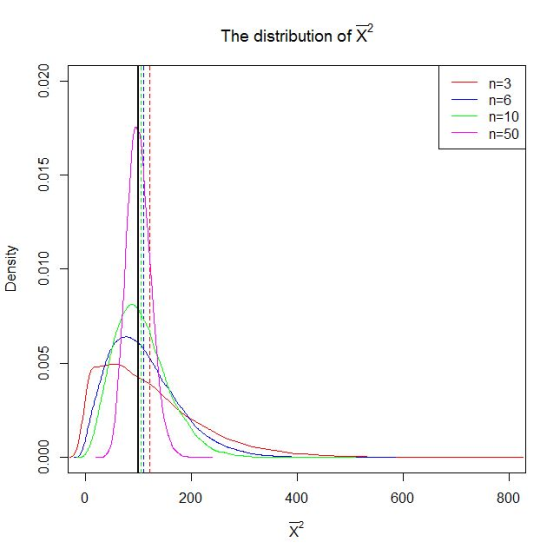
We can see that as the sample size increases, the dotted
vertical line moves closer to the solid line corresponding to
, showing
the asymptotic unbiasedness
We can also observe that the variance of the sampling distribution reduces with the increase in sample size.
Finally we can also see that the density takes on a bell shape as the sample size increases, indicating the asymptotic normality.
The code in text format is below
------------------------------------
#set the mean
mu<-10
# set the standard deviation
sigma<-8
#set the random seed
set.seed(123)
#make an empty plot to add the curves later
plot(1, type="n", xlab=bquote(bar(X)^2), ylab="Density", xlim=c(0,
800),ylim=c(0,0.02),
main=bquote("The distribution of "*bar(X)^2))
#set the colors for the plot
cols<-c("red","blue","green","magenta")
#set the sample sizes
n<-c(3,6,10,50)
#do this for each sample size n
for (i in 1:length(n)){
#set the number of samples to be taken
r<-50000
#draw a sample of size n, r times, that is n*r draws
from normal(10,8^2)
x<-rnorm(n[i]*r,mu,sigma)
#make this into a matrix of n rows and r columns
x<-matrix(x,nrow=n[i],ncol=r)
#get r sample means
xbar<-apply(x,2,mean)
#get the square of means
xbar2<-xbar^2
#draw the density of xbar2
lines(density(xbar2),typ="l",col=cols[i])
#add the vertical line
abline(v=mean(xbar2),col=cols[i],lty=2)
}
#add a solid line for mu^2
abline(v=mu^2,lwd=2)
#add the legend
legend("topright",paste("n=",n,sep=""),col=cols,lty=1)
Add Answer to:
R2. Let X ~ N(μ 10.82). Following up on R1, we will be approximating μ2, which...
R2 Let X ~ N(μ = 10.82). Following up on RI, we will be approximating μ2,...
 R2 Let X ~ N(μ = 10.82). Following up on RI, we will be approximating μ2, which we can see should be 100. For now, let the sample size be n 3, Pick 3 random numbers from X, compute 72 X, and repeat the process a total of 50000 times. Plot a smooth version of the histogram of these 50000 values for X2: the plot(density(...). command in R will be useful. Now find the average of your 50000 values and...
R2 IS THE QUESTION,THANKS! R2. Let X ~ N(μ = 10.82). Following upon we be approximating...
 R2 IS THE QUESTION,THANKS!
R2. Let X ~ N(μ = 10.82). Following upon we be approximating μwe can see should be 100. For now, let the sample size be n = 3, Pick 3 random numbers from X, compute X', and repeat the process a total of 50000 times. Plot a smooth version of the histogram of these 50000 values for X: the plot(density(...)) command in R will be useful. Now find the average of your 50000 values and make...
R2 IS THE QUESTION,THANKS!
R2. Let X ~ N(μ = 10.82). Following upon we be approximating μwe can see should be 100. For now, let the sample size be n = 3, Pick 3 random numbers from X, compute X', and repeat the process a total of 50000 times. Plot a smooth version of the histogram of these 50000 values for X: the plot(density(...)) command in R will be useful. Now find the average of your 50000 values and make...
R1. Suppose X is a continuous RV with E(X-μ and Var(X-σ2 where both μ and σ...
 R1. Suppose X is a continuous RV with E(X-μ and Var(X-σ2 where both μ and σ are unknown. Note that X may not be a normal distribution. Show that X is an asymptotically unbiased estimator for μ2. (This problem does not require the computer.) R2. Let X ~ N(μ 10.82). Following up on R1, we will be approximating μ2, which we can see should be 100, For now, let the sample size be n 3. Pick 3 random numbers from...
RI. Suppose X is a continuous RV with E(X)-μ and Var(X)-σ2 where both μ and σ...
 RI. Suppose X is a continuous RV with E(X)-μ and Var(X)-σ2 where both μ and σ are unknown. Note that X may not be a normal distribution. Show that X is an asymptotically unbiased estimator for μ. (This problem does not require the computer.) R2. Let X ~ ŅĢi-10.82). Following up on RI, we will be approximating μ2, which we can see should be 100. For now, let the sample size be n = 3, Pick 3 random numbers from...
We start out with a couple of defintions and examples. Definition: Let X and Y have...
We start out with a couple of defintions and examples. Definition: Let X and Y have joint pdf f(x,y). The conditional pdf of Y given X = x (resp. of X given Y = y) is defined by h(y|x) = f (x, y) resp. g(x|y) = f (x, y) f1(x) f2(y) If A is a subset of the real line, then P(Y ∈A|X =x)= h(y|x)dy resp. P(X ∈A|Y =y)= g(x|y)dx . AA Example 1 (seen in class) Consider the joint...
A polynomial p(x) is an expression in variable x which is in the form axn + bxn-1 + …. + jx + k, where a, b, …, j, k are...
A polynomial p(x) is an expression in variable x which is in the form axn + bxn-1 + …. + jx + k, where a, b, …, j, k are real numbers, and n is a non-negative integer. n is called the degree of polynomial. Every term in a polynomial consists of a coefficient and an exponent. For example, for the first term axn, a is the coefficient and n is the exponent. This assignment is about representing and computing...
Experimental technique 5. [1pt] Which of the following statements are true for this experiment? E.g., enter...
 Experimental technique
5. [1pt]
Which of the following statements are true for this experiment?
E.g., enter AB. If none are true, enter N. You have 4
tries.
Everyone must wear safety glasses.
For each launch angle, the projectile range is measured for one
speed setting.
Never look into the barrel of the launcher when it is
loaded.
The launch angle θ measured using the plumb line is the angle of
the launcher with respect to the vertical.
The projectile is...
Experimental technique
5. [1pt]
Which of the following statements are true for this experiment?
E.g., enter AB. If none are true, enter N. You have 4
tries.
Everyone must wear safety glasses.
For each launch angle, the projectile range is measured for one
speed setting.
Never look into the barrel of the launcher when it is
loaded.
The launch angle θ measured using the plumb line is the angle of
the launcher with respect to the vertical.
The projectile is...
Need help with stats true or false questions Decide (with short explanations) whether the following statements are true or false a) We consider the model y-Ao +A(z) +E. Let (-0.01, 1.5) be a 95% con...
 Need help with stats true or false questions
Decide (with short explanations) whether the following statements are true or false a) We consider the model y-Ao +A(z) +E. Let (-0.01, 1.5) be a 95% confidence interval for A In this case, a t-test with significance level 1% rejects the null hypothesis Ho : A-0 against a two sided alternative. b) Complicated models with a lot of parameters are better for prediction then simple models with just a few parameters c)...
Need help with stats true or false questions
Decide (with short explanations) whether the following statements are true or false a) We consider the model y-Ao +A(z) +E. Let (-0.01, 1.5) be a 95% confidence interval for A In this case, a t-test with significance level 1% rejects the null hypothesis Ho : A-0 against a two sided alternative. b) Complicated models with a lot of parameters are better for prediction then simple models with just a few parameters c)...
1. For each of the following regression models, write down the X matrix and 3 vector....
 1. For each of the following regression models, write down the X matrix and 3 vector. Assume in both cases that there are four observations (a) Y BoB1X1 + B2X1X2 (b) log Y Bo B1XiB2X2+ 2. For each of the following regression models, write down the X matrix and vector. Assume in both cases that there are five observations. (a) YB1XB2X2+BXE (b) VYBoB, X,a +2 log10 X2+E regression model never reduces R2, why 3. If adding predictor variables to a...
Background (Part 1): We are continuously exposed to ionizing radiation from natural and artificial sources. All...
Background (Part 1): We are continuously exposed to ionizing radiation from natural and artificial sources. All of us are exposed to radiation every day, from natural sources such as minerals in the ground and cosmic radiation to man-made sources such as medical x-rays. According to the National Council on Radiation Protection and Measurements (NCRP), the average annual radiation dose per person in the U.S. is 620 millirem. In this activity, you will use the interactive online dose calculator to estimate...
 R2 Let X ~ N(μ = 10.82). Following up on RI, we will be approximating μ2, which we can see should be 100. For now, let the sample size be n 3, Pick 3 random numbers from X, compute 72 X, and repeat the process a total of 50000 times. Plot a smooth version of the histogram of these 50000 values for X2: the plot(density(...). command in R will be useful. Now find the average of your 50000 values and...
 R2 IS THE QUESTION,THANKS!
R2. Let X ~ N(μ = 10.82). Following upon we be approximating μwe can see should be 100. For now, let the sample size be n = 3, Pick 3 random numbers from X, compute X', and repeat the process a total of 50000 times. Plot a smooth version of the histogram of these 50000 values for X: the plot(density(...)) command in R will be useful. Now find the average of your 50000 values and make...
R2 IS THE QUESTION,THANKS!
R2. Let X ~ N(μ = 10.82). Following upon we be approximating μwe can see should be 100. For now, let the sample size be n = 3, Pick 3 random numbers from X, compute X', and repeat the process a total of 50000 times. Plot a smooth version of the histogram of these 50000 values for X: the plot(density(...)) command in R will be useful. Now find the average of your 50000 values and make...
 R1. Suppose X is a continuous RV with E(X-μ and Var(X-σ2 where both μ and σ are unknown. Note that X may not be a normal distribution. Show that X is an asymptotically unbiased estimator for μ2. (This problem does not require the computer.) R2. Let X ~ N(μ 10.82). Following up on R1, we will be approximating μ2, which we can see should be 100, For now, let the sample size be n 3. Pick 3 random numbers from...
 RI. Suppose X is a continuous RV with E(X)-μ and Var(X)-σ2 where both μ and σ are unknown. Note that X may not be a normal distribution. Show that X is an asymptotically unbiased estimator for μ. (This problem does not require the computer.) R2. Let X ~ ŅĢi-10.82). Following up on RI, we will be approximating μ2, which we can see should be 100. For now, let the sample size be n = 3, Pick 3 random numbers from...
 Experimental technique
5. [1pt]
Which of the following statements are true for this experiment?
E.g., enter AB. If none are true, enter N. You have 4
tries.
Everyone must wear safety glasses.
For each launch angle, the projectile range is measured for one
speed setting.
Never look into the barrel of the launcher when it is
loaded.
The launch angle θ measured using the plumb line is the angle of
the launcher with respect to the vertical.
The projectile is...
Experimental technique
5. [1pt]
Which of the following statements are true for this experiment?
E.g., enter AB. If none are true, enter N. You have 4
tries.
Everyone must wear safety glasses.
For each launch angle, the projectile range is measured for one
speed setting.
Never look into the barrel of the launcher when it is
loaded.
The launch angle θ measured using the plumb line is the angle of
the launcher with respect to the vertical.
The projectile is...
 Need help with stats true or false questions
Decide (with short explanations) whether the following statements are true or false a) We consider the model y-Ao +A(z) +E. Let (-0.01, 1.5) be a 95% confidence interval for A In this case, a t-test with significance level 1% rejects the null hypothesis Ho : A-0 against a two sided alternative. b) Complicated models with a lot of parameters are better for prediction then simple models with just a few parameters c)...
Need help with stats true or false questions
Decide (with short explanations) whether the following statements are true or false a) We consider the model y-Ao +A(z) +E. Let (-0.01, 1.5) be a 95% confidence interval for A In this case, a t-test with significance level 1% rejects the null hypothesis Ho : A-0 against a two sided alternative. b) Complicated models with a lot of parameters are better for prediction then simple models with just a few parameters c)...
 1. For each of the following regression models, write down the X matrix and 3 vector. Assume in both cases that there are four observations (a) Y BoB1X1 + B2X1X2 (b) log Y Bo B1XiB2X2+ 2. For each of the following regression models, write down the X matrix and vector. Assume in both cases that there are five observations. (a) YB1XB2X2+BXE (b) VYBoB, X,a +2 log10 X2+E regression model never reduces R2, why 3. If adding predictor variables to a...
Most questions answered within 3 hours.
-
Where is the error in this code sequence?
String s1 = "Hello";
String s2 = "ello";...
asked 11 months ago -
Financial data for Joel de Paris, Inc., for last year
follow:
Joel de Paris, Inc.
Balance...
asked 11 months ago -
Consider this reaction:
Al2(SO4)3 (aq)+ BaCl3
(aq) Al2Cl6 (aq)- +
3BaSO4(s) . What is the...
asked 11 months ago -
Suppose that Savneet is considering increasing her
recent random sample from 20 car rentals to 40...
asked 11 months ago -
Trucks arrive at an unloading terminal at an average rate of 120
per hour.
Trucks arrive...
asked 11 months ago -
Why are methanol and ethanol completely soluble in water while
octanol is not very little soluble....
asked 11 months ago -
A facilities manager at a university reads in a research report
that the mean amount of...
asked 11 months ago -
When the CuSO4 is rehydrated by adding water to the anhydrous
compound, is this an endothermic...
asked 11 months ago -
A ray of sunlight is passing from diamond into crown glass; the
angle of incidence is...
asked 11 months ago -
A block of mass 0.249 kg is placed on top of a light, vertical
spring of...
asked 11 months ago -
how do the kidneys compensate in the presences of acidosis
a) trigger hyperventilate
b) reserve acid...
asked 11 months ago -
Question 501 pts
The rental rate of capital to the firm increases. Which of the
following...
asked 11 months ago