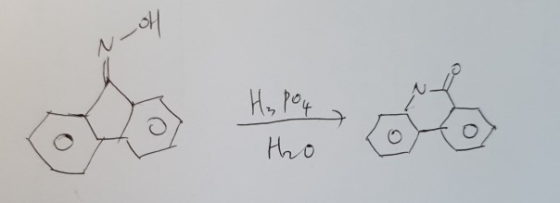
plz explain the mechanism this reaction
Homework Answers
 please correct your
product.
please correct your
product.
can you plz explain how should i do this problem a and b?? c) Write the complete mechanism (using the arrow notation...
 can you plz explain how should i do this problem a and
b??
c) Write the complete mechanism (using the arrow notation) for the monobromination of methylcyclohexane resulting in substitution for a primary hydrogen: 24 points) The organic molecule below is subjected to chlorine gas and light. Cl. hy a) Draw the bond-line structures for all possible products of this reaction in the space provided below. b) Predict the percentage for the formation of all the products from part a...
can you plz explain how should i do this problem a and
b??
c) Write the complete mechanism (using the arrow notation) for the monobromination of methylcyclohexane resulting in substitution for a primary hydrogen: 24 points) The organic molecule below is subjected to chlorine gas and light. Cl. hy a) Draw the bond-line structures for all possible products of this reaction in the space provided below. b) Predict the percentage for the formation of all the products from part a...
Propose a mechanism for the following reaction: PLEASE EXPLAIN! is • (4 points) Propose a mechanism...
 Propose a mechanism for the following reaction:
PLEASE EXPLAIN!
is • (4 points) Propose a mechanism for the following reaction: > HO H+, H2O switch
Propose a mechanism for the following reaction:
PLEASE EXPLAIN!
is • (4 points) Propose a mechanism for the following reaction: > HO H+, H2O switch
1. (1) Give a mechanism for the following reaction : (ii) Explain, in terms of mechanism,...
 1. (1) Give a mechanism for the following reaction : (ii) Explain, in terms of mechanism, why reactant B below will react faster Br2
Give the reaction mechanism for the following reaction and explain why the product is formed HCl,...
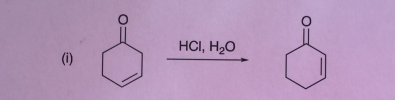 Give the reaction mechanism for the following reaction and
explain why the product is formed
HCl, H2O
Give the reaction mechanism for the following reaction and
explain why the product is formed
HCl, H2O
1. Provide the product/s and mechanism for the following reaction. Explain if the reaction condition favors...
 1. Provide the product/s and mechanism for the following reaction. Explain if the reaction condition favors a SN1 or SN2 mechanism. Determine the stereochemistry configuration (S/R) o the product/s. (25 points) CI NaCN DMSO
1. Provide the product/s and mechanism for the following reaction. Explain if the reaction condition favors...
 1. Provide the product/s and mechanism for the following reaction. Explain if the reaction condition favors a SN1 or SN2 mechanism. Determine the stereochemistry configuration (S/R) o the product/s. (25 points) CI NaCN ♡ DMSO
4. Bonus mechanism problem:. Provide a detailed, step by step mechanism for the following reaction. Explain...
 4. Bonus mechanism problem:. Provide a detailed, step by step mechanism for the following reaction. Explain the unexpected regiochemistry. 1) HNO3 H2SO4 2) NaOH NO2
The E1 reaction is reversible. Explain how the reaction reverses using an electron-pushing mechanism with bother...
The E1 reaction is reversible. Explain how the reaction reverses using an electron-pushing mechanism with bother alkene products. Furthermore, the E2 reaction is irreversible, explain why (7pts)
a) What is the reaction mechanism for the synthesis of the substituted aromatic molecule: 4-Nitroacetanilid? b) explain...
a) What is the reaction mechanism for the synthesis of the substituted aromatic molecule: 4-Nitroacetanilid? b) explain each step in the reaction mechanism.
I need mechanism and R or S and plz don't forget to determine the seteroisomers 4.a)...
 I need mechanism and R or S and
plz don't forget to determine the seteroisomers
4.a) What are the major product(s) formed in each of the following reactions b) Draw the mechanism for each reaction unless otherwise indicated c) Draw all stereoisomers that may form and label chiral carbons as (R) or (S) d) If stereoisomers are formed determine if they are enantiomers, diastereomers, a meso compound or an achiral molecule. (30 Marks,) b) HBr/H22 2-methy-2-butene dilute H2SO4 Br2l H20...
I need mechanism and R or S and
plz don't forget to determine the seteroisomers
4.a) What are the major product(s) formed in each of the following reactions b) Draw the mechanism for each reaction unless otherwise indicated c) Draw all stereoisomers that may form and label chiral carbons as (R) or (S) d) If stereoisomers are formed determine if they are enantiomers, diastereomers, a meso compound or an achiral molecule. (30 Marks,) b) HBr/H22 2-methy-2-butene dilute H2SO4 Br2l H20...
 can you plz explain how should i do this problem a and
b??
c) Write the complete mechanism (using the arrow notation) for the monobromination of methylcyclohexane resulting in substitution for a primary hydrogen: 24 points) The organic molecule below is subjected to chlorine gas and light. Cl. hy a) Draw the bond-line structures for all possible products of this reaction in the space provided below. b) Predict the percentage for the formation of all the products from part a...
can you plz explain how should i do this problem a and
b??
c) Write the complete mechanism (using the arrow notation) for the monobromination of methylcyclohexane resulting in substitution for a primary hydrogen: 24 points) The organic molecule below is subjected to chlorine gas and light. Cl. hy a) Draw the bond-line structures for all possible products of this reaction in the space provided below. b) Predict the percentage for the formation of all the products from part a...
 Propose a mechanism for the following reaction:
PLEASE EXPLAIN!
is • (4 points) Propose a mechanism for the following reaction: > HO H+, H2O switch
Propose a mechanism for the following reaction:
PLEASE EXPLAIN!
is • (4 points) Propose a mechanism for the following reaction: > HO H+, H2O switch
 1. (1) Give a mechanism for the following reaction : (ii) Explain, in terms of mechanism, why reactant B below will react faster Br2
 Give the reaction mechanism for the following reaction and
explain why the product is formed
HCl, H2O
Give the reaction mechanism for the following reaction and
explain why the product is formed
HCl, H2O
 1. Provide the product/s and mechanism for the following reaction. Explain if the reaction condition favors a SN1 or SN2 mechanism. Determine the stereochemistry configuration (S/R) o the product/s. (25 points) CI NaCN DMSO
 1. Provide the product/s and mechanism for the following reaction. Explain if the reaction condition favors a SN1 or SN2 mechanism. Determine the stereochemistry configuration (S/R) o the product/s. (25 points) CI NaCN ♡ DMSO
 4. Bonus mechanism problem:. Provide a detailed, step by step mechanism for the following reaction. Explain the unexpected regiochemistry. 1) HNO3 H2SO4 2) NaOH NO2
 I need mechanism and R or S and
plz don't forget to determine the seteroisomers
4.a) What are the major product(s) formed in each of the following reactions b) Draw the mechanism for each reaction unless otherwise indicated c) Draw all stereoisomers that may form and label chiral carbons as (R) or (S) d) If stereoisomers are formed determine if they are enantiomers, diastereomers, a meso compound or an achiral molecule. (30 Marks,) b) HBr/H22 2-methy-2-butene dilute H2SO4 Br2l H20...
I need mechanism and R or S and
plz don't forget to determine the seteroisomers
4.a) What are the major product(s) formed in each of the following reactions b) Draw the mechanism for each reaction unless otherwise indicated c) Draw all stereoisomers that may form and label chiral carbons as (R) or (S) d) If stereoisomers are formed determine if they are enantiomers, diastereomers, a meso compound or an achiral molecule. (30 Marks,) b) HBr/H22 2-methy-2-butene dilute H2SO4 Br2l H20...
Most questions answered within 3 hours.
-
Where is the error in this code sequence?
String s1 = "Hello";
String s2 = "ello";...
asked 10 months ago -
Financial data for Joel de Paris, Inc., for last year
follow:
Joel de Paris, Inc.
Balance...
asked 10 months ago -
Consider this reaction:
Al2(SO4)3 (aq)+ BaCl3
(aq) Al2Cl6 (aq)- +
3BaSO4(s) . What is the...
asked 10 months ago -
Suppose that Savneet is considering increasing her
recent random sample from 20 car rentals to 40...
asked 10 months ago -
Trucks arrive at an unloading terminal at an average rate of 120
per hour.
Trucks arrive...
asked 10 months ago -
Why are methanol and ethanol completely soluble in water while
octanol is not very little soluble....
asked 10 months ago -
A facilities manager at a university reads in a research report
that the mean amount of...
asked 10 months ago -
When the CuSO4 is rehydrated by adding water to the anhydrous
compound, is this an endothermic...
asked 10 months ago -
A ray of sunlight is passing from diamond into crown glass; the
angle of incidence is...
asked 10 months ago -
A block of mass 0.249 kg is placed on top of a light, vertical
spring of...
asked 10 months ago -
how do the kidneys compensate in the presences of acidosis
a) trigger hyperventilate
b) reserve acid...
asked 10 months ago -
Question 501 pts
The rental rate of capital to the firm increases. Which of the
following...
asked 10 months ago