
Homework Answers
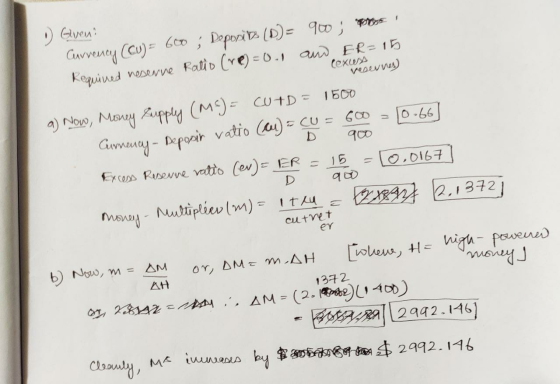
![Niew ER= (1 400 +15) =1915 – ER* New ev, er* = ER* = 1.572 = 10.7118] New mm, mm A ltcu autrrtert ao New AM, AM* = OH-mw = 19](http://img.homeworklib.com/questions/d3c047e0-734c-11ea-8ca8-af4f85260dfa.png?x-oss-process=image/resize,w_560)
d) During the 2008 Financial Crisis, M1 multiplier was less than one. As a result, monetary policy could not provide the desired stimulus, as banks were pessimistic of bad loans piling up post crisis and did not lend as expected by the Fed. This resulted in a slowdown in the credit creation process from (2008-2011).
Even in part c), we see a similar impact arising out of a M1 multiplier, less than one.
Add Answer to:
1. Suppose that currency in circulation is $600 billion, the amount of checkable deposits is $900...
Question 1. (15 points) Suppose that currency in circulation is $600 billion, the amount of chequable...
 Question 1. (15 points) Suppose that currency in circulation is $600 billion, the amount of chequable deposits is $900 billion, and excess reserves are $15 billion and the desired reserve ratio is 10%. a. Calculate the money supply, the currency deposit ratio, the excess reserve ratio, and the money multiplier. b. Suppose the central bank conducts an unusually large open market purchase of bonds held by banks of $1400 billion due to a sharp contraction in the economy. Assuming the...
2. Let's assume that in a hypothetical economy currency in circulation is $600 billion, the amoun...
 2. Let's assume that in a hypothetical economy currency in circulation is $600 billion, the amount of checkable deposits is $900 billion, excess reserves are $15 billion and required reserve ratio is 10%. a. Calculate money supply, currency to deposit ratio, excess reserve ratio and money multiplier. b. Suppose Fed conducts very large open market purchase of $1400 billion due to a sharp recession. Assuming the ratios hold, what will be the effect on money supply? c. Now suppose the...
Answer Part B please 2. Suppose that currency in circulation is $600 billion, the amount of...
 Answer Part B please
2. Suppose that currency in circulation is $600 billion, the amount of chequable deposits is $900 billion, excess reserves are $15 billion, and the desired reserve ratio ra is 10%. a. Calculate the money supply, the currency deposit ratio, the excess reserve ratio, and the money multiplier. b. Suppose the central bank conducts an unusually large open market purchase of bonds held by banks of $1400 billion due to a sharp contraction in the economy. Assuming...
Answer Part B please
2. Suppose that currency in circulation is $600 billion, the amount of chequable deposits is $900 billion, excess reserves are $15 billion, and the desired reserve ratio ra is 10%. a. Calculate the money supply, the currency deposit ratio, the excess reserve ratio, and the money multiplier. b. Suppose the central bank conducts an unusually large open market purchase of bonds held by banks of $1400 billion due to a sharp contraction in the economy. Assuming...
Discussion Questions for Tuesday, Apr. 23 1. Suppose the Fed conducts $10 million open market pur...
 Discussion Questions for Tuesday, Apr. 23 1. Suppose the Fed conducts $10 million open market purchase from Bank A. If Bank A and all the other banks use reserves to purchase only securities, what will happen to deposits in the banking system and how much does it expand? 2. Let's assume that in a hypothetical economy currency in circulation is $600 billion, the amount of checkable deposits is $900 billion, excess reserves are $15 billion and required reserve ratio is...
Please Please answer if you are Expert and you know the answer 100% correct. Also, please...
 Please Please answer if you are Expert and you know
the answer 100% correct. Also, please include the Fred graph,
and send the graph link and explain how to get the graph as you got
it. thank you
Suppose that currency in circulation is $800 billion, the amount of checkable deposits is $1200 billion, the required reserve ratio is 10% and excess reserves are $12 billion a. Calculate the money supply, the currency-to-deposit ratio, the excess reserve ratio, and the...
Please Please answer if you are Expert and you know
the answer 100% correct. Also, please include the Fred graph,
and send the graph link and explain how to get the graph as you got
it. thank you
Suppose that currency in circulation is $800 billion, the amount of checkable deposits is $1200 billion, the required reserve ratio is 10% and excess reserves are $12 billion a. Calculate the money supply, the currency-to-deposit ratio, the excess reserve ratio, and the...
Suppose the required reserve ratio is 15%, currency in circulation is $300 billion, the amount of...
Suppose the required reserve ratio is 15%, currency in circulation is $300 billion, the amount of checkable deposits is $450 billion, and excess reserves are $40.5 billion. Calculate the money supply. _________________ Calculate the currency/deposit ratio. _________________ Calculate the excess reserve ratio. _________________ Calculate the money multiplier. _________________
Suppose that the required reserve ratio is 8%, currency in circulation is $590 billion, the amount...
Suppose that the required reserve ratio is 8%, currency in circulation is $590 billion, the amount of checkable deposits is $890 billion, and excess reserves are $14 billion. The money supply is $ billion. (Round your response to the nearest whole number.) The currency deposit ratio is . (Round your response to three decimal places.) The excess reserves ratio is . (Round your response to three decimal places.) The money multiplier is . (Round your response to two decimal places.)
1. If the required reserve ratio is 10 percent, currency in circulation is $400 billion, checkable...
 1. If the required reserve ratio is 10 percent, currency in circulation is $400 billion, checkable deposits are $800 billion, and excess reserves total $0.8 billion, then the money supply is billion. 2. If the required reserve ratio is 10 percent, currency in circulation is $400 billion, checkable deposits are $800 billion, and excess reserves total $0.8 billion, then the currency-deposit ratio is...
If the required reserve ratio is 10 percent, currency in circulation is $400 billion, checkable deposits...
If the required reserve ratio is 10 percent, currency in circulation is $400 billion, checkable deposits are $800 billion, and excess reserves total $0.8 billion then the money supply is a) 1200 b)8400 c) 8000 d)1200.8 answer is A
Consider a banking system with the following characteristics: Currency in circulation: $250 million Checkable Deposits: $500...
Consider a banking system with the following characteristics: Currency in circulation: $250 million Checkable Deposits: $500 million Bank Reserves: $100 million Reserve Requirement: 10% Calculate the following. Make sure to show your work. Currency ratio Excess reserve ratio Monetary base Money multiplier M1 money supply Repeat the calculations in part a above, but assuming that households now decide to hold more in currency in circulation: $300 million. What can we conclude about the effect that this change in the public’s...
 Question 1. (15 points) Suppose that currency in circulation is $600 billion, the amount of chequable deposits is $900 billion, and excess reserves are $15 billion and the desired reserve ratio is 10%. a. Calculate the money supply, the currency deposit ratio, the excess reserve ratio, and the money multiplier. b. Suppose the central bank conducts an unusually large open market purchase of bonds held by banks of $1400 billion due to a sharp contraction in the economy. Assuming the...
 2. Let's assume that in a hypothetical economy currency in circulation is $600 billion, the amount of checkable deposits is $900 billion, excess reserves are $15 billion and required reserve ratio is 10%. a. Calculate money supply, currency to deposit ratio, excess reserve ratio and money multiplier. b. Suppose Fed conducts very large open market purchase of $1400 billion due to a sharp recession. Assuming the ratios hold, what will be the effect on money supply? c. Now suppose the...
 Answer Part B please
2. Suppose that currency in circulation is $600 billion, the amount of chequable deposits is $900 billion, excess reserves are $15 billion, and the desired reserve ratio ra is 10%. a. Calculate the money supply, the currency deposit ratio, the excess reserve ratio, and the money multiplier. b. Suppose the central bank conducts an unusually large open market purchase of bonds held by banks of $1400 billion due to a sharp contraction in the economy. Assuming...
Answer Part B please
2. Suppose that currency in circulation is $600 billion, the amount of chequable deposits is $900 billion, excess reserves are $15 billion, and the desired reserve ratio ra is 10%. a. Calculate the money supply, the currency deposit ratio, the excess reserve ratio, and the money multiplier. b. Suppose the central bank conducts an unusually large open market purchase of bonds held by banks of $1400 billion due to a sharp contraction in the economy. Assuming...
 Discussion Questions for Tuesday, Apr. 23 1. Suppose the Fed conducts $10 million open market purchase from Bank A. If Bank A and all the other banks use reserves to purchase only securities, what will happen to deposits in the banking system and how much does it expand? 2. Let's assume that in a hypothetical economy currency in circulation is $600 billion, the amount of checkable deposits is $900 billion, excess reserves are $15 billion and required reserve ratio is...
 Please Please answer if you are Expert and you know
the answer 100% correct. Also, please include the Fred graph,
and send the graph link and explain how to get the graph as you got
it. thank you
Suppose that currency in circulation is $800 billion, the amount of checkable deposits is $1200 billion, the required reserve ratio is 10% and excess reserves are $12 billion a. Calculate the money supply, the currency-to-deposit ratio, the excess reserve ratio, and the...
Please Please answer if you are Expert and you know
the answer 100% correct. Also, please include the Fred graph,
and send the graph link and explain how to get the graph as you got
it. thank you
Suppose that currency in circulation is $800 billion, the amount of checkable deposits is $1200 billion, the required reserve ratio is 10% and excess reserves are $12 billion a. Calculate the money supply, the currency-to-deposit ratio, the excess reserve ratio, and the...
 1. If the required reserve ratio is 10 percent, currency in circulation is $400 billion, checkable deposits are $800 billion, and excess reserves total $0.8 billion, then the money supply is billion. 2. If the required reserve ratio is 10 percent, currency in circulation is $400 billion, checkable deposits are $800 billion, and excess reserves total $0.8 billion, then the currency-deposit ratio is...
Most questions answered within 3 hours.
-
Where is the error in this code sequence?
String s1 = "Hello";
String s2 = "ello";...
asked 10 months ago -
Financial data for Joel de Paris, Inc., for last year
follow:
Joel de Paris, Inc.
Balance...
asked 10 months ago -
Consider this reaction:
Al2(SO4)3 (aq)+ BaCl3
(aq) Al2Cl6 (aq)- +
3BaSO4(s) . What is the...
asked 10 months ago -
Suppose that Savneet is considering increasing her
recent random sample from 20 car rentals to 40...
asked 10 months ago -
Trucks arrive at an unloading terminal at an average rate of 120
per hour.
Trucks arrive...
asked 10 months ago -
Why are methanol and ethanol completely soluble in water while
octanol is not very little soluble....
asked 10 months ago -
A facilities manager at a university reads in a research report
that the mean amount of...
asked 10 months ago -
When the CuSO4 is rehydrated by adding water to the anhydrous
compound, is this an endothermic...
asked 10 months ago -
A ray of sunlight is passing from diamond into crown glass; the
angle of incidence is...
asked 10 months ago -
A block of mass 0.249 kg is placed on top of a light, vertical
spring of...
asked 10 months ago -
how do the kidneys compensate in the presences of acidosis
a) trigger hyperventilate
b) reserve acid...
asked 10 months ago -
Question 501 pts
The rental rate of capital to the firm increases. Which of the
following...
asked 10 months ago