
Homework Answers
![25g_0320 (0g)+ Ig (Q) 54020(098+ 210 (99 d [52020] Il a [S20 207 st Given, att 4.34 X10⁻³ molt [529326) = 4.314173 y S hol V](http://img.homeworklib.com/questions/37e56260-734e-11ea-ac5b-a193972c8094.png?x-oss-process=image/resize,w_560)
Add Answer to:
The thiosulfate ion (S2032-) is oxidized by iodine as follows: 252032-(aq) +12(aq) -S4062-(aq) + 21'(aq) In...
Lab 1l: Kinetics In the Kinetics Lab, the reaction of iodide with persulfate was studied, and it ...
 Lab 1l: Kinetics In the Kinetics Lab, the reaction of iodide with persulfate was studied, and it was determined that the rate law was first order in each reactant. 21(a)s20 (22 S042(ag) rateS2091 (a) If [I-] = 0.0550 M, [S2O82-]-0.0350 M, and kー0.00400 M-1 s-1, what is the reaction rate? M/s (b) If [I-]-0.0500 M, [S2082-]-0.0350 M, and the reaction rate is 5.90×10⁻⁶ M/s, what is the rate constant? M-1s-1 (c) The reaction rate was determined indirectly in this lab...
Preliminary: Key Chemical Equations Reaction 2 Fe3 (a)3 I(a)2 Fe(aq) + I3'(aq) I3(ag) 2 S2032(aq) 3 1a)S4O(0) R...
 Preliminary: Key Chemical Equations Reaction 2 Fe3 (a)3 I(a)2 Fe(aq) + I3'(aq) I3(ag) 2 S2032(aq) 3 1a)S4O(0) Reaction 2: + + Prelab Questions 1. List and define any new terms relevant to this experiment 2. Write the general formula for the rate law for Reaction 1 (given above) 3. Write the general formula for calculating average rate bases on the disappearance of thiosulfate (S2O,2) in Reaction 2 (given above) 4. Write the equation used for calculating a concentration after dilution...
Problem 2) Experimentally, the reaction between compound A and iodine (l): A(aq) + 12(aq) - D(aq)...
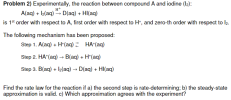 Problem 2) Experimentally, the reaction between compound A and iodine (l): A(aq) + 12(aq) - D(aq) + Hl(aq) is 1st order with respect to A, first order with respect to H+, and zero-th order with respect to lz. The following mechanism has been proposed: Step 1. A(aq) + H+(aq) + HA+(aq) Step 2. HA+(aq) → B(aq) + H+ (aq) Step 3. B(aq) + 12(aq) → D(aq) + Hl(aq) Find the rate law for the reaction if a) the second step...
answer number three please using the equation provided. I dont understand. thanks! 21'(aq) + 2NO2 (aq)...
 answer number three please using the equation provided. I dont
understand. thanks!
21'(aq) + 2NO2 (aq) + 4H(aq) - 12(aq) + 2NO(aq) + 2H2O(1) [Eq. 3] (Note from this equation, that in the experiment, the number of moles of iodide ion present is twice the number of moles of iodine that will be determined by the absorbance measurements. That is, the mole ratio of 12:I" is 1:2. You will not need to account for this mole ratio explicitly, if you...
answer number three please using the equation provided. I dont
understand. thanks!
21'(aq) + 2NO2 (aq) + 4H(aq) - 12(aq) + 2NO(aq) + 2H2O(1) [Eq. 3] (Note from this equation, that in the experiment, the number of moles of iodide ion present is twice the number of moles of iodine that will be determined by the absorbance measurements. That is, the mole ratio of 12:I" is 1:2. You will not need to account for this mole ratio explicitly, if you...
The reaction of peroxydisulfate ion (S2O82-) with iodide ion (I -) is given below. S2O82-(aq) +...
 The reaction of peroxydisulfate ion
(S2O82-) with iodide ion (I
-) is given below.
S2O82-(aq) + 3 I
-
2SO24-(aq)
+I3-
The following data are collected at a certain temperature.
Experiment
[S2O82- ](M)
[I- ](M)
Initial Rate (M/s)
1
0.080
0.034
2.2 X 10⁻⁴
2
0.080
0.017
1.1 X 10⁻⁴
3
0.16
0.017
2.2 X 10⁻⁴
Determine the rate law.
____________________
Calculate the rate constant.
______________ /(M·s)
The reaction of peroxydisulfate ion (S2O8^2-) with iodide ion (I -) is given...
The reaction of peroxydisulfate ion
(S2O82-) with iodide ion (I
-) is given below.
S2O82-(aq) + 3 I
-
2SO24-(aq)
+I3-
The following data are collected at a certain temperature.
Experiment
[S2O82- ](M)
[I- ](M)
Initial Rate (M/s)
1
0.080
0.034
2.2 X 10⁻⁴
2
0.080
0.017
1.1 X 10⁻⁴
3
0.16
0.017
2.2 X 10⁻⁴
Determine the rate law.
____________________
Calculate the rate constant.
______________ /(M·s)
The reaction of peroxydisulfate ion (S2O8^2-) with iodide ion (I -) is given...
7) The reaction of peroxydisulfate ion (S2O82−) with iodide ion (I−) is S2O82−(aq) + 3I−(aq) →...
7) The reaction of peroxydisulfate ion (S2O82−) with iodide ion (I−) is S2O82−(aq) + 3I−(aq) → 2SO42−(aq) + I3−(aq) From the following data collected at a certain temperature, determine the rate law and calculate the rate constant. Experiment [S2O82−](M) [I−](M) Initial Rate [M/s] 1 0.0200 0.0960 7.60 × 10⁻⁴ 2 0.0200 0.0480 3.80 × 10⁻⁴ 3 0.0400 0.0480 7.60 × 10⁻⁴ (a) Which of the following equations represents the rate law for this reaction? A. rate = k[S2O82−][I−] . ...
1) The reaction of hydrogen peroxide with iodine, H2O2(aq)+I2(aq)⇌OH−(aq)+HIO(aq) is first order in H2O2 and first...
1) The reaction of hydrogen peroxide with iodine, H2O2(aq)+I2(aq)⇌OH−(aq)+HIO(aq) is first order in H2O2 and first order in I2. If the concentration of H2O2 was increased by half and the concentration of I2 was quadrupled, by what factor would the reaction rate increase? 2) Consider the following reaction: O3(g)→O2(g)+O(g) Using the results of the Arrhenius analysis (Ea=93.1kJ/mol and A=4.36×10¹¹M⋅s−1), predict the rate constant at 298 K . 3. The rate constant of a chemical reaction increased from 0.100 s−1 to...
Q 1(a) [13.33 Marks] Levels of dissolved oxygen in water can be determined by the Winkler...
 Q 1(a) [13.33 Marks] Levels of dissolved oxygen in water can be determined by the Winkler method in the Leaving Certificate Chemistry course as follows: Under alkaline conditions manganese(II) sulphate produces a white precipitate of manganese(II) hydroxide: Mn2+(aq) + 2OH-(aq) → Mn(OH)2(s) This reacts with the dissolved oxygen to produce a brown precipitate. 2Mn(OH)2(s) + O2(aq) → 2MnO(OH)2(s) Addition of concentrated H2SO4 releases free iodine from KI. MnO(OH)2(s) + 4H+(aq) + 21-(aq) + Mn2+(aq) + 12(aq) + 3H2O(1) The free...
5. The reaction of peroxydisulfate ion (S2O82−) with iodide ion (I−) is S2O82−(aq) + 3I−(aq) →...
5. The reaction of peroxydisulfate ion (S2O82−) with iodide ion (I−) is S2O82−(aq) + 3I−(aq) → 2SO42−(aq) + I3−(aq) From the following data collected at a certain temperature, determine the rate law and calculate the rate constant. Experiment [S2O82−](M) . [I−](M) . Initial Rate [M/s] 1 0.0300 0.0840 8.80 × 10⁻⁴ 2 0.0300 0.0420 4.40 × 10⁻⁴ 3 0.0600 0.0420 8.80 × 10⁻⁴ (a) Which of the following equations represents the rate law for this reaction? What is the...
how can i get the initial concentration of thiosulfate ion (S2O3) in reaction mixture 1 ?...
 how can i get the initial concentration of thiosulfate ion
(S2O3) in reaction mixture 1 ?
and also how can i determine the initial reaction rate for
mixture 1?
A Chemical Clock Your Report: Part I: Determination of the Rate Law 1. Complete Table 1 below using the volumes of each chemical used and the reaction to the reaction times measured that your team used to determine the rate law. Leave any unused rows D Reaction Mixture: Reaction Time /...
how can i get the initial concentration of thiosulfate ion
(S2O3) in reaction mixture 1 ?
and also how can i determine the initial reaction rate for
mixture 1?
A Chemical Clock Your Report: Part I: Determination of the Rate Law 1. Complete Table 1 below using the volumes of each chemical used and the reaction to the reaction times measured that your team used to determine the rate law. Leave any unused rows D Reaction Mixture: Reaction Time /...
 Lab 1l: Kinetics In the Kinetics Lab, the reaction of iodide with persulfate was studied, and it was determined that the rate law was first order in each reactant. 21(a)s20 (22 S042(ag) rateS2091 (a) If [I-] = 0.0550 M, [S2O82-]-0.0350 M, and kー0.00400 M-1 s-1, what is the reaction rate? M/s (b) If [I-]-0.0500 M, [S2082-]-0.0350 M, and the reaction rate is 5.90×10⁻⁶ M/s, what is the rate constant? M-1s-1 (c) The reaction rate was determined indirectly in this lab...
 Preliminary: Key Chemical Equations Reaction 2 Fe3 (a)3 I(a)2 Fe(aq) + I3'(aq) I3(ag) 2 S2032(aq) 3 1a)S4O(0) Reaction 2: + + Prelab Questions 1. List and define any new terms relevant to this experiment 2. Write the general formula for the rate law for Reaction 1 (given above) 3. Write the general formula for calculating average rate bases on the disappearance of thiosulfate (S2O,2) in Reaction 2 (given above) 4. Write the equation used for calculating a concentration after dilution...
 Problem 2) Experimentally, the reaction between compound A and iodine (l): A(aq) + 12(aq) - D(aq) + Hl(aq) is 1st order with respect to A, first order with respect to H+, and zero-th order with respect to lz. The following mechanism has been proposed: Step 1. A(aq) + H+(aq) + HA+(aq) Step 2. HA+(aq) → B(aq) + H+ (aq) Step 3. B(aq) + 12(aq) → D(aq) + Hl(aq) Find the rate law for the reaction if a) the second step...
 answer number three please using the equation provided. I dont
understand. thanks!
21'(aq) + 2NO2 (aq) + 4H(aq) - 12(aq) + 2NO(aq) + 2H2O(1) [Eq. 3] (Note from this equation, that in the experiment, the number of moles of iodide ion present is twice the number of moles of iodine that will be determined by the absorbance measurements. That is, the mole ratio of 12:I" is 1:2. You will not need to account for this mole ratio explicitly, if you...
answer number three please using the equation provided. I dont
understand. thanks!
21'(aq) + 2NO2 (aq) + 4H(aq) - 12(aq) + 2NO(aq) + 2H2O(1) [Eq. 3] (Note from this equation, that in the experiment, the number of moles of iodide ion present is twice the number of moles of iodine that will be determined by the absorbance measurements. That is, the mole ratio of 12:I" is 1:2. You will not need to account for this mole ratio explicitly, if you...
 The reaction of peroxydisulfate ion
(S2O82-) with iodide ion (I
-) is given below.
S2O82-(aq) + 3 I
-
2SO24-(aq)
+I3-
The following data are collected at a certain temperature.
Experiment
[S2O82- ](M)
[I- ](M)
Initial Rate (M/s)
1
0.080
0.034
2.2 X 10⁻⁴
2
0.080
0.017
1.1 X 10⁻⁴
3
0.16
0.017
2.2 X 10⁻⁴
Determine the rate law.
____________________
Calculate the rate constant.
______________ /(M·s)
The reaction of peroxydisulfate ion (S2O8^2-) with iodide ion (I -) is given...
The reaction of peroxydisulfate ion
(S2O82-) with iodide ion (I
-) is given below.
S2O82-(aq) + 3 I
-
2SO24-(aq)
+I3-
The following data are collected at a certain temperature.
Experiment
[S2O82- ](M)
[I- ](M)
Initial Rate (M/s)
1
0.080
0.034
2.2 X 10⁻⁴
2
0.080
0.017
1.1 X 10⁻⁴
3
0.16
0.017
2.2 X 10⁻⁴
Determine the rate law.
____________________
Calculate the rate constant.
______________ /(M·s)
The reaction of peroxydisulfate ion (S2O8^2-) with iodide ion (I -) is given...
 Q 1(a) [13.33 Marks] Levels of dissolved oxygen in water can be determined by the Winkler method in the Leaving Certificate Chemistry course as follows: Under alkaline conditions manganese(II) sulphate produces a white precipitate of manganese(II) hydroxide: Mn2+(aq) + 2OH-(aq) → Mn(OH)2(s) This reacts with the dissolved oxygen to produce a brown precipitate. 2Mn(OH)2(s) + O2(aq) → 2MnO(OH)2(s) Addition of concentrated H2SO4 releases free iodine from KI. MnO(OH)2(s) + 4H+(aq) + 21-(aq) + Mn2+(aq) + 12(aq) + 3H2O(1) The free...
 how can i get the initial concentration of thiosulfate ion
(S2O3) in reaction mixture 1 ?
and also how can i determine the initial reaction rate for
mixture 1?
A Chemical Clock Your Report: Part I: Determination of the Rate Law 1. Complete Table 1 below using the volumes of each chemical used and the reaction to the reaction times measured that your team used to determine the rate law. Leave any unused rows D Reaction Mixture: Reaction Time /...
how can i get the initial concentration of thiosulfate ion
(S2O3) in reaction mixture 1 ?
and also how can i determine the initial reaction rate for
mixture 1?
A Chemical Clock Your Report: Part I: Determination of the Rate Law 1. Complete Table 1 below using the volumes of each chemical used and the reaction to the reaction times measured that your team used to determine the rate law. Leave any unused rows D Reaction Mixture: Reaction Time /...
Most questions answered within 3 hours.
-
Where is the error in this code sequence?
String s1 = "Hello";
String s2 = "ello";...
asked 11 months ago -
Financial data for Joel de Paris, Inc., for last year
follow:
Joel de Paris, Inc.
Balance...
asked 11 months ago -
Consider this reaction:
Al2(SO4)3 (aq)+ BaCl3
(aq) Al2Cl6 (aq)- +
3BaSO4(s) . What is the...
asked 11 months ago -
Suppose that Savneet is considering increasing her
recent random sample from 20 car rentals to 40...
asked 11 months ago -
Trucks arrive at an unloading terminal at an average rate of 120
per hour.
Trucks arrive...
asked 11 months ago -
Why are methanol and ethanol completely soluble in water while
octanol is not very little soluble....
asked 11 months ago -
A facilities manager at a university reads in a research report
that the mean amount of...
asked 11 months ago -
When the CuSO4 is rehydrated by adding water to the anhydrous
compound, is this an endothermic...
asked 11 months ago -
A ray of sunlight is passing from diamond into crown glass; the
angle of incidence is...
asked 11 months ago -
A block of mass 0.249 kg is placed on top of a light, vertical
spring of...
asked 11 months ago -
how do the kidneys compensate in the presences of acidosis
a) trigger hyperventilate
b) reserve acid...
asked 11 months ago -
Question 501 pts
The rental rate of capital to the firm increases. Which of the
following...
asked 11 months ago