
Homework Answers
1)when 0.0 mL of NaOH is added
C6H5COOH dissociates as:
C6H5COOH -----> H+ + C6H5COO-
0.2 0 0
0.2-x x x
Ka = [H+][C6H5COO-]/[C6H5COOH]
Ka = x*x/(c-x)
Assuming x can be ignored as compared to c
So, above expression becomes
Ka = x*x/(c)
so, x = sqrt (Ka*c)
x = sqrt ((6.5*10^-5)*0.2) = 3.606*10^-3
since x is comparable c, our assumption is not correct
we need to solve this using Quadratic equation
Ka = x*x/(c-x)
6.5*10^-5 = x^2/(0.2-x)
1.3*10^-5 - 6.5*10^-5 *x = x^2
x^2 + 6.5*10^-5 *x-1.3*10^-5 = 0
This is quadratic equation (ax^2+bx+c=0)
a = 1
b = 6.5*10^-5
c = -1.3*10^-5
Roots can be found by
x = {-b + sqrt(b^2-4*a*c)}/2a
x = {-b - sqrt(b^2-4*a*c)}/2a
b^2-4*a*c = 5.2*10^-5
roots are :
x = 3.573*10^-3 and x = -3.638*10^-3
since x can't be negative, the possible value of x is
x = 3.573*10^-3
use:
pH = -log [H+]
= -log (3.573*10^-3)
= 2.4469
Answer: 2.45
2)when 10.0 mL of NaOH is added
Given:
M(C6H5COOH) = 0.2 M
V(C6H5COOH) = 50 mL
M(NaOH) = 0.25 M
V(NaOH) = 10 mL
mol(C6H5COOH) = M(C6H5COOH) * V(C6H5COOH)
mol(C6H5COOH) = 0.2 M * 50 mL = 10 mmol
mol(NaOH) = M(NaOH) * V(NaOH)
mol(NaOH) = 0.25 M * 10 mL = 2.5 mmol
We have:
mol(C6H5COOH) = 10 mmol
mol(NaOH) = 2.5 mmol
2.5 mmol of both will react
excess C6H5COOH remaining = 7.5 mmol
Volume of Solution = 50 + 10 = 60 mL
[C6H5COOH] = 7.5 mmol/60 mL = 0.125M
[C6H5COO-] = 2.5/60 = 0.0417M
They form acidic buffer
acid is C6H5COOH
conjugate base is C6H5COO-
Ka = 6.5*10^-5
pKa = - log (Ka)
= - log(6.5*10^-5)
= 4.187
use:
pH = pKa + log {[conjugate base]/[acid]}
= 4.187+ log {4.167*10^-2/0.125}
= 3.71
Answer: 3.71
3)when 20.0 mL of NaOH is added
Given:
M(C6H5COOH) = 0.2 M
V(C6H5COOH) = 50 mL
M(NaOH) = 0.25 M
V(NaOH) = 20 mL
mol(C6H5COOH) = M(C6H5COOH) * V(C6H5COOH)
mol(C6H5COOH) = 0.2 M * 50 mL = 10 mmol
mol(NaOH) = M(NaOH) * V(NaOH)
mol(NaOH) = 0.25 M * 20 mL = 5 mmol
We have:
mol(C6H5COOH) = 10 mmol
mol(NaOH) = 5 mmol
5 mmol of both will react
excess C6H5COOH remaining = 5 mmol
Volume of Solution = 50 + 20 = 70 mL
[C6H5COOH] = 5 mmol/70 mL = 0.0714M
[C6H5COO-] = 5/70 = 0.0714M
They form acidic buffer
acid is C6H5COOH
conjugate base is C6H5COO-
Ka = 6.5*10^-5
pKa = - log (Ka)
= - log(6.5*10^-5)
= 4.187
use:
pH = pKa + log {[conjugate base]/[acid]}
= 4.187+ log {7.143*10^-2/7.143*10^-2}
= 4.187
Answer: 4.19
4)when 40.0 mL of NaOH is added
Given:
M(C6H5COOH) = 0.2 M
V(C6H5COOH) = 50 mL
M(NaOH) = 0.25 M
V(NaOH) = 40 mL
mol(C6H5COOH) = M(C6H5COOH) * V(C6H5COOH)
mol(C6H5COOH) = 0.2 M * 50 mL = 10 mmol
mol(NaOH) = M(NaOH) * V(NaOH)
mol(NaOH) = 0.25 M * 40 mL = 10 mmol
We have:
mol(C6H5COOH) = 10 mmol
mol(NaOH) = 10 mmol
10 mmol of both will react to form C6H5COO- and H2O
C6H5COO- here is strong base
C6H5COO- formed = 10 mmol
Volume of Solution = 50 + 40 = 90 mL
Kb of C6H5COO- = Kw/Ka = 1*10^-14/6.5*10^-5 = 1.538*10^-10
concentration ofC6H5COO-,c = 10 mmol/90 mL = 0.1111M
C6H5COO- dissociates as
C6H5COO- + H2O -----> C6H5COOH + OH-
0.1111 0 0
0.1111-x x x
Kb = [C6H5COOH][OH-]/[C6H5COO-]
Kb = x*x/(c-x)
Assuming x can be ignored as compared to c
So, above expression becomes
Kb = x*x/(c)
so, x = sqrt (Kb*c)
x = sqrt ((1.538*10^-10)*0.1111) = 4.134*10^-6
since c is much greater than x, our assumption is correct
so, x = 4.134*10^-6 M
[OH-] = x = 4.134*10^-6 M
use:
pOH = -log [OH-]
= -log (4.134*10^-6)
= 5.3836
use:
PH = 14 - pOH
= 14 - 5.3836
= 8.6164
Answer: 8.62
5)when 50.0 mL of NaOH is added
Given:
M(C6H5COOH) = 0.2 M
V(C6H5COOH) = 50 mL
M(NaOH) = 0.25 M
V(NaOH) = 50 mL
mol(C6H5COOH) = M(C6H5COOH) * V(C6H5COOH)
mol(C6H5COOH) = 0.2 M * 50 mL = 10 mmol
mol(NaOH) = M(NaOH) * V(NaOH)
mol(NaOH) = 0.25 M * 50 mL = 12.5 mmol
We have:
mol(C6H5COOH) = 10 mmol
mol(NaOH) = 12.5 mmol
10 mmol of both will react
excess NaOH remaining = 2.5 mmol
Volume of Solution = 50 + 50 = 100 mL
[OH-] = 2.5 mmol/100 mL = 0.025 M
use:
pOH = -log [OH-]
= -log (2.5*10^-2)
= 1.6021
use:
PH = 14 - pOH
= 14 - 1.6021
= 12.3979
Answer: 12.40
15. (25 pts) If 25.0 mL of 0.300 M benzoic acid (K, -6.50 x 10°°) is...
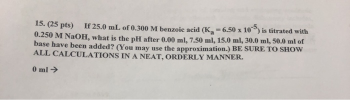 15. (25 pts) If 25.0 mL of 0.300 M benzoic acid (K, -6.50 x 10°°) is titrated with 0.250 M NaOH, what is the pH after 0.00 ml, 7.50 ml, 15.0 ml, 30.0 ml, 50.0 ml of base have been added? (You may use the approximation.) BE SURE TO SHOW ALL CALCULATIONS IN A NEAT, ORDERLY MANNER. 0 ml →
IV. Acid-Base Titration (15 points). A 50 mL of 0.200 M HNO2, (Ka= 4.0 x 10)...
 IV. Acid-Base Titration (15 points). A 50 mL of 0.200 M HNO2, (Ka= 4.0 x 10) solution is titrated with 0.200 M NaOH. Find the pH before titration and after 25 mL, 50 mL, and 60 mL of NaOH has been added.
25. A 50.0 mL sample of 0.150 M weak acid was titrated with a 0,150 M...
 25. A 50.0 mL sample of 0.150 M weak acid was titrated with a 0,150 M NaOH solution. What is the pH after 30.0 mL of the sodium hydroxide solution is added? The Ka of the acid is 1.9x10(3 points) D) 4.78 E) None of these C) 3.03 (A) 4.90 B) 1.34 26. A 25.0 mL sample of 0.25 M hydrofluoric acid (HF) is titrated with a 0.25 M NaOH solution. What is the pH after 38.0 mL of base...
Name 1 (25 pts) Consider the titration of 50 mL of 0.100 M acetic acid (CH-COOH,...
 Name 1 (25 pts) Consider the titration of 50 mL of 0.100 M acetic acid (CH-COOH, K. -1.8 x 10) with 0.200 M NaOH solution. Show all calculations for full credit. a) Write the titration reaction: b) Calculate the pH after 5.00 mL of NaOH: c) Calculate the pH after 12.5 mL of NaOH: d) Calculate the pH after 25 mL of NaOH:
A 30.00 mL solution of 0.0500 M benzoic acid, a monoprotic acid, is titrated with 0.100...
A 30.00 mL solution of 0.0500 M benzoic acid, a monoprotic acid, is titrated with 0.100 M NaOH. The Ka of benzoic acid is 6.3 × 10⁻⁵. Determine the pH after 15.00 mL of the sodium hydroxide solution is added.
2. A sample of 50 ml of nitrous acid (KA = 5.6 x 10“) is titrated...
 2. A sample of 50 ml of nitrous acid (KA = 5.6 x 10“) is titrated with 0.070 M NaOH. The equivalence point is reached after the addition of 43.2 ml of the strong base. a) (3 marks) What is the pH of the solution at the equivalence point? b) (3 marks) What is the pH of the solution after 50 ml of NaOH has been added to the original nitrous acid solution?
5. Exactly 100 mL of 0.15 M nitrous acid (HNO2) are titrated with a 0.15 M NaOH solution. Calculate the pH for [10 pts] the point at which 100 mL of the base has been added. 5. Exactly 100 mL...
 5. Exactly 100 mL of 0.15 M nitrous acid (HNO2) are titrated with a 0.15 M NaOH solution. Calculate the pH for [10 pts] the point at which 100 mL of the base has been added.
5. Exactly 100 mL of 0.15 M nitrous acid (HNO2) are titrated with a 0.15 M NaOH solution. Calculate the pH for [10 pts] the point at which 100 mL of the base has been added.
5. Exactly 100 mL of 0.15 M nitrous acid (HNO2) are titrated with a 0.15 M NaOH solution. Calculate the pH for [10 pts] the point at which 100 mL of the base has been added.
A 50.00 mL aliquot of 0.1548 M benzoic acid is titrated with 0.1325 M sodium hydroxide....
 A 50.00 mL aliquot of 0.1548 M benzoic acid is titrated with 0.1325 M sodium hydroxide. Find (a) V. (b) the initial pH, (c and d) the pH after 10.00 and 30.00 mL are added, (e) the pH at Vand (1) the pH at V. + 10.00 mL. Sketch the titration curve. You may use all usual "assumptions" for the pH calculations. Benzoic acid is a weak acid. Write the numeric answers here: Sketch the titration curve here: a. mL...
24A) 40mL of 0.2 M formic acid is titrated with a strong base (NaOH= 0.5 M). Determine the pH before any base has been...
 24A) 40mL of 0.2 M formic acid is titrated with a strong base
(NaOH= 0.5 M). Determine the pH before any base has been added.
Please show steps and please explain why the answer is what it
is.
24B) The 40mL 0.2 M formic acid is titrated with a 6.0mL of
strong base. Here NaOH can be treated as a conjugate base and
formic acid is the acid.
please show steps and explain!
Us (24-25, Acid/base, aqueous equilibrium) 24A) (4...
24A) 40mL of 0.2 M formic acid is titrated with a strong base
(NaOH= 0.5 M). Determine the pH before any base has been added.
Please show steps and please explain why the answer is what it
is.
24B) The 40mL 0.2 M formic acid is titrated with a 6.0mL of
strong base. Here NaOH can be treated as a conjugate base and
formic acid is the acid.
please show steps and explain!
Us (24-25, Acid/base, aqueous equilibrium) 24A) (4...
Weak-Acid Strong-Base Titrations. These next questions relate to a 25 mL aliquot of 0.35 M acetic acid (Ka = 1.77 x...
 Weak-Acid Strong-Base Titrations. These next questions relate to a 25 mL aliquot of 0.35 M acetic acid (Ka = 1.77 x 10) that is titrated with 0.20 M potassium hydroxide (KOH). (f) What is the pH of the acetic acid solution before the titration begins? (g) What is the pH after 14 mL of 0.20 M KOH has been added to the solution? Use the Henderson-Hasselbalch equation. (h) What is the pH at the equivalence point?
 15. (25 pts) If 25.0 mL of 0.300 M benzoic acid (K, -6.50 x 10°°) is titrated with 0.250 M NaOH, what is the pH after 0.00 ml, 7.50 ml, 15.0 ml, 30.0 ml, 50.0 ml of base have been added? (You may use the approximation.) BE SURE TO SHOW ALL CALCULATIONS IN A NEAT, ORDERLY MANNER. 0 ml →
 IV. Acid-Base Titration (15 points). A 50 mL of 0.200 M HNO2, (Ka= 4.0 x 10) solution is titrated with 0.200 M NaOH. Find the pH before titration and after 25 mL, 50 mL, and 60 mL of NaOH has been added.
 25. A 50.0 mL sample of 0.150 M weak acid was titrated with a 0,150 M NaOH solution. What is the pH after 30.0 mL of the sodium hydroxide solution is added? The Ka of the acid is 1.9x10(3 points) D) 4.78 E) None of these C) 3.03 (A) 4.90 B) 1.34 26. A 25.0 mL sample of 0.25 M hydrofluoric acid (HF) is titrated with a 0.25 M NaOH solution. What is the pH after 38.0 mL of base...
 Name 1 (25 pts) Consider the titration of 50 mL of 0.100 M acetic acid (CH-COOH, K. -1.8 x 10) with 0.200 M NaOH solution. Show all calculations for full credit. a) Write the titration reaction: b) Calculate the pH after 5.00 mL of NaOH: c) Calculate the pH after 12.5 mL of NaOH: d) Calculate the pH after 25 mL of NaOH:
 2. A sample of 50 ml of nitrous acid (KA = 5.6 x 10“) is titrated with 0.070 M NaOH. The equivalence point is reached after the addition of 43.2 ml of the strong base. a) (3 marks) What is the pH of the solution at the equivalence point? b) (3 marks) What is the pH of the solution after 50 ml of NaOH has been added to the original nitrous acid solution?
 5. Exactly 100 mL of 0.15 M nitrous acid (HNO2) are titrated with a 0.15 M NaOH solution. Calculate the pH for [10 pts] the point at which 100 mL of the base has been added.
5. Exactly 100 mL of 0.15 M nitrous acid (HNO2) are titrated with a 0.15 M NaOH solution. Calculate the pH for [10 pts] the point at which 100 mL of the base has been added.
5. Exactly 100 mL of 0.15 M nitrous acid (HNO2) are titrated with a 0.15 M NaOH solution. Calculate the pH for [10 pts] the point at which 100 mL of the base has been added.
 A 50.00 mL aliquot of 0.1548 M benzoic acid is titrated with 0.1325 M sodium hydroxide. Find (a) V. (b) the initial pH, (c and d) the pH after 10.00 and 30.00 mL are added, (e) the pH at Vand (1) the pH at V. + 10.00 mL. Sketch the titration curve. You may use all usual "assumptions" for the pH calculations. Benzoic acid is a weak acid. Write the numeric answers here: Sketch the titration curve here: a. mL...
 24A) 40mL of 0.2 M formic acid is titrated with a strong base
(NaOH= 0.5 M). Determine the pH before any base has been added.
Please show steps and please explain why the answer is what it
is.
24B) The 40mL 0.2 M formic acid is titrated with a 6.0mL of
strong base. Here NaOH can be treated as a conjugate base and
formic acid is the acid.
please show steps and explain!
Us (24-25, Acid/base, aqueous equilibrium) 24A) (4...
24A) 40mL of 0.2 M formic acid is titrated with a strong base
(NaOH= 0.5 M). Determine the pH before any base has been added.
Please show steps and please explain why the answer is what it
is.
24B) The 40mL 0.2 M formic acid is titrated with a 6.0mL of
strong base. Here NaOH can be treated as a conjugate base and
formic acid is the acid.
please show steps and explain!
Us (24-25, Acid/base, aqueous equilibrium) 24A) (4...
 Weak-Acid Strong-Base Titrations. These next questions relate to a 25 mL aliquot of 0.35 M acetic acid (Ka = 1.77 x 10) that is titrated with 0.20 M potassium hydroxide (KOH). (f) What is the pH of the acetic acid solution before the titration begins? (g) What is the pH after 14 mL of 0.20 M KOH has been added to the solution? Use the Henderson-Hasselbalch equation. (h) What is the pH at the equivalence point?
Most questions answered within 3 hours.
-
Where is the error in this code sequence?
String s1 = "Hello";
String s2 = "ello";...
asked 11 months ago -
Financial data for Joel de Paris, Inc., for last year
follow:
Joel de Paris, Inc.
Balance...
asked 11 months ago -
Consider this reaction:
Al2(SO4)3 (aq)+ BaCl3
(aq) Al2Cl6 (aq)- +
3BaSO4(s) . What is the...
asked 11 months ago -
Suppose that Savneet is considering increasing her
recent random sample from 20 car rentals to 40...
asked 11 months ago -
Trucks arrive at an unloading terminal at an average rate of 120
per hour.
Trucks arrive...
asked 11 months ago -
Why are methanol and ethanol completely soluble in water while
octanol is not very little soluble....
asked 11 months ago -
A facilities manager at a university reads in a research report
that the mean amount of...
asked 11 months ago -
When the CuSO4 is rehydrated by adding water to the anhydrous
compound, is this an endothermic...
asked 11 months ago -
A ray of sunlight is passing from diamond into crown glass; the
angle of incidence is...
asked 11 months ago -
A block of mass 0.249 kg is placed on top of a light, vertical
spring of...
asked 11 months ago -
how do the kidneys compensate in the presences of acidosis
a) trigger hyperventilate
b) reserve acid...
asked 11 months ago -
Question 501 pts
The rental rate of capital to the firm increases. Which of the
following...
asked 11 months ago