Why does GAAP require the deduction of annual depreciation on the excess fair value assigned to...
Why does GAAP require the deduction of annual depreciation on the excess fair value assigned to subsidiary assets during a consolidation?
Homework Answers
Answer: As per GAAP, During consolidation Parent company records assets of Subsidiary company at the Fair Market value of the assets at acquisition date. Therefore due to such excess between the Book value of the assets and the fair market value of assets is being recorded in the books of Parent company, the parent company records depreciation at the recorded fair market value instead of subsidiary's book value and this is the reason for such excess annual depreciation being recorded during consolidation.
Add Answer to:
Why does GAAP require the deduction of annual depreciation on
the excess fair value assigned to...
Rules of financial reporting (GAAP) require (4pts) that direct manufacturing costs and a fair share of...
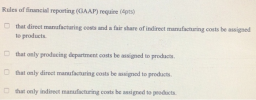 Rules of financial reporting (GAAP) require (4pts) that direct manufacturing costs and a fair share of indirect manufacturing costs be assigned to products. that only producing department costs be assigned to products. that only direct manufacturing costs be assigned to products. that only indirect manufacturing costs be assigned to products. Which joint cost allocation method is described by the following statement? Joint cost is prorated to the products on the basis of each product's share of units. O physical units...
6. Regardless of the GAAP depreciation method selected ... a. the maximum allowable depreciation over the...
 6. Regardless of the GAAP depreciation method selected ... a. the maximum allowable depreciation over the asset's life is the b. the total accumulated depreciation at the end of the asset's life will equal the depreciable base. c. the total accumulated depreciation at the end of the asset's life cannot exceed the depreciable base. d. all of the above. 7. On August 1 of the current year, a company with a December 31 year-end buys a nonresidential building for $600,000,...
6. Regardless of the GAAP depreciation method selected.. a. the maximum allowable depreciation over the asset's...
 6. Regardless of the GAAP depreciation method selected.. a. the maximum allowable depreciation over the asset's life is the same. b. the total accumulated depreciation at the end of the asset's life will equal the depreciable base. c. the total accumulated depreciation at the end of the asset's life cannot exceed the depreciable base. d. all of the above. On August 1 of the current year, a company with a December 31 year-end buys a nonresidential building for $600,000, which...
Question 11 Goodwill is: the excess of the appraised value of net assets over the fair...
 Question 11 Goodwill is: the excess of the appraised value of net assets over the fair value of net assets O the excess of the appraised value of net assets over the book value of net assets the excess of the purchase price of net assets over the fair value of net assets O the excess of the purchase price of net assets over the book value of net assets
Why does the Federal Reserve require that banks have reserves? What are excess reserves? How do...
 Why does the Federal Reserve require that banks have reserves? What are excess reserves? How do you calculate the excess reserves held? 6.
stering Depreciation Depreciation of property other than real property begins in the middle of the in...
 stering Depreciation Depreciation of property other than real property begins in the middle of the in which it is placed in service when more than: 25% of the total cost ofall depreciable property placed in service du occurs during the fourth quarter. 40% of the total cost of property less any Section 179 deduction placed in service during the year occurs during the fourth quarter. 40% of the total cost of all depreciable property placed in service during the ye...
During the consolidation process, the Income in Subsidiary account on the parent's income statement is eliminated....
During the consolidation process, the Income in Subsidiary account on the parent's income statement is eliminated. It is replaced with (read all choices and select the most complete answer): Group of answer choices Subsidiary's assets and liabilities. Subsidiary equity Subsidiary revenues, expenses, and annual amortization expenses related to fair market value allocations. Subsidiary dividends
A parent acquired 90% of the voting stock of a subsidiary for $20,000. The fair value...
A parent acquired 90% of the voting stock of a subsidiary for $20,000. The fair value of the noncontrolling interest was $2,000. The subsidiary's book value at the date of acquisition was $1,000. Following is revaluation information for the subsidiary's identifiable net assets at the date of acquisition: Fair Value – Book Value Inventories $ (400) Equipment (10,000) Identifiable intangibles 16,000 What is the amount of consolidated goodwill attributed to the noncontrolling interest at the date of acquisition, following U.S....
1. Which of the following is a reason why lease accounting under U.S. GAAP and IFRS...
1. Which of the following is a reason why lease accounting under U.S. GAAP and IFRS were revised? It was too easy for firms to circumvent lease capitalization criteria. To enhance comparability for analyzing different companies’ financial statements. Operating leases were a popular means of off-balance sheet financing. All of these answer choices are correct. 2. A temporary difference that causes book income to be greater than or less than taxable income when it is initially recorded is a/an: Multiple...
U.S. GAAP does not allow the revaluation of fixed assets where as it is allowed under...
U.S. GAAP does not allow the revaluation of fixed assets where as it is allowed under IFRS. Revaluation allows the entity to measure fixed assets at fair value. Discuss the advantages and disadvantages of using revaluation for property, plant, and equipment. Provide an example to support your discussion.
 Rules of financial reporting (GAAP) require (4pts) that direct manufacturing costs and a fair share of indirect manufacturing costs be assigned to products. that only producing department costs be assigned to products. that only direct manufacturing costs be assigned to products. that only indirect manufacturing costs be assigned to products. Which joint cost allocation method is described by the following statement? Joint cost is prorated to the products on the basis of each product's share of units. O physical units...
 6. Regardless of the GAAP depreciation method selected ... a. the maximum allowable depreciation over the asset's life is the b. the total accumulated depreciation at the end of the asset's life will equal the depreciable base. c. the total accumulated depreciation at the end of the asset's life cannot exceed the depreciable base. d. all of the above. 7. On August 1 of the current year, a company with a December 31 year-end buys a nonresidential building for $600,000,...
 6. Regardless of the GAAP depreciation method selected.. a. the maximum allowable depreciation over the asset's life is the same. b. the total accumulated depreciation at the end of the asset's life will equal the depreciable base. c. the total accumulated depreciation at the end of the asset's life cannot exceed the depreciable base. d. all of the above. On August 1 of the current year, a company with a December 31 year-end buys a nonresidential building for $600,000, which...
 Question 11 Goodwill is: the excess of the appraised value of net assets over the fair value of net assets O the excess of the appraised value of net assets over the book value of net assets the excess of the purchase price of net assets over the fair value of net assets O the excess of the purchase price of net assets over the book value of net assets
 Why does the Federal Reserve require that banks have reserves? What are excess reserves? How do you calculate the excess reserves held? 6.
 stering Depreciation Depreciation of property other than real property begins in the middle of the in which it is placed in service when more than: 25% of the total cost ofall depreciable property placed in service du occurs during the fourth quarter. 40% of the total cost of property less any Section 179 deduction placed in service during the year occurs during the fourth quarter. 40% of the total cost of all depreciable property placed in service during the ye...
Most questions answered within 3 hours.
-
Where is the error in this code sequence?
String s1 = "Hello";
String s2 = "ello";...
asked 11 months ago -
Financial data for Joel de Paris, Inc., for last year
follow:
Joel de Paris, Inc.
Balance...
asked 11 months ago -
Consider this reaction:
Al2(SO4)3 (aq)+ BaCl3
(aq) Al2Cl6 (aq)- +
3BaSO4(s) . What is the...
asked 11 months ago -
Suppose that Savneet is considering increasing her
recent random sample from 20 car rentals to 40...
asked 11 months ago -
Trucks arrive at an unloading terminal at an average rate of 120
per hour.
Trucks arrive...
asked 11 months ago -
Why are methanol and ethanol completely soluble in water while
octanol is not very little soluble....
asked 11 months ago -
A facilities manager at a university reads in a research report
that the mean amount of...
asked 11 months ago -
When the CuSO4 is rehydrated by adding water to the anhydrous
compound, is this an endothermic...
asked 11 months ago -
A ray of sunlight is passing from diamond into crown glass; the
angle of incidence is...
asked 11 months ago -
A block of mass 0.249 kg is placed on top of a light, vertical
spring of...
asked 11 months ago -
how do the kidneys compensate in the presences of acidosis
a) trigger hyperventilate
b) reserve acid...
asked 11 months ago -
Question 501 pts
The rental rate of capital to the firm increases. Which of the
following...
asked 11 months ago