
Homework Answers
Reversing third equation, sign of E° also reversed and we get :
CuI = Cu 2+ + I- + e- E° = -0.86 V
From second equation : Cu 2+ + 2e- = Cu E° = 0.34V
Adding both above equation
CuI + e- = Cu + I-
E° = -0.86+0.34
= -0.52 V
Add Answer to:
What is the standard electrode potential of the first
reaction?
E ? Cul+e = Cu +I...
What is the standard electrode potential of the first reaction? 102 다음에 주어진 두 개의 표준...
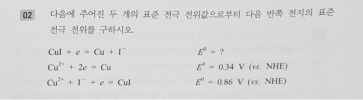 What is the standard electrode potential of the first
reaction?
102 다음에 주어진 두 개의 표준 전극 전위값으로부터 다음 반쪽 전지의 표준 전극 전위를 구하시오.. | Cul+e = Cu + I Cut + 2e = Cu Cut + I + e = Cul E = ? E = 0.34 V (wss. NHE) E = 0.86 V (vs. NHE) |
What is the standard electrode potential of the first
reaction?
102 다음에 주어진 두 개의 표준 전극 전위값으로부터 다음 반쪽 전지의 표준 전극 전위를 구하시오.. | Cul+e = Cu + I Cut + 2e = Cu Cut + I + e = Cul E = ? E = 0.34 V (wss. NHE) E = 0.86 V (vs. NHE) |
In the following cell, A is a standard Cu2+Cu electrode connected to a standard hydrogen electrode....
 In the following cell, A is a standard Cu2+Cu electrode connected to a standard hydrogen electrode. If the voltmeter reading is +0.34 V, which half-reaction occurs in the left-hand cell compartment? Given: Standard reduction potential of the H1/H2 and Cu2*/Cu couples are 0.00 and +0.34 V, respectively. Holo H2(g) --> 2H+ (aq) + 2e7 2H(aq) + 2e --> H2(g) Cu(s) --> Cu2(aq) + 2e Cu2(aq) + 2e --> Cu(s)
What is the standard electrode potential for a galvanic cell constructed in the appropriate way from...
 What is the standard electrode potential for a galvanic cell constructed in the appropriate way from these two nan-cers Reduction Half-Reactions Cu2(aq) + 2e- Cu(s) AP ) 3e- A ) Ecel +0.34 V -1.66V +4.34V +2.00 V 200V 112V
Calculate the equilibrium potential of a copper wire immersed in 0.0009 M CuSO4 solution. The standard...
 Calculate the equilibrium potential of a copper wire immersed in 0.0009 M CuSO4 solution. The standard electrode potential for the reaction Cu2+ 2e -Cu at 25°C is 0.34 V (NHE). Now, answer the following questions and enter your results (numerical number only) Calculate the ionic strength (M) of the solution Submit Answer Tries 0/25 Calculate the activity coefficient of Cu2+. Submit Answer Tries 0/25 Calculate the equilibrium potential (v) of the copper wire electrode. Note: use activity instead of concentration...
hurry!! The standard reduction potential of the Cu2+1Cu electrode is +0.34 V and the standard potential...
 hurry!!
The standard reduction potential of the Cu2+1Cu electrode is +0.34 V and the standard potential of the cell Pb(s) Pb2+(aq) || Cu2+(aq) | Cu(s) is +0.47 V. What is the standard reduction potential of the Pb2+|Pb electrode? 0-0.81V +0.81 V O +0.13 V 0 -0.26 V O-0.13 V
hurry!!
The standard reduction potential of the Cu2+1Cu electrode is +0.34 V and the standard potential of the cell Pb(s) Pb2+(aq) || Cu2+(aq) | Cu(s) is +0.47 V. What is the standard reduction potential of the Pb2+|Pb electrode? 0-0.81V +0.81 V O +0.13 V 0 -0.26 V O-0.13 V
If a platinum indicator electrode is used to measure [Cu^22^++] (standard reduction potential of Cu^22^++ is 0.337 V), and [Cu^22^++] = 0.0053 M, what is the cell potential (V) if the reference electr...
 If a platinum indicator electrode is used to measure [Cu^22^++]
(standard reduction potential of Cu^22^++ is 0.337 V), and
[Cu^22^++] = 0.0053 M, what is the cell potential (V) if the
reference electrode is SCE and the measurement is taken at 298
K?
Indicator Electrode--Quantification (Homework) Homework Unanswered If a platinum indicator electrode is used to measure [Cu2+] (standard reduction potential of Cu +is 0.337 V), and [Cu2+ o.0053 M, what is the cell potential (V) if the reference electrode...
If a platinum indicator electrode is used to measure [Cu^22^++]
(standard reduction potential of Cu^22^++ is 0.337 V), and
[Cu^22^++] = 0.0053 M, what is the cell potential (V) if the
reference electrode is SCE and the measurement is taken at 298
K?
Indicator Electrode--Quantification (Homework) Homework Unanswered If a platinum indicator electrode is used to measure [Cu2+] (standard reduction potential of Cu +is 0.337 V), and [Cu2+ o.0053 M, what is the cell potential (V) if the reference electrode...
A copper, Cu(s), electrode is immersed in a solution that is 1.00 M in ammonia, NH3,...
 A copper, Cu(s), electrode is immersed in a solution that is 1.00 M in ammonia, NH3, and 1.00 M in tetraamminecopper(I), [Cu(NH). If a standard hydrogen electrode is used as the cathode, the cell potential, Ecell, is found to be 0.074 V at 298 K Constants Periodic Table Use the standard reduction potentials shown here to answer the questions Reduction half-reaction E (V) Cu2+ (aq) 2e Cu(s) 0.337 2H + (aq) + 2e →H, (g) | 0.000 ▼ Part A...
question iii 10. An electrochemical cell consists of a standard Fe/Fe electrode (Fe (aq) (1.OM) IFe...
 question iii
10. An electrochemical cell consists of a standard Fe/Fe electrode (Fe (aq) (1.OM) IFe (aq) (1.0M) IPt(s) and a copper metal electrode ( concentrations) Cu2 (aq) +2e Cu(s) Fe (aq) le Fe (aq) +0.34 V -034 +0.77V Mark what is the corect balanced equation for the spontaneous reac u (aq) Fe (aq) Cu(s)+Fe2 (aq) C) Cu(s) + Fe (aq) Cu (aq) + Fe (aq) α Cu2+(aq) + 2e → Cu(s) + Fe2+(aq) Cu → Cu2ト+20 94 i) (...
question iii
10. An electrochemical cell consists of a standard Fe/Fe electrode (Fe (aq) (1.OM) IFe (aq) (1.0M) IPt(s) and a copper metal electrode ( concentrations) Cu2 (aq) +2e Cu(s) Fe (aq) le Fe (aq) +0.34 V -034 +0.77V Mark what is the corect balanced equation for the spontaneous reac u (aq) Fe (aq) Cu(s)+Fe2 (aq) C) Cu(s) + Fe (aq) Cu (aq) + Fe (aq) α Cu2+(aq) + 2e → Cu(s) + Fe2+(aq) Cu → Cu2ト+20 94 i) (...
*A copper, Cu(s), electrode is immersed in a solution that is 1.00 M in ammonia, NH3, and 1.00 M in tetraamminecopper(II), [Cu(NH3)4]2+. If a standard hydrogen electrode is used as the cathode, the ce...
 *A copper, Cu(s), electrode is immersed in a solution that is
1.00 M in ammonia, NH3, and 1.00 M in tetraamminecopper(II),
[Cu(NH3)4]2+. If a standard hydrogen electrode is used as the
cathode, the cell potential, Ecell, is found to be 0.070 V at 298
K.
A copper, Cu(s), electrode is immersed in a solution that is 1.00 M in ammonia, NH3, and 1.00 M in tetraamminecopper(II), [NH. If a standard hydrogen electrode is used as the cathode, the cell potential,...
*A copper, Cu(s), electrode is immersed in a solution that is
1.00 M in ammonia, NH3, and 1.00 M in tetraamminecopper(II),
[Cu(NH3)4]2+. If a standard hydrogen electrode is used as the
cathode, the cell potential, Ecell, is found to be 0.070 V at 298
K.
A copper, Cu(s), electrode is immersed in a solution that is 1.00 M in ammonia, NH3, and 1.00 M in tetraamminecopper(II), [NH. If a standard hydrogen electrode is used as the cathode, the cell potential,...
A voltaic cell consists of a Cu2+/Cu electrode (E°red = 0.34 V) and an Au3+/Au electrode...
A voltaic cell consists of a Cu2+/Cu electrode (E°red = 0.34 V) and an Au3+/Au electrode (E°red = 1.50V). Calculate [Au3+] if [Cu2+] = 1.20 M and Ecell = 1.13 V
 What is the standard electrode potential of the first
reaction?
102 다음에 주어진 두 개의 표준 전극 전위값으로부터 다음 반쪽 전지의 표준 전극 전위를 구하시오.. | Cul+e = Cu + I Cut + 2e = Cu Cut + I + e = Cul E = ? E = 0.34 V (wss. NHE) E = 0.86 V (vs. NHE) |
What is the standard electrode potential of the first
reaction?
102 다음에 주어진 두 개의 표준 전극 전위값으로부터 다음 반쪽 전지의 표준 전극 전위를 구하시오.. | Cul+e = Cu + I Cut + 2e = Cu Cut + I + e = Cul E = ? E = 0.34 V (wss. NHE) E = 0.86 V (vs. NHE) |
 In the following cell, A is a standard Cu2+Cu electrode connected to a standard hydrogen electrode. If the voltmeter reading is +0.34 V, which half-reaction occurs in the left-hand cell compartment? Given: Standard reduction potential of the H1/H2 and Cu2*/Cu couples are 0.00 and +0.34 V, respectively. Holo H2(g) --> 2H+ (aq) + 2e7 2H(aq) + 2e --> H2(g) Cu(s) --> Cu2(aq) + 2e Cu2(aq) + 2e --> Cu(s)
 What is the standard electrode potential for a galvanic cell constructed in the appropriate way from these two nan-cers Reduction Half-Reactions Cu2(aq) + 2e- Cu(s) AP ) 3e- A ) Ecel +0.34 V -1.66V +4.34V +2.00 V 200V 112V
 Calculate the equilibrium potential of a copper wire immersed in 0.0009 M CuSO4 solution. The standard electrode potential for the reaction Cu2+ 2e -Cu at 25°C is 0.34 V (NHE). Now, answer the following questions and enter your results (numerical number only) Calculate the ionic strength (M) of the solution Submit Answer Tries 0/25 Calculate the activity coefficient of Cu2+. Submit Answer Tries 0/25 Calculate the equilibrium potential (v) of the copper wire electrode. Note: use activity instead of concentration...
 hurry!!
The standard reduction potential of the Cu2+1Cu electrode is +0.34 V and the standard potential of the cell Pb(s) Pb2+(aq) || Cu2+(aq) | Cu(s) is +0.47 V. What is the standard reduction potential of the Pb2+|Pb electrode? 0-0.81V +0.81 V O +0.13 V 0 -0.26 V O-0.13 V
hurry!!
The standard reduction potential of the Cu2+1Cu electrode is +0.34 V and the standard potential of the cell Pb(s) Pb2+(aq) || Cu2+(aq) | Cu(s) is +0.47 V. What is the standard reduction potential of the Pb2+|Pb electrode? 0-0.81V +0.81 V O +0.13 V 0 -0.26 V O-0.13 V
 If a platinum indicator electrode is used to measure [Cu^22^++]
(standard reduction potential of Cu^22^++ is 0.337 V), and
[Cu^22^++] = 0.0053 M, what is the cell potential (V) if the
reference electrode is SCE and the measurement is taken at 298
K?
Indicator Electrode--Quantification (Homework) Homework Unanswered If a platinum indicator electrode is used to measure [Cu2+] (standard reduction potential of Cu +is 0.337 V), and [Cu2+ o.0053 M, what is the cell potential (V) if the reference electrode...
If a platinum indicator electrode is used to measure [Cu^22^++]
(standard reduction potential of Cu^22^++ is 0.337 V), and
[Cu^22^++] = 0.0053 M, what is the cell potential (V) if the
reference electrode is SCE and the measurement is taken at 298
K?
Indicator Electrode--Quantification (Homework) Homework Unanswered If a platinum indicator electrode is used to measure [Cu2+] (standard reduction potential of Cu +is 0.337 V), and [Cu2+ o.0053 M, what is the cell potential (V) if the reference electrode...
 A copper, Cu(s), electrode is immersed in a solution that is 1.00 M in ammonia, NH3, and 1.00 M in tetraamminecopper(I), [Cu(NH). If a standard hydrogen electrode is used as the cathode, the cell potential, Ecell, is found to be 0.074 V at 298 K Constants Periodic Table Use the standard reduction potentials shown here to answer the questions Reduction half-reaction E (V) Cu2+ (aq) 2e Cu(s) 0.337 2H + (aq) + 2e →H, (g) | 0.000 ▼ Part A...
 question iii
10. An electrochemical cell consists of a standard Fe/Fe electrode (Fe (aq) (1.OM) IFe (aq) (1.0M) IPt(s) and a copper metal electrode ( concentrations) Cu2 (aq) +2e Cu(s) Fe (aq) le Fe (aq) +0.34 V -034 +0.77V Mark what is the corect balanced equation for the spontaneous reac u (aq) Fe (aq) Cu(s)+Fe2 (aq) C) Cu(s) + Fe (aq) Cu (aq) + Fe (aq) α Cu2+(aq) + 2e → Cu(s) + Fe2+(aq) Cu → Cu2ト+20 94 i) (...
question iii
10. An electrochemical cell consists of a standard Fe/Fe electrode (Fe (aq) (1.OM) IFe (aq) (1.0M) IPt(s) and a copper metal electrode ( concentrations) Cu2 (aq) +2e Cu(s) Fe (aq) le Fe (aq) +0.34 V -034 +0.77V Mark what is the corect balanced equation for the spontaneous reac u (aq) Fe (aq) Cu(s)+Fe2 (aq) C) Cu(s) + Fe (aq) Cu (aq) + Fe (aq) α Cu2+(aq) + 2e → Cu(s) + Fe2+(aq) Cu → Cu2ト+20 94 i) (...
 *A copper, Cu(s), electrode is immersed in a solution that is
1.00 M in ammonia, NH3, and 1.00 M in tetraamminecopper(II),
[Cu(NH3)4]2+. If a standard hydrogen electrode is used as the
cathode, the cell potential, Ecell, is found to be 0.070 V at 298
K.
A copper, Cu(s), electrode is immersed in a solution that is 1.00 M in ammonia, NH3, and 1.00 M in tetraamminecopper(II), [NH. If a standard hydrogen electrode is used as the cathode, the cell potential,...
*A copper, Cu(s), electrode is immersed in a solution that is
1.00 M in ammonia, NH3, and 1.00 M in tetraamminecopper(II),
[Cu(NH3)4]2+. If a standard hydrogen electrode is used as the
cathode, the cell potential, Ecell, is found to be 0.070 V at 298
K.
A copper, Cu(s), electrode is immersed in a solution that is 1.00 M in ammonia, NH3, and 1.00 M in tetraamminecopper(II), [NH. If a standard hydrogen electrode is used as the cathode, the cell potential,...
Most questions answered within 3 hours.
-
Where is the error in this code sequence?
String s1 = "Hello";
String s2 = "ello";...
asked 10 months ago -
Financial data for Joel de Paris, Inc., for last year
follow:
Joel de Paris, Inc.
Balance...
asked 10 months ago -
Consider this reaction:
Al2(SO4)3 (aq)+ BaCl3
(aq) Al2Cl6 (aq)- +
3BaSO4(s) . What is the...
asked 10 months ago -
Suppose that Savneet is considering increasing her
recent random sample from 20 car rentals to 40...
asked 10 months ago -
Trucks arrive at an unloading terminal at an average rate of 120
per hour.
Trucks arrive...
asked 10 months ago -
Why are methanol and ethanol completely soluble in water while
octanol is not very little soluble....
asked 10 months ago -
A facilities manager at a university reads in a research report
that the mean amount of...
asked 10 months ago -
When the CuSO4 is rehydrated by adding water to the anhydrous
compound, is this an endothermic...
asked 10 months ago -
A ray of sunlight is passing from diamond into crown glass; the
angle of incidence is...
asked 10 months ago -
A block of mass 0.249 kg is placed on top of a light, vertical
spring of...
asked 10 months ago -
how do the kidneys compensate in the presences of acidosis
a) trigger hyperventilate
b) reserve acid...
asked 10 months ago -
Question 501 pts
The rental rate of capital to the firm increases. Which of the
following...
asked 10 months ago