
Homework Answers
Add Answer to:
Complete each of the following half-reactions with the correct number of electrons and then arrange them...
Complete each of the following half-reactions with the correct number of electrons and then arrange them...
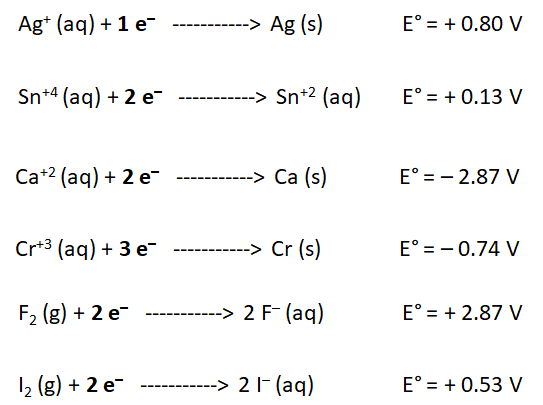
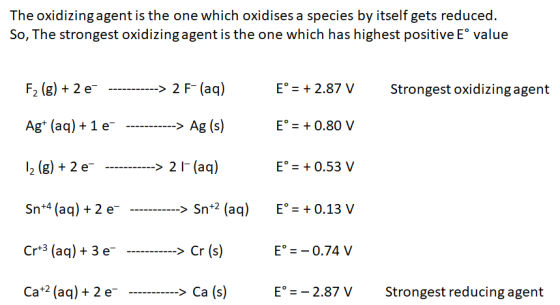
 Complete each of the following half-reactions with the correct number of electrons and then arrange them from strongest oxidizing potential to strongest reducing potential. Strongest Oxidizing Potential Drag the text blocks below into their correct order. 5e 2H*(aq) H2(g) E +0.00 V бе Cu2 (aq) Cu (aq) E = +0.15 V 4e Au3 (aq) Au(s) E 1.50 V 2e (s) 21(aq) E +0.53 V e Fe3 (aq) Fe2 (aq) E° = +0.77 V 2F (aq) E = +2.87 V F2(g)...
Complete each of the following half-reactions with the correct number of electrons and then arrange them...
 Complete each of the following half-reactions with the correct number of electrons and then arrange them from strongest oxidizing potential to strongest reducing potential. Strongest Oxidizing Potential Drag the text blocks below into their correct order. 2e Au3+ (aq) + e + Au(s) E° = +1.50 V 5e Sn2+ (aq) + e + Sn(s) E° = -0.14 V 6e Ca2+ (aq) + 2e + Ca(s) E° = -2.87 V wwwwwwwwwwwwwwwwwwwwwwwwwwwwwwwww 4e Co3+ (aq) + 2e + Co2+ (aq) E° =...
Complete each of the following half-reactions with the correct number of electrons and then arrange them from strongest...
 Complete each of the following half-reactions with the correct number of electrons and then arrange them from strongest oxidizing potential to strongest reducing potential. Strongest Oxidizing Potential Drag the text blocks below into their correct order. 2e 12(s) + → 21 (aq) E° = +0.53 V 4e Fe (aq) + → Fez (aq) E° = +0.77 V F2(g) + 2F-(aq) E° = +2.87 V AHOROD WWWWWWWWWWWWWWWWWWWWWWWWWWWWWWY Au3+ (aq) + Au(s) E° = +1.50 V 2H'(aq) + - + H2(g) E°...
Complete each of the following half-reactions with the correct number of electrons and then arrange them...
 Complete each of the following half-reactions with the correct number of electrons and then arrange them from strongest caidizing potential to strongest reducing potential Strongest Oxidizing Potential Drag the text blocks below into their correct order. Fes (aq) + + Fe (aq) = +0.77 V 2H(aq) + * H(o) +0.00 V Natal - Nais) E.-2.71 V Co (aq) + -Co" (aq) +1.82 V Br(0) + - 2Br(ad E - +1.07 v Nad) - Nis) E--0.25 V Strongest Reducting Potential
12. Using two half reactions that have NEGATIVE standard reduction potentials results results in a battery...
 12. Using two half reactions that have NEGATIVE standard reduction potentials results results in a battery that... Reduction Half-Reaction F2(g) + 2e →2F(aq) S2082 (aq) + 2e- → 25042 (aq) O2(g) + 4H+ (aq) + 4e → 2H2O(1) Br2(1) + 2e + 2Br (aq) Agt(aq) + e → Ag(s) Fe3+ (aq) + e- → Fe2+ (aq) 126) + 2e → 21 (aq) Cu2+ (aq) + 2e → Cu(s) Sn4+ (aq) + 2e → Sn2+ (aq) S(s) + 2H+ (aq) +...
help with these please Consider the following half-reactions: Half-reaction Eo (V) F2(g)+ 2e 2F (aq) 2.870V...
 help with these please
Consider the following half-reactions: Half-reaction Eo (V) F2(g)+ 2e 2F (aq) 2.870V Sn2 (aq) + 2e- Sn(s) 0.140V Cr3 (aq) + 3e° _ Cr(s)-0.740V (1) The strongest oxidizing agent is: enter formula (2) The weakest oxidizing agent is: (3) The weakest reducing agent is: (4) The strongest reducing agent is: (5) Will F2(g) oxidize Cr(s) to Cr3 (aq)? (6) Which species can be oxidized by Sn2 (aq)? If none, leave box blank. Consider the following half-reactions:...
help with these please
Consider the following half-reactions: Half-reaction Eo (V) F2(g)+ 2e 2F (aq) 2.870V Sn2 (aq) + 2e- Sn(s) 0.140V Cr3 (aq) + 3e° _ Cr(s)-0.740V (1) The strongest oxidizing agent is: enter formula (2) The weakest oxidizing agent is: (3) The weakest reducing agent is: (4) The strongest reducing agent is: (5) Will F2(g) oxidize Cr(s) to Cr3 (aq)? (6) Which species can be oxidized by Sn2 (aq)? If none, leave box blank. Consider the following half-reactions:...
A chemist designs a galvanic cell that uses these two half-reactions: standard reduction potential half-reaction +...
 A chemist designs a galvanic cell that uses these two half-reactions: standard reduction potential half-reaction + O2(9)+4 H (aq)+4e' 2H20) = 1.23 V red Ered Fe+. (аq) Fe3(aq)+e = +0.771 V Answer the following questions about thiss cell Write a balanced equation for the half-reaction that happens at the cathode Write a balanced equation for the half-reaction that happens at the anode Write a balanced equation for the overall reaction that powers the cell. Be sure the reaction is spontaneous...
Consider the following half-reactions: Half-reaction E° (V) F2(g) +2e - →2F (aq) 2.870V 2H*(aq) + 2e...
 Consider the following half-reactions: Half-reaction E° (V) F2(g) +2e - →2F (aq) 2.870V 2H*(aq) + 2e - H2(g) 0.000V Cr3+ (aq) + 3e — Cr(s) -0.740V (1) The strongest oxidizing agent is: enter formula (2) The weakest oxidizing agent is: (3) The weakest reducing agent is: (4) The strongest reducing agent is: (5) Will F2(g) oxidize Cr(s) to Cr3+ (aq)? (6) Which species can be oxidized by H(aq)? If none, leave box blank.
Half-reaction Cr3+ (aq) + 3e- → Cr(s) Fe2+ (aq) + 2e- → Fe (s) Fe3+ (aq) + e- + Fe2+ (s) Sn4+ (aq) + 2e- + Sn2+ (aq...
 Half-reaction Cr3+ (aq) + 3e- → Cr(s) Fe2+ (aq) + 2e- → Fe (s) Fe3+ (aq) + e- + Fe2+ (s) Sn4+ (aq) + 2e- + Sn2+ (aq) E° (V) -0.74 -0.440 +0.771 +0.154 3Sn** (aq) +2Cr(s) → 2Cr** (aq) +3Sn²+ (aq) 3. What is the cell potential, Ecell, for the reaction above if [Sn] = 1.00 M, [Cr3+1 = 0.0200 M and [Sn2+] = 0.0100 M?
A certain half-reaction has a standard reduction potential E Ted =-0.99 V. An engineer proposes using...
 A certain half-reaction has a standard reduction potential E Ted =-0.99 V. An engineer proposes using this half-reaction at the anode of a galvanic cell that must provide at least 0.90 V of electrical power. The cell will operate under standard conditions. Note for advanced students: assume the engineer requires this half-reaction to happen at the anode of the cell O- Is there a minimum standard reduction potential that the half-reaction used at the cathode of this cell can have?...
 Complete each of the following half-reactions with the correct number of electrons and then arrange them from strongest oxidizing potential to strongest reducing potential. Strongest Oxidizing Potential Drag the text blocks below into their correct order. 5e 2H*(aq) H2(g) E +0.00 V бе Cu2 (aq) Cu (aq) E = +0.15 V 4e Au3 (aq) Au(s) E 1.50 V 2e (s) 21(aq) E +0.53 V e Fe3 (aq) Fe2 (aq) E° = +0.77 V 2F (aq) E = +2.87 V F2(g)...
 Complete each of the following half-reactions with the correct number of electrons and then arrange them from strongest oxidizing potential to strongest reducing potential. Strongest Oxidizing Potential Drag the text blocks below into their correct order. 2e Au3+ (aq) + e + Au(s) E° = +1.50 V 5e Sn2+ (aq) + e + Sn(s) E° = -0.14 V 6e Ca2+ (aq) + 2e + Ca(s) E° = -2.87 V wwwwwwwwwwwwwwwwwwwwwwwwwwwwwwwww 4e Co3+ (aq) + 2e + Co2+ (aq) E° =...
 Complete each of the following half-reactions with the correct number of electrons and then arrange them from strongest oxidizing potential to strongest reducing potential. Strongest Oxidizing Potential Drag the text blocks below into their correct order. 2e 12(s) + → 21 (aq) E° = +0.53 V 4e Fe (aq) + → Fez (aq) E° = +0.77 V F2(g) + 2F-(aq) E° = +2.87 V AHOROD WWWWWWWWWWWWWWWWWWWWWWWWWWWWWWY Au3+ (aq) + Au(s) E° = +1.50 V 2H'(aq) + - + H2(g) E°...
 Complete each of the following half-reactions with the correct number of electrons and then arrange them from strongest caidizing potential to strongest reducing potential Strongest Oxidizing Potential Drag the text blocks below into their correct order. Fes (aq) + + Fe (aq) = +0.77 V 2H(aq) + * H(o) +0.00 V Natal - Nais) E.-2.71 V Co (aq) + -Co" (aq) +1.82 V Br(0) + - 2Br(ad E - +1.07 v Nad) - Nis) E--0.25 V Strongest Reducting Potential
 12. Using two half reactions that have NEGATIVE standard reduction potentials results results in a battery that... Reduction Half-Reaction F2(g) + 2e →2F(aq) S2082 (aq) + 2e- → 25042 (aq) O2(g) + 4H+ (aq) + 4e → 2H2O(1) Br2(1) + 2e + 2Br (aq) Agt(aq) + e → Ag(s) Fe3+ (aq) + e- → Fe2+ (aq) 126) + 2e → 21 (aq) Cu2+ (aq) + 2e → Cu(s) Sn4+ (aq) + 2e → Sn2+ (aq) S(s) + 2H+ (aq) +...
 help with these please
Consider the following half-reactions: Half-reaction Eo (V) F2(g)+ 2e 2F (aq) 2.870V Sn2 (aq) + 2e- Sn(s) 0.140V Cr3 (aq) + 3e° _ Cr(s)-0.740V (1) The strongest oxidizing agent is: enter formula (2) The weakest oxidizing agent is: (3) The weakest reducing agent is: (4) The strongest reducing agent is: (5) Will F2(g) oxidize Cr(s) to Cr3 (aq)? (6) Which species can be oxidized by Sn2 (aq)? If none, leave box blank. Consider the following half-reactions:...
help with these please
Consider the following half-reactions: Half-reaction Eo (V) F2(g)+ 2e 2F (aq) 2.870V Sn2 (aq) + 2e- Sn(s) 0.140V Cr3 (aq) + 3e° _ Cr(s)-0.740V (1) The strongest oxidizing agent is: enter formula (2) The weakest oxidizing agent is: (3) The weakest reducing agent is: (4) The strongest reducing agent is: (5) Will F2(g) oxidize Cr(s) to Cr3 (aq)? (6) Which species can be oxidized by Sn2 (aq)? If none, leave box blank. Consider the following half-reactions:...
 A chemist designs a galvanic cell that uses these two half-reactions: standard reduction potential half-reaction + O2(9)+4 H (aq)+4e' 2H20) = 1.23 V red Ered Fe+. (аq) Fe3(aq)+e = +0.771 V Answer the following questions about thiss cell Write a balanced equation for the half-reaction that happens at the cathode Write a balanced equation for the half-reaction that happens at the anode Write a balanced equation for the overall reaction that powers the cell. Be sure the reaction is spontaneous...
 Consider the following half-reactions: Half-reaction E° (V) F2(g) +2e - →2F (aq) 2.870V 2H*(aq) + 2e - H2(g) 0.000V Cr3+ (aq) + 3e — Cr(s) -0.740V (1) The strongest oxidizing agent is: enter formula (2) The weakest oxidizing agent is: (3) The weakest reducing agent is: (4) The strongest reducing agent is: (5) Will F2(g) oxidize Cr(s) to Cr3+ (aq)? (6) Which species can be oxidized by H(aq)? If none, leave box blank.
 Half-reaction Cr3+ (aq) + 3e- → Cr(s) Fe2+ (aq) + 2e- → Fe (s) Fe3+ (aq) + e- + Fe2+ (s) Sn4+ (aq) + 2e- + Sn2+ (aq) E° (V) -0.74 -0.440 +0.771 +0.154 3Sn** (aq) +2Cr(s) → 2Cr** (aq) +3Sn²+ (aq) 3. What is the cell potential, Ecell, for the reaction above if [Sn] = 1.00 M, [Cr3+1 = 0.0200 M and [Sn2+] = 0.0100 M?
 A certain half-reaction has a standard reduction potential E Ted =-0.99 V. An engineer proposes using this half-reaction at the anode of a galvanic cell that must provide at least 0.90 V of electrical power. The cell will operate under standard conditions. Note for advanced students: assume the engineer requires this half-reaction to happen at the anode of the cell O- Is there a minimum standard reduction potential that the half-reaction used at the cathode of this cell can have?...
Most questions answered within 3 hours.
-
Where is the error in this code sequence?
String s1 = "Hello";
String s2 = "ello";...
asked 11 months ago -
Financial data for Joel de Paris, Inc., for last year
follow:
Joel de Paris, Inc.
Balance...
asked 11 months ago -
Consider this reaction:
Al2(SO4)3 (aq)+ BaCl3
(aq) Al2Cl6 (aq)- +
3BaSO4(s) . What is the...
asked 11 months ago -
Suppose that Savneet is considering increasing her
recent random sample from 20 car rentals to 40...
asked 11 months ago -
Trucks arrive at an unloading terminal at an average rate of 120
per hour.
Trucks arrive...
asked 11 months ago -
Why are methanol and ethanol completely soluble in water while
octanol is not very little soluble....
asked 11 months ago -
A facilities manager at a university reads in a research report
that the mean amount of...
asked 11 months ago -
When the CuSO4 is rehydrated by adding water to the anhydrous
compound, is this an endothermic...
asked 11 months ago -
A ray of sunlight is passing from diamond into crown glass; the
angle of incidence is...
asked 11 months ago -
A block of mass 0.249 kg is placed on top of a light, vertical
spring of...
asked 11 months ago -
how do the kidneys compensate in the presences of acidosis
a) trigger hyperventilate
b) reserve acid...
asked 11 months ago -
Question 501 pts
The rental rate of capital to the firm increases. Which of the
following...
asked 11 months ago