A bullet of mass m = 40 g, moving horizontally with speed v, strikes a clay...
A bullet of mass m = 40 g, moving horizontally with speed v, strikes a clay block of mass M=1.33 kg that is hanging on a light inextensible string of length L=0.767. The bullet becomes embedded in the block, which was originally at rest. What is the smallest value of vv which would cause the block-on-a-string to swing around and execute a complete vertical circle?
Homework Answers

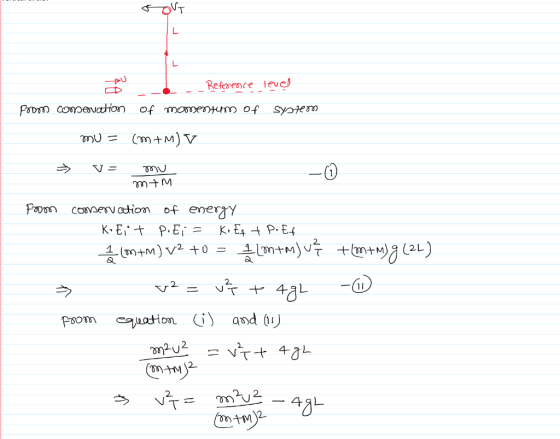
![F.BD of bullet-clay system at top {m+m] 9 HT For circular motion (on tm) g +T = (mtm] vt for minimum speed, Teo .. (on+m) y =](http://img.homeworklib.com/questions/d0ebfe30-739a-11ea-bf10-c52166607914.png?x-oss-process=image/resize,w_560)
Add Answer to:
A bullet of mass m = 40 g, moving horizontally with speed v,
strikes a clay...
A bullet of mass m = 40 g, moving horizontally with speed v, strikes a clay...
 A bullet of mass m = 40 g, moving horizontally with speed v, strikes a clay block of mass M = 1.73 kg that is hanging on a light inextensible string of length = 0.774. The bullet becomes embedded in the block, which was originally at rest. What is the smallest value of v which would cause the block-on-a-string to swing around and execute a complete vertical circle? Please enter a numerical answer below. Accepted formats are numbers or "e"...
[This is a particularly challenging problem, incorporating momentum, conservation of energy, and centripetal force. If you...
[This is a particularly challenging problem, incorporating momentum, conservation of energy, and centripetal force. If you find yourself getting annoyed, just remember that I could have turned the block into a projectile as well :-). Consider it a bonus.] A bullet of mass m = 40 g, moving horizontally with speed v, strikes a clay block of mass M = 1.68 kg that is hanging on a light inextensible string of length L = 0.620. The bullet becomes embedded in...
See the picture (This is a particularly challenging problem, incorporating momentum, conservation of energy, and centripetal...
 See
the picture
(This is a particularly challenging problem, incorporating momentum, conservation of energy, and centripetal force. If you find yourself getting annoyed, just remember that I could have turned the block into a projectile as well :-). Consider it a bonus.) A bullet of mass m = 40 g, moving horizontally with speed u, strikes a clay block of mass M = 1.45 kg that is hanging on a light inextensible string of length L = 0.770. The bullet...
See
the picture
(This is a particularly challenging problem, incorporating momentum, conservation of energy, and centripetal force. If you find yourself getting annoyed, just remember that I could have turned the block into a projectile as well :-). Consider it a bonus.) A bullet of mass m = 40 g, moving horizontally with speed u, strikes a clay block of mass M = 1.45 kg that is hanging on a light inextensible string of length L = 0.770. The bullet...
a bullet of mass m1 =5g is moving with speed v1. it strikes a block of...
a bullet of mass m1 =5g is moving with speed v1. it strikes a block of mass m2=6 kg that is hanging at rest from a cord. the bullet embeds itself into the block and the bullet and block swing up on the cord , coming to rest at a height h=2 cm above the original position of the block. whatbisnthe correct expression for momentum conservation when the bullet strikes the block?
26) In Figure 8.4, a bullet of mass 0.01 kg moving horizontally strikes a block of...
 26) In Figure 8.4, a bullet of mass 0.01 kg moving horizontally strikes a block of wood of which is suspended as a pendulum. The bullet lodges in the wood, and together they swing upward a distance of 0.40 m. What was the velocity of the bullet just before it struck the wooden block? The length of thestringis2 meters. A) 646 m/s B) 366 m/s C)423 m/s D)250 m/s E) 66.7 m/s 667m-
QUESTION 7 A bullet of mass 40.0 g moving with a speed of 249 m/s strikes...
 QUESTION 7 A bullet of mass 40.0 g moving with a speed of 249 m/s strikes a block of wood of mass 2.00 kg and becomes imbedded in it (stuck inside it). The block had been originally at rest and is free to move. What is the speed of the block and bullet immediately after the collision, in units of m/s? QUESTION 10 If an object is initially at rest and then 'explodes' into two separate pieces, what do we...
A 35 g bullet is fired horizontally into a hanging wooden block (mass 1.7kg) as shown...
A 35 g bullet is fired horizontally into a hanging wooden block (mass 1.7kg) as shown in (Figure 1). The bullet's initial speed is 300 m/s . The bullet becomes embedded in the block, which then swings upward some height. What is the maximum height to which the block rises? Instead of getting embedded in the block, the bullet passes completely through it, emerging on the other side with a speed of 100 m/s . How high does the block...
A 70g bullet moving east at 40 m/s strikes a 1.2kg block suspended and becomes embedded...
A 70g bullet moving east at 40 m/s strikes a 1.2kg block suspended and becomes embedded in the block. How high will the bullet-block system rise above its original point?
11. A bullet moving at 200 m/s strikes a wooden block which has several hundred times...
 11. A bullet moving at 200 m/s strikes a wooden block which has several hundred times the bullet's mass. The block is hanging from a string. Only 1% of the kinetic energy of the bullet shows up as motion of the block after the bullet has become embedd ed in the block. What happened to the rest of the energy? Describe how the block moves and some of the changes to the block.
 A bullet of mass m = 40 g, moving horizontally with speed v, strikes a clay block of mass M = 1.73 kg that is hanging on a light inextensible string of length = 0.774. The bullet becomes embedded in the block, which was originally at rest. What is the smallest value of v which would cause the block-on-a-string to swing around and execute a complete vertical circle? Please enter a numerical answer below. Accepted formats are numbers or "e"...
 See
the picture
(This is a particularly challenging problem, incorporating momentum, conservation of energy, and centripetal force. If you find yourself getting annoyed, just remember that I could have turned the block into a projectile as well :-). Consider it a bonus.) A bullet of mass m = 40 g, moving horizontally with speed u, strikes a clay block of mass M = 1.45 kg that is hanging on a light inextensible string of length L = 0.770. The bullet...
See
the picture
(This is a particularly challenging problem, incorporating momentum, conservation of energy, and centripetal force. If you find yourself getting annoyed, just remember that I could have turned the block into a projectile as well :-). Consider it a bonus.) A bullet of mass m = 40 g, moving horizontally with speed u, strikes a clay block of mass M = 1.45 kg that is hanging on a light inextensible string of length L = 0.770. The bullet...
 26) In Figure 8.4, a bullet of mass 0.01 kg moving horizontally strikes a block of wood of which is suspended as a pendulum. The bullet lodges in the wood, and together they swing upward a distance of 0.40 m. What was the velocity of the bullet just before it struck the wooden block? The length of thestringis2 meters. A) 646 m/s B) 366 m/s C)423 m/s D)250 m/s E) 66.7 m/s 667m-
 QUESTION 7 A bullet of mass 40.0 g moving with a speed of 249 m/s strikes a block of wood of mass 2.00 kg and becomes imbedded in it (stuck inside it). The block had been originally at rest and is free to move. What is the speed of the block and bullet immediately after the collision, in units of m/s? QUESTION 10 If an object is initially at rest and then 'explodes' into two separate pieces, what do we...
 11. A bullet moving at 200 m/s strikes a wooden block which has several hundred times the bullet's mass. The block is hanging from a string. Only 1% of the kinetic energy of the bullet shows up as motion of the block after the bullet has become embedd ed in the block. What happened to the rest of the energy? Describe how the block moves and some of the changes to the block.
Most questions answered within 3 hours.
-
Where is the error in this code sequence?
String s1 = "Hello";
String s2 = "ello";...
asked 11 months ago -
Financial data for Joel de Paris, Inc., for last year
follow:
Joel de Paris, Inc.
Balance...
asked 11 months ago -
Consider this reaction:
Al2(SO4)3 (aq)+ BaCl3
(aq) Al2Cl6 (aq)- +
3BaSO4(s) . What is the...
asked 11 months ago -
Suppose that Savneet is considering increasing her
recent random sample from 20 car rentals to 40...
asked 11 months ago -
Trucks arrive at an unloading terminal at an average rate of 120
per hour.
Trucks arrive...
asked 11 months ago -
Why are methanol and ethanol completely soluble in water while
octanol is not very little soluble....
asked 11 months ago -
A facilities manager at a university reads in a research report
that the mean amount of...
asked 11 months ago -
When the CuSO4 is rehydrated by adding water to the anhydrous
compound, is this an endothermic...
asked 11 months ago -
A ray of sunlight is passing from diamond into crown glass; the
angle of incidence is...
asked 11 months ago -
A block of mass 0.249 kg is placed on top of a light, vertical
spring of...
asked 11 months ago -
how do the kidneys compensate in the presences of acidosis
a) trigger hyperventilate
b) reserve acid...
asked 11 months ago -
Question 501 pts
The rental rate of capital to the firm increases. Which of the
following...
asked 11 months ago