Which of the following investments is most risky? a. large cap stocks b. blue chip stocks...
Which of the following investments is most risky?
a. large cap stocks
b. blue chip stocks
c. growth stocks
d. treasury stocks
Homework Answers
the following investments is most risky:-
c. growth stocks
a growth stock is a stock of a company that generates substantial cash flow and whose revenues and earnings are expected to increase at a faster rate than the average company within the same industry
Add Answer to:
Which of the following investments is most risky?
a. large cap stocks
b. blue chip stocks...
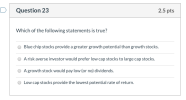
Also, Question 23 2.5 pts Which of the following statements is true? Blue chip stocks provide...
 Also,
Question 23 2.5 pts Which of the following statements is true? Blue chip stocks provide a greater growth potential than growth stocks Arisk averse investor would prefer low cap stocks to large cap stocks. A growth stock would pay low (or no) dividends. Low cap stocks provide the lowest potential rate of return Question 32 2.5pts Which of the following statements is false? A 15 year mortgage would have a higher interest rate than a 30 year mortgage A...
Also,
Question 23 2.5 pts Which of the following statements is true? Blue chip stocks provide a greater growth potential than growth stocks Arisk averse investor would prefer low cap stocks to large cap stocks. A growth stock would pay low (or no) dividends. Low cap stocks provide the lowest potential rate of return Question 32 2.5pts Which of the following statements is false? A 15 year mortgage would have a higher interest rate than a 30 year mortgage A...
Which of the following is most likely to have the highest returns? A) Small stocks B)...
Which of the following is most likely to have the highest returns? A) Small stocks B) Inflation C) Treasury bills D) Large stocks Which assets are considered risk free? A) AAA rated bonds B) Treasury bills C) Large stocks D) Speculative bonds
stock. 68) - 68) An investment that pays higher-than-average dividends is called a(n) A) blue chip...
 stock. 68) - 68) An investment that pays higher-than-average dividends is called a(n) A) blue chip B) income C) micro cap D) midcap E) penny 69) 69) A stock that typically sells for less than $5 per share (or in some cases, less than S1 per share) is called a(n)_ _stock. A) blue chip B) income C) micro cap D) midcap E) penny 70) 70) Cliff retired 10 years ago and wants to still own a few stocks. Dividends are...
3. Stocks that pay a high dividend are called ____________ stocks. Growth Large Cap Income Speculative...
3. Stocks that pay a high dividend are called ____________ stocks. Growth Large Cap Income Speculative 4. The stock price will fall by the amount of the dividend on the _____________. Declaration Date Ex Dividend Date Payment Date Record Date 5. What is the value of a right if the stock (including the right) sells for $60 and it takes four rights to buy stock for $40? a) $4 b) $4.5 c) $5 d) $6.67
company y: first drop down options are- a. an income b. a large cap c. a...
 company y:
first drop down options are-
a. an income
b. a large cap
c. a bluechip
d. a small cap
second drop down options are a. high or b. low
company x:
a. a small cap
b. a growth
c. a speculative
d. a large cap
second drop down options:
a. between 2-10 billion
b. more than 15 billion
c. more than 10 billion
d. less than 2 billion
the graph drop down for both parts is either company...
company y:
first drop down options are-
a. an income
b. a large cap
c. a bluechip
d. a small cap
second drop down options are a. high or b. low
company x:
a. a small cap
b. a growth
c. a speculative
d. a large cap
second drop down options:
a. between 2-10 billion
b. more than 15 billion
c. more than 10 billion
d. less than 2 billion
the graph drop down for both parts is either company...
Sort of the following securities in order of riskiness (from lowest until highest): Large cap stocks,...
Sort of the following securities in order of riskiness (from lowest until highest): Large cap stocks, cash, small cap stocks, corporate bonds, government bonds.
The average returns for large-cap stocks have been around 9 or 10 percent. This is in...
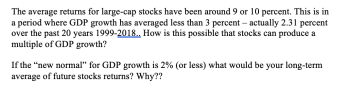 The average returns for large-cap stocks have been around 9 or 10 percent. This is in a period where GDP growth has averaged less than 3 percent - actually 2.31 percent over the past 20 years 1999-2018.. How is this possible that stocks can produce a multiple of GDP growth? If the “new normal” for GDP growth is 2% (or less) what would be your long-term average of future stocks returns? Why??
T or F 17. STOCKS GENERALLY ARE MORE RISKY THAN BONDS. BONDS ARE DEBT INVESTMENTS. 18....
T or F 17. STOCKS GENERALLY ARE MORE RISKY THAN BONDS. BONDS ARE DEBT INVESTMENTS. 18. REAL INTEREST RATE < NOMINAL INTEREST RATE. 19. ACCOUNTING PROFIT= NET INCOME= REVENUES- EXPENSES – TAXES 20. ECONOMIC PROFIT= NET INCOME= REVENUES – EXPLICIT COSTS – IMPLICIT COSTS. 21. POSITIVE CASH FLOW = INFLOW < OUTFLOW. 22. FIRMS RAISE MONEY BY USE OF STOCKS, BONDS, AND DIVIDENDS. 23. OWNERS EQUITY= REVENUE – DIVIDENDS + EXPENSES – OWNERS PAID IN CAP. 24. RISKS ARE INDIRECTLY...
Please show all work. Thanks! An optimal risky portfolio has been developed with investments in stocks...
 Please show all work. Thanks!
An optimal risky portfolio has been developed with investments in stocks and bonds This optimal portfolio has 24% invested in bonds and the remainder invested in stocks The optimal portfolio mean return is 12.05% and its standard deviation is 18.45% The t-bill rate is 4.75%; what is the mean of the complete portfolio if 33% is invested in the optimal portfolio and theremainder is invested in T-bills? a What is the resulting allocation to stocks...
Please show all work. Thanks!
An optimal risky portfolio has been developed with investments in stocks and bonds This optimal portfolio has 24% invested in bonds and the remainder invested in stocks The optimal portfolio mean return is 12.05% and its standard deviation is 18.45% The t-bill rate is 4.75%; what is the mean of the complete portfolio if 33% is invested in the optimal portfolio and theremainder is invested in T-bills? a What is the resulting allocation to stocks...
Which of the following is considered to be one of the riskiest of all investments? O...
 Which of the following is considered to be one of the riskiest of all investments? O A. Load funds B. Blue-chip stock C. Common stock D. No-load funds O E. Mutual funds
 Also,
Question 23 2.5 pts Which of the following statements is true? Blue chip stocks provide a greater growth potential than growth stocks Arisk averse investor would prefer low cap stocks to large cap stocks. A growth stock would pay low (or no) dividends. Low cap stocks provide the lowest potential rate of return Question 32 2.5pts Which of the following statements is false? A 15 year mortgage would have a higher interest rate than a 30 year mortgage A...
Also,
Question 23 2.5 pts Which of the following statements is true? Blue chip stocks provide a greater growth potential than growth stocks Arisk averse investor would prefer low cap stocks to large cap stocks. A growth stock would pay low (or no) dividends. Low cap stocks provide the lowest potential rate of return Question 32 2.5pts Which of the following statements is false? A 15 year mortgage would have a higher interest rate than a 30 year mortgage A...
 stock. 68) - 68) An investment that pays higher-than-average dividends is called a(n) A) blue chip B) income C) micro cap D) midcap E) penny 69) 69) A stock that typically sells for less than $5 per share (or in some cases, less than S1 per share) is called a(n)_ _stock. A) blue chip B) income C) micro cap D) midcap E) penny 70) 70) Cliff retired 10 years ago and wants to still own a few stocks. Dividends are...
 company y:
first drop down options are-
a. an income
b. a large cap
c. a bluechip
d. a small cap
second drop down options are a. high or b. low
company x:
a. a small cap
b. a growth
c. a speculative
d. a large cap
second drop down options:
a. between 2-10 billion
b. more than 15 billion
c. more than 10 billion
d. less than 2 billion
the graph drop down for both parts is either company...
company y:
first drop down options are-
a. an income
b. a large cap
c. a bluechip
d. a small cap
second drop down options are a. high or b. low
company x:
a. a small cap
b. a growth
c. a speculative
d. a large cap
second drop down options:
a. between 2-10 billion
b. more than 15 billion
c. more than 10 billion
d. less than 2 billion
the graph drop down for both parts is either company...
 The average returns for large-cap stocks have been around 9 or 10 percent. This is in a period where GDP growth has averaged less than 3 percent - actually 2.31 percent over the past 20 years 1999-2018.. How is this possible that stocks can produce a multiple of GDP growth? If the “new normal” for GDP growth is 2% (or less) what would be your long-term average of future stocks returns? Why??
 Please show all work. Thanks!
An optimal risky portfolio has been developed with investments in stocks and bonds This optimal portfolio has 24% invested in bonds and the remainder invested in stocks The optimal portfolio mean return is 12.05% and its standard deviation is 18.45% The t-bill rate is 4.75%; what is the mean of the complete portfolio if 33% is invested in the optimal portfolio and theremainder is invested in T-bills? a What is the resulting allocation to stocks...
Please show all work. Thanks!
An optimal risky portfolio has been developed with investments in stocks and bonds This optimal portfolio has 24% invested in bonds and the remainder invested in stocks The optimal portfolio mean return is 12.05% and its standard deviation is 18.45% The t-bill rate is 4.75%; what is the mean of the complete portfolio if 33% is invested in the optimal portfolio and theremainder is invested in T-bills? a What is the resulting allocation to stocks...
 Which of the following is considered to be one of the riskiest of all investments? O A. Load funds B. Blue-chip stock C. Common stock D. No-load funds O E. Mutual funds
Most questions answered within 3 hours.
-
Where is the error in this code sequence?
String s1 = "Hello";
String s2 = "ello";...
asked 11 months ago -
Financial data for Joel de Paris, Inc., for last year
follow:
Joel de Paris, Inc.
Balance...
asked 11 months ago -
Consider this reaction:
Al2(SO4)3 (aq)+ BaCl3
(aq) Al2Cl6 (aq)- +
3BaSO4(s) . What is the...
asked 11 months ago -
Suppose that Savneet is considering increasing her
recent random sample from 20 car rentals to 40...
asked 11 months ago -
Trucks arrive at an unloading terminal at an average rate of 120
per hour.
Trucks arrive...
asked 11 months ago -
Why are methanol and ethanol completely soluble in water while
octanol is not very little soluble....
asked 11 months ago -
A facilities manager at a university reads in a research report
that the mean amount of...
asked 11 months ago -
When the CuSO4 is rehydrated by adding water to the anhydrous
compound, is this an endothermic...
asked 11 months ago -
A ray of sunlight is passing from diamond into crown glass; the
angle of incidence is...
asked 11 months ago -
A block of mass 0.249 kg is placed on top of a light, vertical
spring of...
asked 11 months ago -
how do the kidneys compensate in the presences of acidosis
a) trigger hyperventilate
b) reserve acid...
asked 11 months ago -
Question 501 pts
The rental rate of capital to the firm increases. Which of the
following...
asked 11 months ago